
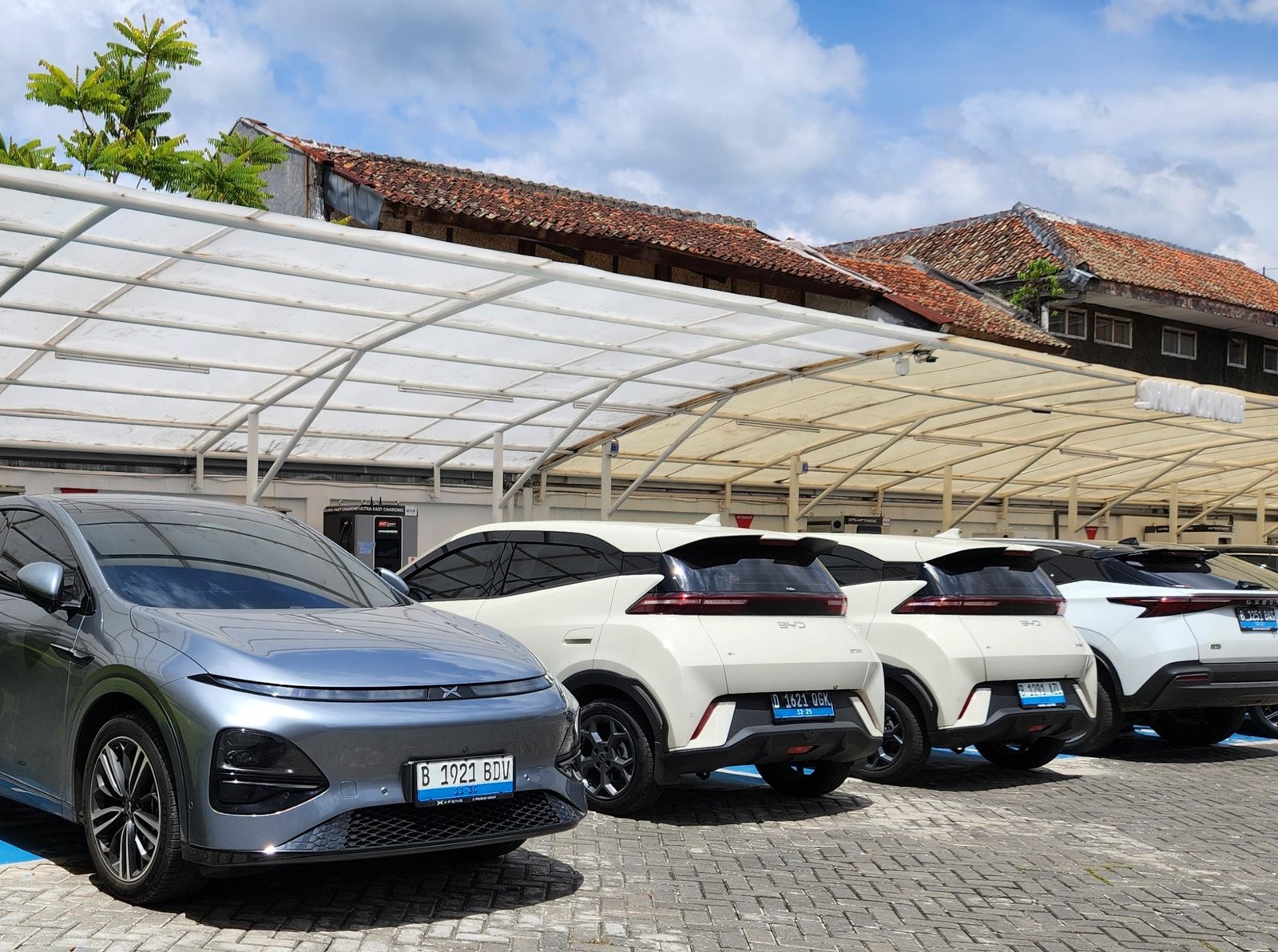
Charging Ahead: Indonesia’s Push to Dominate Southeast Asia’s EV Infrastructure Market
Electric Vehicle Charging Station Business Opportunities in Indonesia: Market Analysis and Five-Year Outlook 2025-2030
Reading Time: 32 minutes
Key Highlights
• Explosive Infrastructure Growth: Indonesia's public EV charging stations (SPKLU) increased 299% from 1,081 units in 2023 to 3,233 units by end of 2024, with targets reaching 5,810 units by end of 2025 and projections approaching 32,000 units by 2030
• Substantial Investment Requirements: SPKLU development investment estimated between USD 1.35 million (IDR 22.5 billion) to USD 6.75 million (IDR 112.4 billion) for 2025 under moderate scenarios, scaling to USD 38.4 million (IDR 639.7 billion) by 2030
• Surging Transaction Growth: SPKLU charging transactions increased 337% in 2024 compared to 2023, with 2025 Lebaran period showing 4.9x growth versus same period in 2024, demonstrating accelerating adoption
• Private Sector Opening: Government Regulation PP No. 28/2025 reduces minimum foreign investment requirements to IDR 10 billion per province, enabling broader private participation beyond PLN's current 73% market share
• Technology Specifications: Charging infrastructure spans AC slow charging (7-22 kW), DC fast charging (50-150 kW), and emerging DC ultra-fast charging (200-400 kW) with CCS2, CHAdeMO, and AC Type 2 connector standards deployed across Indonesia
Executive Summary
Indonesia's electric vehicle charging station sector represents one of Southeast Asia's most dynamic infrastructure business opportunities, driven by government mandates targeting 2 million electric cars and 12.9 million electric two-wheelers by 2030 alongside corresponding charging infrastructure deployment across archipelago spanning 17,000 islands. Public charging infrastructure specifically designated for electric vehicles through Stasiun Pengisian Kendaraan Listrik Umum (SPKLU) increased from merely 1,081 operational units in 2023 to 3,233 units by December 2024, representing 299% growth rate reflecting aggressive government and private sector deployment strategies.1 This infrastructure expansion creates substantial business opportunities spanning equipment supply, installation services, operations management, technology integration, and supporting services across diverse geographic markets and customer segments.
Market fundamentals supporting charging station business development include Indonesia's strategic position as holder of world's largest nickel reserves essential for electric vehicle battery production, government policy framework establishing comprehensive regulatory support through Presidential Regulation No. 55/2019 (updated No. 79/2023) and subsequent implementing regulations, and rapidly growing electric vehicle adoption driven by fiscal incentives reducing VAT from 11% to 1% for qualifying electric vehicles. State electricity company PT PLN (Persero) established dominant infrastructure position with 73% market share as of September 2023, while actively promoting public-private partnerships with over 28 private entities including global manufacturers and charging infrastructure startups to accelerate deployment meeting national targets.2 Recent regulatory reforms through Government Regulation No. 28/2025 significantly reduce foreign investment barriers by lowering minimum investment requirements from per-location to per-province basis at IDR 10 billion threshold, directly stimulating broader private participation opportunities.
Investment requirements for SPKLU business development vary substantially based on technology specifications, location characteristics, and deployment scale. Institute for Essential Services Reform (IESR) analysis projects total investment needs ranging from approximately USD 1.35 million (IDR 22.5 billion at 16,650 exchange rate) under conservative Business As Usual scenarios to USD 6.75 million (IDR 112.4 billion) under moderate scenarios for 2025, scaling to USD 6.3 million (IDR 104.9 billion) and USD 38.4 million (IDR 639.7 billion) respectively by 2050 under same scenarios.3 Individual station investment costs typically range IDR 500 million to IDR 2 billion depending on charging capacity, technology level, site infrastructure requirements, and grid connection specifications, with fast charging DC stations commanding higher investment than AC charging alternatives.
This comprehensive analysis examines Indonesia's electric vehicle charging station business landscape through 2030, covering market dynamics, technology specifications, regulatory frameworks, investment requirements, business models, competitive positioning, risk factors, and strategic recommendations for businesses considering entry or expansion in this rapidly evolving sector. Drawing on government policy documents, industry data from PLN and private operators, international best practices, and market research from development institutions including Asian Development Bank and World Bank, the discussion provides foundation for understanding SPKLU business opportunities and their implementation across Indonesian market contexts serving automotive manufacturers, energy companies, real estate developers, retail chains, and specialized charging infrastructure operators throughout archipelago.
Indonesia's Electric Vehicle Market Context and Growth Trajectory
Indonesian electric vehicle market demonstrates accelerating adoption trajectory creating fundamental demand for charging infrastructure investments. Domestic electric vehicle sales reached 43,188 battery electric cars (BEV) and over 100,000 electric motorcycles in 2024, though representing small percentage of total vehicle market indicating substantial growth potential ahead.4 Government established ambitious deployment targets reaching 2 million electric cars and 12.9 million electric two-wheelers by 2030, supported by comprehensive policy framework including fiscal incentives, local content requirements promoting domestic manufacturing, and infrastructure development mandates. Transportation sector currently generates approximately 35 million tons annual carbon emissions from 11 million vehicles, accounting for 70-80% of urban emissions, establishing environmental imperative alongside economic development objectives driving electrification policies.
Electric vehicle adoption acceleration stems from multiple converging factors including government VAT reduction from 11% to 1% for electric vehicles meeting 40% local content requirements, benefiting manufacturers including Hyundai and Wuling with established Indonesian assembly operations. Additional incentive through 0% import duty on completely built up (CBU) and completely knocked down (CKD) electric vehicles for manufacturers committing to domestic factory establishment by 2026 attracted major players including BYD establishing Indonesian presence. Indonesia projects becoming world's third-largest electric two-wheeler market by 2030 with approximately 2 million units annually, while four-wheeler segment targets 400,000 electric cars by 2025 (government target subsequently adjusted). These adoption projections directly translate into charging infrastructure requirements supporting daily charging needs and long-distance travel capabilities.
Electric Vehicle Market Drivers:
Government Policy Support:
• Presidential Regulation No. 55/2019 and No. 79/2023 establishing EV program framework
• VAT reduction from 11% to 1% for qualifying electric vehicles
• Import duty exemption (0%) for manufacturers with domestic investment commitments
• Electric vehicle exemption from motor vehicle tax
• Mandatory SPKLU installation in new building permits (Jakarta regulation)
• Public-private partnership frameworks through Ministry of Finance guidelines
Economic Fundamentals:
• World's largest nickel reserves supporting battery manufacturing ecosystem
• Local content requirements driving domestic value addition to 80% by 2030
• Target USD 127 billion investment in EV battery supply chain through 2040
• Growing middle class with 153 million labor force (February 2025)
• Strategic position accessing 670 million ASEAN consumer market
• Lower total cost of ownership compared to internal combustion vehicles
Environmental Imperatives:
• Net Zero Emissions target by 2060 requiring transportation transformation
• Urban air quality improvement addressing 35 million tons annual vehicle emissions
• Climate change commitments under Paris Agreement implementation
• Renewable energy integration supporting clean electricity grid
• Reduction of fossil fuel import dependence improving trade balance
• Corporate ESG compliance requirements increasing sustainability pressure
Technology and Infrastructure:
• Declining electric vehicle purchase prices improving affordability
• Expanding charging network reducing range anxiety barriers
• Battery technology improvements extending driving range capabilities
• Digital infrastructure enabling integrated charging management platforms
• Smart grid development supporting distributed charging loads
• Payment system integration facilitating convenient user experiences
Comparative regional context positions Indonesia's electric vehicle ecosystem alongside rapidly developing Southeast Asian markets. Thailand achieved 12.25% electric vehicle market share selling over 70,000 units in 2024, while Vietnam reached 16% market share through aggressive domestic manufacturer VinFast deployment strategies and supporting infrastructure investments. Indonesia's electric vehicle penetration remains lower but government commitment through policy support, infrastructure investment, and manufacturing incentives establishes foundation for accelerated growth trajectory. Unlike Thailand and Vietnam with more concentrated geographic markets, Indonesia's archipelagic geography spanning thousands of islands presents unique infrastructure challenges requiring distributed deployment strategies and innovative business models addressing diverse market conditions from dense urban centers to remote island communities.
Consumer confidence in electric vehicle adoption correlates directly with charging infrastructure availability addressing range anxiety as primary adoption barrier. Survey data consistently identifies infrastructure availability concerns as foremost hesitation preventing electric vehicle purchases among Indonesian consumers. PLN targets achieving vehicle-to-charger ratio of 17:1 to 20:1 matching European benchmarks, improving from current 21:1 ratio as of March 2025 with 3,772 SPKLU units serving growing electric vehicle population.5 Geographic distribution currently concentrates infrastructure heavily in Java (2,667 units), Sumatra (442 units), and Bali-Nusa Tenggara (246 units), with limited penetration in Kalimantan (217 units), Sulawesi (148 units), and eastern regions (52 units combined in Maluku and Papua). This geographic imbalance presents significant business opportunities for infrastructure expansion into underserved markets as electric vehicle adoption spreads beyond initial urban concentration areas.
Charging Station Technology Specifications and Infrastructure Types
Electric vehicle charging infrastructure encompasses diverse technology specifications differentiated by power output capacity, charging speed, current type (AC versus DC), connector standards, and use case applications. Indonesian market deploys internationally standardized charging technologies adapted to local grid conditions, vehicle specifications, and user requirements across residential, commercial, and public charging applications. Understanding technical specifications proves essential for business planning as technology choices directly impact capital investment requirements, operating characteristics, customer targeting, and competitive positioning within charging infrastructure market segments.
Alternating Current (AC) charging represents most common residential and workplace charging technology utilizing onboard vehicle chargers converting AC to DC for battery storage. AC charging infrastructure spans three power levels including AC Level 1 providing 3.7-7 kW charging capacity typically requiring 8-12 hours for full charge suitable for overnight residential applications, AC Level 2 delivering 22-43 kW capacity completing charges in 4-6 hours appropriate for workplace and retail parking applications, and high-power AC charging reaching 22 kW upper limit. AC charging advantages include lower infrastructure costs ranging IDR 15-50 million per charging point, simpler installation requirements, reduced electrical infrastructure demands, and suitability for locations where vehicles park extended periods. Primary limitation involves extended charging time incompatible with convenience-oriented public charging applications where users expect rapid turnaround.6
Charging Technology Specifications:
AC Slow Charging (Level 1):
• Power output: 3.7-7 kW
• Charging time: 8-12 hours for full charge
• Voltage: 220-240V single phase
• Applications: Home charging, overnight parking
• Investment cost: IDR 15-30 million per unit
• Connector types: AC Type 2 (Mennekes) standard in Indonesia
AC Fast Charging (Level 2):
• Power output: 22-43 kW
• Charging time: 4-6 hours for full charge
• Voltage: 400V three phase
• Applications: Workplace, retail parking, destination charging
• Investment cost: IDR 30-80 million per unit
• Suitable for locations with 2-8 hour parking duration
DC Fast Charging (Level 3):
• Power output: 50-150 kW
• Charging time: 30-60 minutes to 80% state of charge
• Voltage: 400-500V direct current
• Applications: Highway rest areas, public stations, commercial facilities
• Investment cost: IDR 500 million to IDR 1.5 billion per unit
• Connector types: CCS2 (Combined Charging System), CHAdeMO standards
DC Ultra-Fast Charging:
• Power output: 200-400 kW (emerging 600 kW+ systems)
• Charging time: 15-30 minutes to 80% state of charge
• Voltage: 800-1000V direct current
• Applications: Strategic highway corridors, urban charging hubs
• Investment cost: IDR 1.5-3 billion per unit
• Requires substantial electrical infrastructure and grid capacity
Direct Current (DC) fast charging technology bypasses vehicle onboard chargers by converting AC to DC externally within charging station equipment, enabling substantially higher power delivery directly to vehicle batteries. DC fast charging (50-150 kW) achieves 80% battery charge in approximately 30-60 minutes making it suitable for public charging stations, highway corridors, and commercial applications where customers expect rapid service. DC ultra-fast charging advancing to 200-400 kW capacities (with emerging 600 kW systems) reduces charging times to 15-30 minutes, though requiring substantial electrical infrastructure investments and available grid capacity. Indonesian SPKLU deployments predominantly feature DC fast charging at 50-150 kW capacity, with select locations including PLN's flagship Rest Area KM 38B charging hub featuring 200 kW ultra-fast units demonstrating emerging technology capabilities.
Connector standards deployed in Indonesian market follow international conventions with some regional variations. CCS2 (Combined Charging System Type 2) represents dominant standard for DC fast charging, offering compatibility with European and many Asian electric vehicle models including popular Indonesian market vehicles from Hyundai, Wuling, and other manufacturers. CHAdeMO standard developed by Japanese manufacturers provides alternative DC fast charging protocol supported by vehicles including Nissan Leaf and Mitsubishi models, though declining in market share relative to CCS2 global standardization trends. AC Type 2 (Mennekes) serves as standard AC charging connector widely deployed for slower charging applications. GB/T standard used in Chinese market vehicles requires consideration as Chinese manufacturers including BYD, Chery, and others expand Indonesian presence, with some charging infrastructure providers offering multi-standard compatibility supporting diverse vehicle populations.
Charging infrastructure business models differentiate between public charging stations (SPKLU) designed for general public access versus private or semi-public installations serving specific customer segments. Public SPKLU typically located at retail centers, gas stations, rest areas, parking facilities, and strategic urban locations require high-visibility sites with convenient access, adequate parking spaces, and electrical grid capacity supporting multiple simultaneous charging sessions. Private charging infrastructure includes home charging installations (approximately 33,086 customers served by PLN as of March 2025), workplace charging for employee fleets, captive facilities for commercial fleets including taxi and delivery services, and destination charging at hotels, resorts, and entertainment venues. Semi-public category encompasses charging available to specific groups such as apartment residents, office tenants, or membership-based services. Each category presents distinct business opportunities with varying investment requirements, revenue models, regulatory considerations, and operational characteristics requiring tailored approaches.
Regulatory Framework and Policy Environment Supporting SPKLU Development
Indonesian government established comprehensive regulatory framework promoting electric vehicle charging infrastructure development through Presidential Regulations, Ministerial Decrees, and implementing guidelines addressing licensing, technical standards, electricity tariffs, investment incentives, and operational requirements. Policy architecture reflects strategic government priority elevating electric vehicle ecosystem development as national economic development pillar supporting manufacturing growth, environmental objectives, and energy transition goals. Understanding regulatory landscape proves essential for business planning as policy provisions directly influence investment economics, market access conditions, operational requirements, and competitive dynamics throughout charging infrastructure value chain.
Presidential Regulation No. 55/2019 concerning Acceleration of Battery-Based Electric Vehicle Program for Road Transportation establishes foundational policy framework mandating charging infrastructure development alongside electric vehicle adoption targets. Subsequent Presidential Regulation No. 79/2023 updates implementation provisions reflecting market evolution and expanding incentive structures. These regulations establish legal basis for SPKLU operations, define roles for government entities and private sector participants, set technical and safety standards, and provide policy direction for supporting ecosystem development including manufacturing, battery supply chains, and research and development activities. Ministry of Energy and Mineral Resources (ESDM) holds primary regulatory authority over SPKLU deployment through electricity sector oversight, while Investment Coordinating Board (BKPM) administers investment licensing and incentives.7
Essential Indonesian Regulations and Policy Documents for SPKLU Development
1. Presidential Regulation No. 55/2019 - Battery-Based Electric Vehicle Program
Establishes foundational framework for electric vehicle infrastructure including SPKLU deployment mandates
Download PDF »
2. Ministry of ESDM Roadmap for SPKLU Development 2025-2030 (Kepmen)
Comprehensive roadmap establishing targets, policies, and implementation strategies for national SPKLU deployment through 2030
Download PDF »
3. Ministry of ESDM - Charging Infrastructure Provision and Electricity Tariff Regulations (2025)
Details infrastructure requirements, technical standards, and electricity pricing framework for SPKLU operations
Download PDF »
4. Ministry of ESDM - Energy Policy for EV Charging Infrastructure Acceleration
Policy framework addressing incentives, permitting streamlining, and facilitation measures for SPKLU deployment
Download PDF »
5. Concept Roadmap for SPKLU Development and Policy Through 2030
Strategic planning document outlining phased development approach, technology deployment, and market development strategies
Download PDF »
6. DPR Indonesia - Electric Vehicle and Hybrid Incentive Policy (January 2025)
Parliamentary policy brief analyzing fiscal incentives, tax structures, and support mechanisms for EV ecosystem
Download PDF »
7. ITDP Indonesia - National Roadmap for Public Transportation Electrification
Comprehensive study on public transport electrification including SPKLU requirements and deployment strategies
Download PDF »
8. IESR - The Future of Transport: EV Policy Study 2025 and 2050
Research analysis examining long-term electric vehicle scenarios, charging infrastructure needs, and policy recommendations through 2050
Download PDF »
Government Regulation No. 28/2025 represents significant policy reform reducing investment barriers for private SPKLU operators by lowering minimum foreign investment requirement from per-location basis to per-province threshold set at IDR 10 billion. This regulatory adjustment directly stimulates foreign direct investment interest by enabling smaller-scale entry strategies, reducing capital requirements for market entry, and facilitating phased expansion approaches starting from single provinces rather than requiring nationwide commitments. Reform aims to accelerate private sector participation beyond PLN's current dominance, diversify charging network ownership, accelerate deployment speed through competitive dynamics, and attract international charging infrastructure specialists bringing technology and operational expertise to Indonesian market. Regulation maintains technical standards, safety requirements, and consumer protection provisions while liberalizing investment access conditions.8
Electricity tariff structure for SPKLU operations follows Ministry of ESDM Regulation No. 1/2023 establishing official rates approximately IDR 2,466 per kWh for public charging applications. Operators may impose additional service fees covering infrastructure costs, with fast charging services typically charged IDR 25,000 per session and ultra-fast charging commanding IDR 57,000 per session reflecting higher infrastructure investments and premium service positioning. Tariff structure balances affordability objectives encouraging electric vehicle adoption against cost recovery requirements ensuring SPKLU business viability and investment returns. PLN implements time-of-use pricing offering 30% discounts during off-peak hours (10 PM to 5 AM) incentivizing load shifting supporting grid management objectives while providing economic benefits to cost-sensitive users willing to charge during off-peak periods. Residential home charging utilizes standard household electricity tariffs ranging IDR 1,352 to IDR 1,444 per kWh, substantially lower than public charging rates creating economic incentive for home charging adoption where feasible.
Licensing and permitting requirements for SPKLU operators include electricity business license from ESDM, business location permit from local government, environmental clearance for installations meeting thresholds requiring environmental impact assessment, fire safety certification, electrical installation safety certification, and operational permits addressing consumer protection and service standards. PLN implements partnership frameworks including franchise schemes reducing barriers for private operators through simplified approval processes, reduced electrical connection fees (offered as investment incentive), standardized technical specifications, and operational support services. Local government regulations increasingly mandate SPKLU installation in new commercial and residential developments, with Jakarta implementing requirements for new building permits to include charging infrastructure addressing future demand growth proactively while distributing infrastructure costs across broader real estate development economics rather than concentrating exclusively in dedicated charging businesses.
SPKLU Investment Requirements and Financial Analysis
Electric vehicle charging station business requires substantial upfront capital investment spanning equipment procurement, site development, electrical infrastructure, installation labor, permitting and regulatory compliance, and working capital supporting initial operations before achieving positive cash flow. Investment requirements vary significantly based on charging technology specifications (AC versus DC, power capacity levels), site characteristics influencing civil works and electrical connection costs, geographic location affecting equipment delivery and installation expenses, and scale of deployment influencing unit economics through volume purchasing and operational efficiencies. Understanding detailed investment economics proves essential for business planning, financing structuring, partner negotiations, and investment decision-making throughout SPKLU development lifecycle.
Individual SPKLU investment costs typically range IDR 500 million to IDR 2 billion per station depending primarily on charging power capacity and technology level. AC Level 2 charging stations (22 kW capacity) represent lower investment tier approximately IDR 30-80 million per charging point suitable for workplace and destination charging applications where extended parking durations accommodate slower charging speeds. DC fast charging stations (50-150 kW) requiring external power conversion equipment, higher-capacity electrical connections, and more sophisticated control systems command investment range IDR 500 million to IDR 1.5 billion per multi-port installation. DC ultra-fast charging facilities (200-400 kW) reaching upper investment tier IDR 1.5-3 billion per station reflecting advanced power electronics, substantial electrical infrastructure, enhanced cooling systems, and premium site development requirements supporting flagship installations at strategic highway locations and urban charging hubs.9
SPKLU Investment Cost Components:
Equipment and Hardware (40-50% of total):
• Charging equipment (AC chargers, DC converters, power modules)
• Electrical cabinets and distribution equipment
• Metering and monitoring systems
• Payment terminals and user interface equipment
• Communication and connectivity hardware
• Safety equipment and emergency systems
Site Development and Civil Works (15-25%):
• Land acquisition or lease agreements
• Site preparation and grading
• Concrete foundations and charging equipment mounting
• Parking area markings and signage
• Canopy structures and weather protection
• Landscaping and aesthetic improvements
Electrical Infrastructure (20-30%):
• Grid connection and service entrance
• Electrical transformers (if required)
• Electrical panels and distribution systems
• Cable runs and conduit installations
• Grounding and lightning protection systems
• PLN connection fees and infrastructure contributions
Software and Digital Systems (5-10%):
• Charging management software platforms
• Mobile application development or integration
• Payment processing system integration
• Cloud-based monitoring and analytics
• User authentication and access control
• Energy management and load balancing software
Soft Costs and Professional Services (10-15%):
• Engineering design and technical specifications
• Permitting and regulatory compliance fees
• Legal services and contract preparation
• Project management and coordination
• Installation labor and commissioning
• Initial marketing and user acquisition
Broader market investment projections from Institute for Essential Services Reform (IESR) estimate total SPKLU sector capital requirements under multiple scenarios. Business As Usual scenario projects approximately USD 1.35 million (IDR 22.5 billion) investment requirement for 2025, scaling to USD 6.3 million (IDR 104.9 billion) by 2050. Moderate growth scenario anticipates USD 6.75 million (IDR 112.4 billion) investment for 2025, increasing to USD 38.4 million (IDR 639.7 billion) by 2050. Ambitious scenario supporting accelerated electric vehicle adoption and comprehensive charging network deployment requires substantially higher investment commitments, though IESR analysis suggests such investment levels may challenge government budget capacity necessitating private sector capital mobilization through public-private partnerships, project financing, and direct private investment. These projections utilize exchange rate approximately IDR 16,650 per USD 1.00 reflecting recent market rates (November 2025 averaging IDR 16,660-16,700).10
Revenue models for SPKLU operations derive primarily from charging service fees calculated per kilowatt-hour electricity delivered plus session-based service charges. Typical revenue structure combines electricity cost pass-through at regulated tariff (IDR 2,466 per kWh) with service fee markup (IDR 25,000-57,000 per session depending on charging speed) generating total customer charges approximately IDR 50,000-150,000 for typical charging session delivering 20-50 kWh battery capacity depending on vehicle type and charging level. Additional revenue opportunities include advertising placements at charging locations, retail partnerships collecting referral fees from adjacent commercial establishments, subscription or membership programs offering preferential pricing or guaranteed access, data services monetizing user behavior and charging patterns (subject to privacy regulations), and ancillary services including vehicle washing, maintenance scheduling, or concierge services during charging sessions. Revenue realization depends critically on utilization rates determining how frequently expensive charging equipment generates revenue versus standing idle.
Operating costs for SPKLU businesses span electricity procurement representing largest variable cost component, site lease or land costs for locations not owned outright, maintenance and repair expenses averaging 3-5% of equipment cost annually, insurance and security services, staffing costs for customer service and technical support (though many stations operate unmanned with remote monitoring), payment processing fees typically 2-3% of transaction value, telecommunications and connectivity charges for digital platform operations, and administrative overhead including accounting, legal, and regulatory compliance. Fixed cost structure means profitability depends heavily on achieving adequate utilization rates amortizing substantial capital investments and covering fixed operating costs across sufficient charging sessions. Break-even analysis typically requires utilization rates exceeding 15-20% of theoretical maximum capacity depending on specific cost structures, though actual performance varies widely based on location quality, competitive positioning, and local electric vehicle population density.
Business Models and Market Entry Strategies for SPKLU Operations
Electric vehicle charging station business encompasses diverse operational models differentiated by ownership structures, revenue mechanisms, customer segments, and strategic positioning within evolving charging infrastructure ecosystem. Successful market entry requires careful consideration of business model selection aligned with organizational capabilities, capital availability, competitive positioning, target markets, and long-term strategic objectives. Indonesian market demonstrates multiple viable approaches from fully integrated charging network operators to specialized service providers, equipment suppliers, and supporting technology platforms, creating opportunities for businesses with varying competencies and investment capacities across charging infrastructure value chain.
Integrated charging network operator model represents most comprehensive approach where single entity owns and operates multiple charging stations across geographic network, typically branded under unified identity, utilizing common technology platforms, and serving broad customer base. PLN exemplifies this model in Indonesian market, operating approximately 73% of existing SPKLU installations through centralized network management, standardized equipment specifications, integrated digital platform (PLN Mobile application), and coordinated expansion strategy. Advantages include economies of scale in equipment procurement, operational efficiency through centralized management, strong brand recognition supporting customer acquisition, negotiating leverage with property owners and partners, comprehensive data enabling network optimization, and ability to cross-subsidize strategic locations requiring development with profitable established sites. Capital intensity represents primary challenge requiring substantial funding supporting initial network deployment before achieving positive returns, alongside operational complexity managing distributed assets across diverse locations and technical expertise requirements spanning electrical engineering, software development, customer service, and business operations.
SPKLU Business Models and Market Approaches:
Integrated Network Operator:
• Own and operate multiple charging stations across network
• Unified branding and customer experience
• Centralized technology platform and management
• Direct customer relationships and data ownership
• Capital requirements: High (IDR 50-500 billion for regional network)
• Examples: PLN, private operators like INVI, VinFast announced plans
Franchise and Partnership Models:
• Leverage existing brands and infrastructure (PLN partnerships)
• Reduced capital requirements through shared investment
• Standardized operating procedures and technical support
• Revenue sharing arrangements between franchisor and franchisee
• Capital requirements: Medium (IDR 5-50 billion per location)
• Examples: PLN franchise schemes, automotive OEM partnerships
Location Host Partnerships:
• Partner with retail, hospitality, or commercial real estate
• Charging infrastructure as customer amenity and traffic driver
• Revenue sharing or fixed rental arrangements with operator
• Limited operational responsibility for property owner
• Capital requirements: Low to Medium (IDR 1-20 billion)
• Examples: KFC-PLN partnership, Alfamart agreements, gas stations (Pertamina)
Fleet and Captive Operations:
• Dedicated charging for commercial fleets (taxi, delivery, buses)
• Closed-loop systems optimizing specific vehicle requirements
• Predictable utilization patterns and usage forecasting
• Integration with fleet management systems
• Capital requirements: Medium (IDR 10-100 billion for fleet depot)
• Examples: TransJakarta bus depots, Blue Bird taxi charging, Gojek/Grab plans
Equipment Supply and Technology Services:
• Manufacturing or importing charging equipment
• Software platforms for charge point management
• Installation and maintenance services
• Technology integration and system optimization
• Capital requirements: Variable (manufacturing vs. service focus)
• Examples: International suppliers (ABB, Schneider, Delta), Indonesian integrators (INVI, Kempower distributors)
Franchise and partnership models offer alternative approaches reducing capital intensity while leveraging established brands, technical platforms, and operational expertise. PLN developed franchise schemes enabling private investors to establish SPKLU sites utilizing PLN's brand, technical standards, equipment procurement advantages, operational support, and digital platform integration while investor provides site, local management, and shares revenue. This model reduces PLN's capital requirements while accelerating network expansion, provides investors with established brand recognition and technical support, and distributes business risk across multiple stakeholders. Automotive original equipment manufacturers (OEMs) pursue partnerships establishing charging networks supporting their electric vehicle sales, with Hyundai owning approximately 18% of SPKLU capacity as of September 2023 demonstrating OEM commitment to comprehensive ecosystem development.11 VinFast announced intentions establishing 30,000-100,000 charging points in Indonesia representing USD 1 billion investment commitment supporting vehicle sales strategy.
Location host partnership model emphasizes leveraging existing commercial real estate, retail locations, hospitality facilities, or other high-traffic destinations as charging station hosts generating customer amenity value, incremental foot traffic, and enhanced property positioning. Retail partnerships prove particularly attractive with convenience stores (Alfamart partnership example), quick-service restaurants (KFC-PLN collaboration), shopping malls, and gas stations (Pertamina targeting 120+ SPKLU installations) providing ready-made locations with existing electrical infrastructure, customer traffic patterns matching charging dwell times, and complementary business activities benefiting from captive charging customers. Revenue models typically involve either revenue sharing arrangements where property owner receives percentage of charging revenues, fixed rental payments providing predictable income stream, or strategic partnerships where charging infrastructure installed at no cost to property owner serving primarily as customer attraction rather than direct revenue generator. This model enables rapid expansion leveraging existing commercial footprint while distributing infrastructure costs across multiple parties.
Fleet and captive operations represent specialized business model focusing on dedicated charging infrastructure serving specific commercial vehicle fleets including electric bus operations, taxi and ride-hailing fleets, delivery vehicle fleets, and corporate vehicle pools. Fleet charging offers significant advantages including predictable utilization patterns enabling accurate financial forecasting, consistent customer base eliminating consumer acquisition costs, route optimization opportunities allowing strategic charging placement along fixed routes, potential for depot-based overnight charging utilizing off-peak electricity, and integration with broader fleet management systems coordinating charging with vehicle assignments and maintenance schedules. TransJakarta electric bus program, Blue Bird taxi electrification initiatives, and Gojek/Grab ride-hailing expansion into electric vehicles create substantial fleet charging opportunities. Depot charging typically combines AC overnight charging for routine daily needs with DC fast charging for mid-day top-ups or unexpected range requirements, optimizing total cost of ownership while ensuring vehicle availability meeting service requirements.
Equipment supply and technology services business models focus on manufacturing, importing, or distributing charging hardware and software platforms supporting SPKLU operators rather than operating charging networks directly. International suppliers including ABB, Schneider Electric, Delta Electronics, and Kempower provide high-quality charging equipment to Indonesian market, while local companies including INVI develop domestic manufacturing capability and market-specific solutions. Software platforms for charge point management systems (CPMS) enabling remote monitoring, payment processing, user authentication, energy management, and data analytics represent high-margin technology business complementing hardware sales. Installation and maintenance services provide recurring revenue streams as charging networks expand and mature requiring ongoing technical support. Technology integration services connecting charging infrastructure with smart grid systems, renewable energy sources, energy storage, and broader mobility platforms create additional value-added service opportunities for specialized technical providers.
Market Projections and Five-Year Development Outlook 2025-2030
Indonesian electric vehicle charging infrastructure market projects robust expansion through 2030 driven by government policy commitments, accelerating electric vehicle adoption, private sector investment mobilization, and technology advancement improving charging speeds and user experiences. PLN's Electricity Supply Business Plan (RUPTL) 2025-2034 establishes official infrastructure deployment targets with public charging stations increasing from 3,772 units (March 2025) to approximately 5,810 units by end of 2025, continuing to estimated 32,000 SPKLU units required by 2030 supporting government's electric vehicle adoption targets.12 Ministry of Energy and Mineral Resources projections align broadly with PLN assessments while acknowledging substantial uncertainty depending on actual electric vehicle market penetration, economic conditions, technology costs, and policy implementation effectiveness influencing deployment trajectories over five-year planning horizon.
Year-by-year deployment projections indicate steady acceleration from current baseline. 2025 targets approximately 5,810 SPKLU units representing 54% growth over March 2025 baseline (3,772 units), achievable through PLN's committed 1,100-unit expansion plan plus growing private sector contributions. 2026-2027 period projects continued growth reaching 8,000-12,000 units as regulatory reforms enabling broader private participation take effect, automotive manufacturers expand captive charging networks supporting vehicle sales, and retail partnerships proliferate leveraging commercial real estate. 2028-2030 accelerates dramatically toward 25,000-32,000 units as electric vehicle population surpasses critical mass justifying rapid infrastructure scaling, international charging network operators potentially enter Indonesian market bringing capital and operational expertise, and technology cost reductions improve investment economics facilitating broader deployment across geographic markets including currently underserved regions beyond Java and Sumatra concentration.
Five-Year SPKLU Market Projections (2025-2030):
2025 Infrastructure Status:
• Baseline: 3,772 SPKLU units (March 2025 actual)
• Year-end target: 5,810 units (+54% growth)
• Transaction volume: 400-500% growth versus 2024
• Geographic concentration: 70% Java, 20% Sumatra, 10% other regions
• Operator mix: 70% PLN, 30% private partnerships
• Investment: USD 6.75-10 million (IDR 112-166 billion) estimated
2026-2027 Projection:
• Target: 8,000-12,000 SPKLU units (40-100% growth versus 2025)
• Private sector share increasing to 40-45% of installations
• Geographic expansion: Bali, Sulawesi, Kalimantan growing share
• Technology shift: DC fast charging 60-70% of new installations
• Fleet charging emergence: Major bus and taxi operators establishing depots
• Investment: USD 15-25 million (IDR 250-415 billion) annual
2028-2030 Trajectory:
• Target: 25,000-32,000 SPKLU units (aggressive growth supporting EV targets)
• Private operators potentially reaching 50% market share
• Technology evolution: Ultra-fast charging (200-400 kW) becoming standard
• Geographic balance: 60% Java, 25% Sumatra, 15% other regions
• International operators: Potential market entry by global charging networks
• Investment: USD 100-150 million (IDR 1.66-2.49 trillion) cumulative 2025-2030
Key Market Indicators Through 2030:
• Electric vehicle population: 2 million cars + 12.9 million two-wheelers (government target)
• Vehicle-to-charger ratio: Improving from 21:1 toward 17:1 international benchmark
• Utilization rates: Increasing from current 10-15% to 20-30% as EV density grows
• Revenue per station: IDR 300-800 million annually (varies by location and technology)
• Market concentration: Potential emergence of 3-5 major charging networks
• Technology standards: CCS2 dominance with multi-standard compatibility increasing
Geographic expansion patterns project gradual diversification from current Java-Sumatra concentration toward broader archipelago coverage. Java maintains dominant share through 2030 given population concentration, economic activity density, and electric vehicle adoption leadership, but relative share declining from current 70% toward 55-60% as infrastructure extends to growth markets. Bali-Nusa Tenggara region benefits from tourism infrastructure supporting rental electric vehicles and destination charging at resorts and attractions. Sulawesi and Kalimantan represent emerging markets with improving economic conditions, growing urban centers, and government development priorities driving electrification programs. Eastern regions including Maluku and Papua remain challenging markets through 2025-2030 period given limited electric vehicle adoption, infrastructure constraints, and economic conditions, though government may pursue strategic deployments supporting broader electrification and connectivity objectives despite weak immediate business cases.
Technology evolution trends influence market development trajectories through deployment periods. DC fast charging (50-150 kW) solidifies position as dominant public charging standard representing 60-70% of new SPKLU installations 2026-2030 period as users demand convenient charging speeds supporting travel patterns and lifestyle integration. Ultra-fast charging (200-400 kW) emerges from niche applications toward mainstream deployment along Trans Java and Trans Sumatra highway corridors, major urban charging hubs, and flagship locations demonstrating cutting-edge capabilities. AC Level 2 charging maintains important role for workplace, residential, and destination charging where extended parking durations accommodate slower speeds and lower infrastructure costs optimize economics. Wireless charging technologies may emerge in specialized applications though mainstream adoption remains beyond 2030 timeframe. Vehicle-to-grid (V2G) capabilities enabling electric vehicles to return electricity to grid during peak demand periods represent longer-term opportunity requiring technology standardization, regulatory frameworks, and business model development extending beyond immediate five-year horizon.
Competitive dynamics evolve as market matures from PLN's current dominance toward multi-operator landscape with diverse business models and strategic positioning. PLN maintains substantial market share through first-mover advantages, government backing, established brand recognition, extensive partnership network, and capital access, while pursuing operational efficiency improvements and customer service enhancements defending market position against emerging competitors. Automotive OEMs expand branded charging networks supporting vehicle sales and differentiation strategies, with potential consolidation or partnerships between manufacturers achieving scale economies. International charging network operators including established European, Chinese, or American players may enter Indonesian market through partnerships, acquisitions, or greenfield investments bringing operational expertise and capital accelerating sophisticated network deployment. Technology companies leveraging digital platforms, payment systems, and data analytics capabilities potentially disrupt traditional utility-dominated model through superior user experiences and innovative business approaches. Retail and real estate operators increasingly participate through host partnerships or captive network development supporting core business strategies.
Risk Factors and Implementation Challenges
Electric vehicle charging station business entails numerous risks and implementation challenges requiring careful consideration in business planning, investment decision-making, and operational management. Market risks stem from fundamental uncertainty regarding electric vehicle adoption rates, with actual deployment potentially lagging government targets due to vehicle affordability constraints, limited model availability, residual range anxiety despite infrastructure improvements, or macroeconomic conditions affecting consumer purchasing power. Slower-than-projected electric vehicle growth directly impacts charging station utilization rates, revenue realization, and investment returns, creating potential for stranded assets or extended payback periods. Market entry timing presents strategic dilemma balancing first-mover advantages securing prime locations and establishing brand presence against risks of premature investment before market achieves sufficient scale supporting viable business operations.
Technology risks encompass potential obsolescence as charging technologies evolve, with investments in current-generation equipment potentially superseded by faster charging speeds, improved efficiency, enhanced user interfaces, or alternative charging approaches. Connector standard evolution poses compatibility challenges if Chinese manufacturers' GB/T standard gains market share requiring multi-standard equipment or retrofits. Battery technology advancement potentially extends vehicle range capabilities reducing charging frequency requirements and public charging station utilization. Grid integration challenges arise from high-power charging installations stressing local distribution infrastructure requiring utility coordination, infrastructure upgrades, or energy storage buffering managing peak demand impacts. Software and cybersecurity vulnerabilities create operational risks as charging networks increasingly depend on digital platforms vulnerable to hacking, data breaches, payment fraud, or system failures disrupting service availability.
Critical Risk Categories:
Market and Demand Risks:
• Electric vehicle adoption slower than projections
• Competition from home charging reducing public charging demand
• Economic downturn affecting consumer vehicle purchases
• Geographic mismatch between infrastructure and EV concentrations
• Price competition eroding margins as market matures
• Customer acquisition costs exceeding projections
Technology and Operational Risks:
• Equipment obsolescence as charging speeds advance
• Connector standard fragmentation requiring multi-standard support
• Reliability issues affecting uptime and customer satisfaction
• Cybersecurity vulnerabilities in digital payment and control systems
• Grid integration challenges limiting charging capacity
• Maintenance costs exceeding initial estimates
Regulatory and Policy Risks:
• Electricity tariff increases reducing competitiveness versus gasoline
• Policy changes affecting EV incentives slowing adoption
• Local government permitting delays or restrictions
• Technical standard changes requiring equipment modifications
• Environmental regulations affecting site development
• Taxation changes affecting business economics
Financial and Business Risks:
• Extended payback periods straining cash flow
• Financing availability and cost for capital-intensive business
• Currency fluctuations affecting imported equipment costs
• Property lease terms and rent escalations
• Vandalism and theft losses
• Insurance costs and liability exposures
Regulatory and policy risks include potential changes to electricity tariff structures affecting charging economics, with electricity price increases relative to gasoline potentially dampening electric vehicle total cost of ownership advantages reducing adoption rates. Electric vehicle incentive programs including VAT reductions may phase out as market matures or government priorities shift, removing key adoption driver. Technical standards and safety regulations may evolve requiring equipment modifications or retrofits. Local government approval processes for site development, electrical connections, and operational permits introduce uncertainty and potential delays affecting project timelines and economics. Environmental regulations governing site development, stormwater management, and other aspects may restrict suitable locations or increase compliance costs.
Financial risks center on capital intensity requiring substantial upfront investment with uncertain payback periods dependent on utilization growth trajectories. Debt financing availability and cost influences project viability, with limited track record of charging station businesses potentially constraining conventional lending requiring higher equity contributions or alternative financing structures. Currency risks affect imported equipment costs given substantial dollar-denominated procurement while revenues realized in rupiah, with exchange rate volatility creating cost uncertainty. Property lease arrangements introduce ongoing fixed costs with potential escalation clauses, while location securing involves competitive bidding for prime sites potentially inflating rental rates. Vandalism, theft, and physical damage risks require insurance coverage and security measures adding operating costs. Liability exposures from electrical safety incidents, vehicle damage during charging, or payment system compromises necessitate comprehensive insurance programs and risk management protocols.
Strategic Recommendations for Market Entry and Business Development
Successful electric vehicle charging station business development requires strategic approach combining thorough market analysis, appropriate business model selection, strong execution capabilities, and adaptive management responding to evolving market conditions. Companies considering SPKLU market entry should conduct comprehensive due diligence assessing market opportunity alignment with organizational capabilities, competitive positioning strategies, and realistic financial projections incorporating conservative utilization assumptions and contingency planning. Partnership strategies leveraging complementary capabilities prove particularly valuable in capital-intensive, technically complex charging infrastructure business, with strategic alliances potentially combining site access, technical expertise, operational management, and financial resources across multiple parties creating robust competitive positioning exceeding capabilities of individual organizations operating independently.
Location strategy represents critical success factor with charging station performance highly dependent on site quality measured through multiple dimensions. High-traffic locations with extended dwell times including shopping centers, entertainment venues, restaurants, hotels, and recreational facilities offer natural fits for charging infrastructure where customers already parking for complementary activities can charge vehicles during visit. Highway corridors and strategic travel routes require charging infrastructure supporting intercity travel, with optimal locations at 100-150 kilometer intervals matching typical electric vehicle range and driver comfort patterns. Urban charging hubs near residential areas without home charging access serve important market segment including apartment dwellers and homes lacking dedicated parking. Workplace charging represents substantial market opportunity with employers increasingly providing charging amenities attracting and retaining environmentally conscious employees while supporting sustainability commitments. Site selection analysis should evaluate electrical infrastructure capacity, grid connection costs, parking availability and traffic patterns, competitive charging options nearby, local electric vehicle population density, property lease terms, and regulatory approval probability before committing investment resources.
Strategic Success Factors:
Market Entry Strategy:
• Conduct thorough market analysis assessing local EV adoption and competition
• Start with focused geographic or customer segment rather than dispersed deployment
• Leverage existing customer relationships or business infrastructure where possible
• Consider partnership models reducing capital requirements and risk
• Pursue anchor locations establishing brand presence and operational learning
• Develop scalable platform supporting future expansion
Location Selection Criteria:
• High vehicle traffic with extended dwell times (20+ minutes)
• Adequate electrical infrastructure or economically feasible upgrades
• Visible, easily accessible locations with clear signage and navigation
• Parking availability and configuration supporting charging equipment
• Complementary amenities (retail, food, restrooms, WiFi) enhancing customer experience
• Favorable lease terms with reasonable escalations and exit provisions
Technology and Operations:
• Select proven, reliable charging equipment from established suppliers
• Implement comprehensive remote monitoring and management systems
• Ensure multi-standard compatibility supporting diverse vehicle types
• Develop preventive maintenance programs maximizing uptime
• Provide excellent customer service and responsive technical support
• Integrate user-friendly payment and authentication systems
Financial Planning:
• Develop conservative utilization projections with sensitivity analysis
• Secure adequate capitalization covering extended ramp-up period
• Structure flexible financing enabling phased deployment
• Pursue government incentives and support programs where available
• Monitor unit economics closely enabling rapid course corrections
• Plan for technology refresh cycles managing obsolescence risk
Technology selection balancing capital costs, operational reliability, future flexibility, and customer expectations influences long-term business success. Charging equipment should prioritize reliability and uptime given customer frustration from non-functional chargers damaging brand reputation and discouraging return visits. Established international equipment suppliers including ABB, Schneider Electric, Delta Electronics, and others provide proven technology backed by warranty support and service networks, though potentially commanding premium pricing. Emerging suppliers may offer competitive pricing but require careful due diligence regarding reliability, support capabilities, and long-term viability. Multi-standard connector compatibility supporting CCS2, CHAdeMO, and potentially GB/T standards maximizes addressable customer base though increasing equipment costs. Software platform selection requires careful evaluation regarding functionality, reliability, user experience, payment processing integration, data analytics capabilities, and vendor support quality with preference for established platforms serving substantial existing customer base demonstrating operational maturity.
Customer experience optimization proves increasingly important as market matures and competition intensifies. Reliable equipment functioning consistently represents fundamental requirement, with industry-leading operators targeting 95%+ uptime performance. Clear, intuitive user interfaces with multilingual support accommodate diverse customer base. Seamless payment integration supporting multiple methods including credit cards, digital wallets (Dana, GoPay, OVO, LinkAja), and loyalty programs removes transaction friction. Real-time availability information through mobile applications prevents wasted trips to occupied stations. Transparent pricing without hidden fees builds customer trust. Safe, well-lit, clean facilities with security monitoring address safety concerns particularly for remote or nighttime charging. Complementary amenities including WiFi connectivity, restroom access, beverage services, and comfortable waiting areas enhance charging experience during necessary dwell time. Loyalty programs rewarding frequent users and referral incentives accelerating customer acquisition create competitive advantages in increasingly crowded marketplace.
Conclusions and Strategic Outlook
Indonesia's electric vehicle charging station sector represents compelling business opportunity characterized by strong government policy support, accelerating electric vehicle adoption, substantial investment requirements creating entry barriers, and evolving competitive dynamics as market transitions from dominated state-owned enterprise landscape toward diverse multi-operator ecosystem. SPKLU infrastructure growth from 3,233 units (December 2024) toward projected 25,000-32,000 units by 2030 creates market expansion opportunities for equipment suppliers, installation contractors, network operators, technology providers, and supporting service businesses across charging infrastructure value chain. Market success requires strategic positioning combining appropriate business model selection, excellent execution capabilities, adequate capitalization supporting extended development periods, and adaptive management responding to rapid market evolution and emerging competitive dynamics.
Government policy framework establishing comprehensive regulatory support through Presidential Regulations, Ministerial implementing guidelines, fiscal incentives promoting electric vehicle adoption, and investment facilitation reducing barriers for private sector participation creates favorable environment for charging infrastructure business development. Recent regulatory reforms through Government Regulation No. 28/2025 reducing minimum foreign investment thresholds significantly improve market access conditions for international operators and smaller-scale domestic players previously constrained by capital requirements. PLN's partnership frameworks offering franchise opportunities, reduced connection fees, and technical support facilitate private sector participation while maintaining quality standards and interoperability across networks. These policy foundations position Indonesia favorably compared to regional markets regarding regulatory clarity, government commitment, and stakeholder coordination supporting charging infrastructure deployment at scale required meeting 2030 electric vehicle targets.
Market fundamentals supporting long-term business viability include Indonesia's strategic natural resource position with world's largest nickel reserves creating competitive advantages in electric vehicle battery supply chains, growing middle class with improving purchasing power supporting premium vehicle segments, urbanization concentrating populations in metropolitan areas where charging infrastructure achieves viable utilization economics, environmental imperatives driving transportation electrification policies addressing urban air quality and climate commitments, and technology cost reductions improving electric vehicle affordability and charging infrastructure economics. Demographic dividend with young, increasingly educated workforce supports technology adoption and mobility transformation. Geographic position accessing regional ASEAN markets creates opportunities for companies establishing Indonesian presence to expand across broader Southeast Asian region as electric vehicle adoption accelerates throughout emerging markets.
Critical success factors for charging infrastructure businesses include securing high-quality locations with strong electric vehicle traffic and complementary customer activities, deploying reliable technology maximizing uptime and customer satisfaction, implementing efficient operations minimizing costs while maintaining service quality, developing strong brand recognition and customer loyalty in competitive marketplace, maintaining adequate capitalization weathering extended ramp-up periods before achieving profitability, and building partnership ecosystems leveraging complementary capabilities across site access, technical expertise, customer relationships, and financial resources. Companies combining these elements through strategic planning, disciplined execution, and adaptive management responding to market feedback position favorably for success in rapidly evolving Indonesian electric vehicle charging infrastructure marketplace representing significant component of broader energy transition and transportation transformation through 2030 and beyond.
Frequently Asked Questions (FAQ)
Q1: What are the typical investment costs for establishing a public EV charging station (SPKLU) in Indonesia?
Investment costs vary significantly based on charging technology and capacity. AC Level 2 charging stations (22 kW) cost approximately IDR 30-80 million per charging point, suitable for workplace and destination charging. DC fast charging stations (50-150 kW) require IDR 500 million to IDR 1.5 billion per multi-port installation. DC ultra-fast charging facilities (200-400 kW) cost IDR 1.5-3 billion per station. These costs include equipment, site development, electrical infrastructure, software systems, and installation. Additional costs include land lease, permitting, and initial marketing expenses.
Q2: What charging technology types and power levels are currently deployed in Indonesian SPKLU networks?
Indonesian charging infrastructure encompasses three primary technology categories: AC slow charging (3.7-7 kW) for 8-12 hour charging periods suitable for residential overnight use; AC fast charging (22-43 kW) providing 4-6 hour charging for workplace and retail locations; and DC fast charging (50-150 kW) delivering 30-60 minute charging for public stations. Emerging DC ultra-fast charging (200-400 kW) achieves 15-30 minute charging times at flagship locations. Connector standards include CCS2 (dominant for DC fast charging), CHAdeMO (Japanese vehicles), and AC Type 2 (Mennekes) for AC charging applications.
Q3: How many electric vehicle charging stations currently operate in Indonesia and what are projections for 2030?
As of March 2025, Indonesia operates 3,772 public SPKLU units for four-wheeled vehicles distributed across 2,515 locations, with concentration in Java (2,667 units), Sumatra (442 units), and other regions. PLN targets increasing to 5,810 units by end of 2025, representing 54% annual growth. Government projections indicate approximately 32,000 SPKLU units required by 2030 to support targeted electric vehicle adoption of 2 million cars and 12.9 million two-wheelers. This represents nearly 10-fold expansion over current infrastructure requiring substantial public and private investment mobilization.
Q4: What are the main business models for operating EV charging stations in Indonesia?
Primary business models include: (1) Integrated network operators owning and operating multiple stations across geographic networks with unified branding, requiring high capital (IDR 50-500 billion) but offering economies of scale; (2) Franchise and partnership models leveraging PLN's brand and infrastructure with medium capital requirements (IDR 5-50 billion); (3) Location host partnerships with retail/commercial real estate providing sites, requiring low to medium capital (IDR 1-20 billion); (4) Fleet and captive operations serving specific commercial vehicles with predictable utilization; and (5) Equipment supply and technology services providing hardware, software, and installation services across the value chain.
Q5: What regulatory changes have improved private sector access to Indonesia's charging infrastructure market?
Government Regulation No. 28/2025 significantly reduced investment barriers by lowering minimum foreign investment requirements from per-location basis to per-province threshold at IDR 10 billion. This reform enables smaller-scale market entry, reduces capital requirements, and facilitates phased expansion approaches. Presidential Regulation No. 55/2019 (updated No. 79/2023) establishes comprehensive policy framework supporting charging infrastructure development. Ministry of ESDM regulations set electricity tariffs approximately IDR 2,466 per kWh with additional service fees for fast charging (IDR 25,000) and ultra-fast charging (IDR 57,000), providing clarity for business planning while PLN offers reduced connection fees as investment incentives.
Q6: What is the current market share distribution between PLN and private operators in Indonesia's SPKLU sector?
As of September 2023, state-owned PLN holds approximately 73% market share of SPKLU charging units, with private operators including automotive OEMs and charging infrastructure companies holding remaining 27%. Hyundai represents largest private operator with approximately 18% market share supporting its electric vehicle sales strategy. PLN actively promotes public-private partnerships collaborating with over 28 private entities including global manufacturers and infrastructure startups. Government targets increasing private sector participation toward 40-50% market share by 2027-2030 period as regulatory reforms enable broader entry and market matures beyond initial state-led development phase.
Q7: How do electricity tariffs and charging fees structure revenue for SPKLU operators?
SPKLU operators pay approximately IDR 2,466 per kWh for electricity supply (per Ministry of ESDM Regulation No. 1/2023), which they pass through to customers along with service fee markups. Fast charging typically adds IDR 25,000 per session while ultra-fast charging commands IDR 57,000 premium. Total customer charges range IDR 50,000-150,000 per typical session depending on battery capacity (20-50 kWh) and charging speed. PLN offers 30% off-peak discount (10 PM to 5 AM) encouraging load shifting. Additional revenue opportunities include advertising, retail partnerships, subscription programs, and ancillary services. Residential home charging costs substantially less at IDR 1,352-1,444 per kWh, creating economic incentive for home charging where feasible.
Q8: What are the main risks and challenges facing SPKLU business operators in Indonesia?
Primary risks include market demand uncertainty if electric vehicle adoption lags government targets affecting utilization and revenues; technology obsolescence as charging speeds advance and equipment standards evolve; competition from home charging reducing public charging demand; regulatory changes affecting electricity tariffs or EV incentives; extended payback periods straining cash flow given capital intensity; geographic mismatch between infrastructure location and actual EV concentrations; grid integration challenges requiring infrastructure upgrades; and operational issues including reliability, maintenance costs, vandalism, and cybersecurity vulnerabilities. Success requires conservative financial planning, flexible deployment strategies, reliable technology selection, excellent execution, and adaptive management responding to evolving conditions.
Q9: Which geographic regions offer the best business opportunities for SPKLU deployment through 2030?
Java maintains strongest near-term opportunities given highest electric vehicle adoption, population density, and economic activity, currently hosting 70% of infrastructure but remaining undersaturated relative to demand. Bali-Nusa Tenggara presents attractive opportunities driven by tourism supporting rental EVs and destination charging at resorts. Trans Java and Trans Sumatra highway corridors require strategic fast-charging deployments supporting intercity travel. Urban centers including Jakarta, Surabaya, Bandung, Semarang, Medan, and Makassar offer viable utilization economics. Emerging opportunities exist in Sulawesi and Kalimantan as economic development and urbanization progress. Eastern regions remain challenging through 2030 given limited EV adoption and infrastructure constraints, though government may pursue strategic deployments supporting broader electrification objectives.
Q10: What strategic partnerships and collaboration opportunities exist in Indonesia's EV charging sector?
Strategic partnership opportunities include: PLN franchise programs offering established brand, technical support, and operational expertise; automotive OEM collaborations establishing charging networks supporting vehicle sales with potential revenue sharing; retail partnerships with convenience stores (Alfamart), restaurants (KFC), gas stations (Pertamina), and shopping centers providing high-traffic locations; real estate developers integrating charging into mixed-use developments and industrial parks; fleet operators including bus companies (TransJakarta), taxi services (Blue Bird), and ride-hailing platforms (Gojek, Grab) requiring dedicated charging infrastructure; technology providers supplying equipment, software platforms, payment systems, and integration services; and international charging network operators potentially entering through joint ventures or strategic alliances bringing operational expertise and capital accelerating market development.
References and Data Sources:
1. Tempo.co. (February 2025). PLN's EV Charging Stations Increased by 299 Percent in 2024.
https://en.tempo.co/read/1973958/plns-ev-charging-stations-increased-by-299-percent-in-2024
2. Knowledge Sourcing. (October 2025). Indonesia Electric Vehicle Charging Stations Market Analysis.
https://www.knowledge-sourcing.com/report/indonesia-electric-vehicle-charging-stations-market
3. Databoks Katadata. (May 2021). 3 Electric Vehicle Charging Station Investment Scenarios.
https://databoks.katadata.co.id/en/energy/statistics/0ab4d19ba832c17/3-electric-vehicle-charging-station-investment-scenarios
4. IBC Bulletin. (2025). Indonesia's EV Ecosystem in 2025.
https://ibc-bulletin-vol4.vercel.app/
5. The Jakarta Post. (May 2025). PLN Leads the Charge in Expanding EV Charging Infrastructure.
https://www.thejakartapost.com/adv/2025/05/22/pln-leads-the-charge-in-expanding-ev-charging-infrastructure.html
6. INVI Indonesia. (July 2024). Definition of SPKLU / Charging Station.
https://www.invi-indonesia.co.id/blog/definition-of-spklu-charging-station/
7. UKPBJ Kemlu. (2019). Presidential Regulation No. 55/2019 - Battery-Based Electric Vehicle Program.
https://ukpbj.kemlu.go.id/uploads/laporan/20231124143104-peraturan-presiden.pdf
8. ANTARA News. (May 2025). Indonesia to Allow Private Players to Build EV Charging Stations.
https://en.antaranews.com/news/354181/indonesia-to-allow-private-players-to-build-ev-charging-stations
9. AstraOtoshop. (March 2025). Fast Charging for Electric Vehicles: Ultra Fast Charging SPKLU Technology.
https://astraotoshop.com/article/fast-charging-mobil-listrik
10. Trading Economics. (November 2025). Indonesian Rupiah Exchange Rate Data.
https://tradingeconomics.com/indonesia/currency
11. IISD. (February 2025). Indonesian Electric Vehicle Boom: A Temporary Trend or Long-Term Vision?
https://www.iisd.org/articles/deep-dive/indonesian-electric-vehicle-boom-temporary-trend-or-long-term-vision
12. Databoks Katadata. (July 2025). Projected Demand for EV Charging Stations in Indonesia 2025-2034.
https://databoks.katadata.co.id/en/transportation-logistics/statistics/68665760217a8/projected-demand-for-ev-charging-stations-in-indonesia-2025-2034
13. TIAR.ai. (2025). The Boom of EV Charging Infrastructure in Indonesia.
https://www.tiar.ai/blog/the-boom-of-ev-charging-infrastructure-in-indonesia
14. The ICCT. (February 2024). Charging Indonesia's Vehicle Electrification.
https://theicct.org/wp-content/uploads/2024/02/ID-88-–-Indonesia-charging_final2.pdf
15. ACV Capital. (2023). Indonesia's Electric Vehicle Outlook Report.
https://acv.vc/wp-content/uploads/2023/07/Report-Indonesias-Electric-Vehicle-Outlook-Supercharging-Tomorrows-Mobility_NEW.pdf
16. Ministry of ESDM Indonesia. (2025). Indonesian Government Supports EV Charging Application.
https://www.esdm.go.id/en/media-center/news-archives/indonesian-govt-supports-ev-charging-application
17. GGGI. (2025). Situational Analysis Report on EV System Development in Indonesia.
https://gggi.org/wp-content/uploads/2025/03/01_GT_Situational-Analysis-Report.pdf
18. ISI-BATT. (2025). Electric Vehicle Charging Solutions in Indonesia.
https://isibatt.co.id/solusi-pengisian-kendaraan-listrik-di-indonesia/
19. BCA Ocean. (2025). Electric Vehicle Development in Indonesia 2025: Market Potential.
https://ocean.bca.co.id/en/artikel/Perkembangan-Mobil-Listrik-di-Indonesia-Tahun-2025-Bagaimana-Potensinya
20. DPR Indonesia. (January 2025). Electric Vehicle and Hybrid Incentive Policy Brief.
https://berkas.dpr.go.id/pusaka/files/info_singkat/Info%20Singkat-XVII-2-II-P3DI-Januari-2025-246.pdf

Professional Advisory Services for Electric Vehicle Charging Infrastructure Development
SUPRA International provides comprehensive consulting services for electric vehicle charging station business development including market analysis, feasibility studies, technology selection, site assessment, regulatory compliance, financial modeling, partnership structuring, and implementation support. Our team assists automotive companies, energy firms, real estate developers, retail operators, and infrastructure investors evaluating SPKLU opportunities across Indonesia's rapidly expanding electric vehicle ecosystem through strategic planning and execution guidance.
Need expert guidance on electric vehicle charging infrastructure business opportunities and development strategies?
Contact us to discuss your EV charging station project planning and implementation requirements
Share:
If you face challenges in water, waste, or energy, whether it is system reliability, regulatory compliance, efficiency, or cost control, SUPRA is here to support you. When you connect with us, our experts will have a detailed discussion to understand your specific needs and determine which phase of the full-lifecycle delivery model fits your project best.