

How Carbon Capture and Storage Works: A Clear, Structured Explanation of Indonesia’s Carbon Capture and Storage Pathways
Carbon Capture and Storage in Indonesia: Technology, Regulatory Frameworks, Projects, Business Models, and Regional Leadership Opportunities in Asia-Pacific CCS Development
Reading Time: 58 minutes
Key Highlights
• Storage capacity potential: Indonesia possesses estimated 400-600 gigatons of geological CO₂ storage capacity in depleted oil and gas reservoirs and deep saline aquifers, positioning nation as potential Asia-Pacific regional hub serving high-emission economies including Singapore, Japan, and South Korea requiring cross-border carbon storage solutions lacking domestic geological formations
• Regulatory framework advancement: Government established comprehensive legal structure through MEMR Regulation 2/2023 governing CCS in upstream oil and gas, Presidential Regulation 14/2024 providing umbrella framework, and MEMR Regulation 16/2024 enabling non-PSC contractors operate designated carbon storage permit areas, with provisions allowing 30% storage capacity allocation for international CO₂ imports
• Major project development: Pertamina advances CCS hubs in Asri Basin (partnering ExxonMobil and Korea's KNOC with 1.1-3.0 gigatons capacity requiring USD 2 billion investment), Kutai Basin, and Offshore North West Java, while bp develops Tangguh CCUS project (25-30 million tons capacity over 10-15 years expected onstream 2028) and 15+ projects targeted operations by 2030
• Business model innovation: Emerging revenue streams include carbon credit monetization, CO₂ storage services for domestic and international emitters, enhanced oil recovery integration generating 30-40% production increases, and blue hydrogen/ammonia production enablement, with government incentives including cost recovery treatment, fiscal incentives, and public-private partnership frameworks supporting commercial viability
Executive Summary
Carbon capture and storage represents technological pathway enabling continued operation of fossil fuel-based energy infrastructure and hard-to-abate industrial facilities while substantially reducing greenhouse gas emissions through capturing carbon dioxide at source before atmospheric release, transporting captured CO₂ to suitable geological formations, and permanently storing underground in depleted hydrocarbon reservoirs or deep saline aquifers. Indonesia recognizes CCS as integral component of national climate strategy targeting net-zero emissions by 2060, with 29% reduction by 2030, leveraging vast geological storage potential estimated between 400-600 gigatons, equivalent to centuries of regional industrial emissions, combined with extensive existing oil and gas infrastructure facilitating cost-effective deployment and strategic geographic position serving Southeast Asian and Northeast Asian high-emission economies requiring carbon storage solutions.
International Energy Agency identifies CCUS technologies as necessary pillar achieving global net-zero targets, with cumulative 107 gigatons CO₂ requiring permanent storage through 2060 under Clean Technology Scenario, while operational capacity globally reaches only 50 million tons annually as of first quarter 2025 despite accelerating project announcements representing USD 27+ billion investment commitments. Indonesia positions itself capturing substantial share of emerging global CCS market through aggressive regulatory development, strategic international partnerships, and coordinated project deployment across multiple geological basins spanning Sumatra, Java, Kalimantan, and Papua. Government commitment demonstrated through comprehensive legal framework establishment, international engagement with Singapore, South Korea, and Japan regarding cross-border CO₂ transport and storage, and active promotion of 19 oil and gas blocks conversion to carbon storage facilities engaging multinational energy majors including ExxonMobil, bp, INPEX, Repsol, and domestic champion Pertamina.
Technology applications span capture from natural gas processing facilities (currently representing 65% global operational capacity given low capture costs), power generation enabling continued coal and gas plant operation, industrial emissions from cement, steel, and chemical production representing hard-to-abate sectors lacking viable alternatives, and atmospheric carbon dioxide removal through direct air capture or bioenergy with CCS supporting negative emissions requirements. Transport infrastructure utilizes pipelines (potentially repurposing existing oil and gas networks reducing costs 90% versus new construction), specialized CO₂ carrier vessels for offshore storage sites, and integrated hub-and-spoke systems serving multiple emitters through shared infrastructure reducing individual project costs. Storage security depends on careful geological site selection ensuring caprock integrity, comprehensive monitoring systems detecting potential leakage, and regulatory frameworks establishing long-term liability transfer mechanisms protecting operators from perpetual stewardship obligations.
Business models supporting commercial viability include enhanced oil recovery generating revenue through incremental production (Pertamina trials demonstrating 30-40% increases), carbon credit monetization under compliance markets and voluntary schemes, storage-as-a-service for third-party emitters (particularly international sources), blue hydrogen production enabling decarbonized energy carriers, and government incentives including capital subsidies, operational cost recovery, tax credits, and guaranteed offtake agreements mitigating demand uncertainty. Economic analysis indicates capture costs ranging USD 30-100 per ton for natural gas processing to USD 50-150 for power generation and USD 80-200 for industrial applications depending on CO₂ concentration and scale, while transport costs span USD 2-14 per ton via pipeline and storage costs typically below USD 10 per ton for suitable formations, though combined systems require carbon pricing mechanisms or direct subsidies achieving competitiveness against unabated emissions alternatives.
Indonesia's CCS development strategy emphasizes five priority areas: comprehensive regulatory framework providing legal certainty and operational guidance, geological mapping and site characterization identifying optimal storage locations and quantifying capacity, international partnerships enabling cross-border CO₂ value chains and foreign investment attraction, technology development and deployment through pilot projects building domestic capability, and business model innovation ensuring commercial sustainability. Strategic positioning as regional CCS hub creates substantial economic opportunities including direct project investment (infrastructure, equipment, services), operational employment, technology transfer and capacity building, regional service export potential, and enhanced energy security supporting continued hydrocarbon resource utilization while meeting climate commitments. Successful implementation depends on sustained policy support, coordinated public-private collaboration, technical capacity development, and stakeholder acceptance addressing environmental concerns and community engagement ensuring social license enabling transformative infrastructure deployment across Indonesian archipelago.
Carbon Capture and Storage Technology Fundamentals
Carbon capture and storage encompasses three distinct phases: capture of CO₂ from emission sources or directly from atmosphere, transport to storage locations, and permanent geological storage preventing atmospheric release. Each phase presents distinct technical challenges, cost structures, and operational requirements demanding integrated system design optimizing total value chain economics rather than individual component optimization. Successful CCS deployment requires careful matching of capture technology with emission source characteristics, transport infrastructure appropriate to volumes and distances, and storage sites offering adequate capacity, security, and accessibility supporting decades-long injection operations and perpetual storage integrity.
Capture technologies separate CO₂ from gas streams through chemical, physical, or membrane processes with selection dependent on source concentration, pressure, temperature, and presence of other components. Pre-combustion capture extracts CO₂ before fuel burning through gasification producing hydrogen and CO₂ streams, enabling cleaner fuel utilization though requiring substantial infrastructure modifications unsuitable for existing facilities. Post-combustion capture treats flue gases after combustion through chemical absorption using amine solvents (most mature technology deployed in natural gas processing and fertilizer production), physical absorption for high-pressure streams, or membrane separation showing promise for lower costs though requiring additional development. Oxy-fuel combustion burns fuel in pure oxygen rather than air producing concentrated CO₂ streams simplifying capture though requiring energy-intensive oxygen production limiting current applications.
Carbon Capture Technology Overview:
Post-Combustion Capture:
• Chemical absorption: Amine-based solvents (MEA, DEA, MDEA) capturing CO₂ from flue gas at atmospheric pressure
• Typical conditions: 3-15% CO₂ concentration, 40-60°C temperature, atmospheric pressure
• Energy requirement: 2.5-4.0 GJ/ton CO₂ for regeneration primarily as low-pressure steam
• Capture efficiency: 85-95% depending on solvent selection and process configuration
• Applications: Coal and gas power plants, cement kilns, steel blast furnaces
• Cost range: USD 50-100/ton CO₂ for power generation, USD 80-150/ton for industrial sources
• Advantages: Retrofittable to existing facilities, mature technology with operating experience
• Limitations: High energy penalty (20-30% power output reduction), solvent degradation, space requirements
Pre-Combustion Capture:
• Gasification: Fuel conversion to synthesis gas (H₂ + CO) followed by water-gas shift reaction producing H₂ and CO₂
• Physical absorption: Selexol or Rectisol processes separating CO₂ at elevated pressure (typically 30-70 bar)
• Energy requirement: 1.5-2.5 GJ/ton CO₂ benefiting from high-pressure separation
• Capture efficiency: 90-98% given high CO₂ concentrations (15-40%) and pressure
• Applications: IGCC power plants, hydrogen production, synthetic fuel manufacturing
• Cost range: USD 40-80/ton CO₂ depending on scale and integration
• Advantages: Lower energy penalty, high-purity CO₂ stream, hydrogen co-production
• Limitations: Requires gasification infrastructure unsuitable for existing facilities, high capital cost
Oxy-Fuel Combustion:
• Process: Combustion in high-purity oxygen (>95% O₂) producing flue gas with 80-98% CO₂
• Oxygen production: Cryogenic air separation requiring 200-250 kWh/ton O₂
• Energy requirement: 2.0-3.5 GJ/ton CO₂ including oxygen production and compression
• Capture efficiency: 95-99% given inherently high CO₂ concentrations
• Applications: Purpose-built power plants, cement kilns, industrial boilers
• Cost range: USD 45-90/ton CO₂ depending on oxygen production efficiency
• Advantages: High-purity CO₂, elimination of NOₓ formation, existing boiler compatibility
• Limitations: Oxygen production energy penalty, flue gas recycle requirements, limited retrofitting potential
Direct Air Capture:
• Technology: Atmospheric CO₂ extraction using liquid solvents or solid sorbents
• Concentration challenge: 420 ppm CO₂ in air versus 3-15% in flue gas requiring massive throughput
• Energy requirement: 5-10 GJ/ton CO₂ given dilute source and regeneration demands
• Capture rate: Typically 0.5-2 tons CO₂ per day per unit in current pilot facilities
• Applications: Negative emissions, carbon removal offsetting unavoidable emissions
• Cost range: USD 200-600/ton CO₂ currently, targeting USD 100-200 with scale and optimization
• Advantages: Location-independent, addresses distributed emissions, permanent removal enabling negative emissions
• Limitations: Very high costs currently, energy-intensive, requires renewable energy avoiding emissions shifting
Transport infrastructure moves captured CO₂ from sources to storage sites utilizing pipelines for large volumes and continuous operations, shipping for offshore destinations or intermittent flows, and potentially rail or truck for small-scale or temporary applications though economically limited. Pipeline transport dominates current systems given lowest costs at scale, with over 8,000 kilometers operating globally (primarily United States for enhanced oil recovery) demonstrating technical feasibility and safety. CO₂ requires compression to 100-150 bar for pipeline transport maintaining dense phase (600-900 kg/m³) reducing volume and enabling efficient transmission, with compression representing 60-70% of transport costs. Pipeline construction costs range USD 50,000-150,000 per kilometer depending on diameter (typically 300-600 mm), terrain, population density affecting routing, and regulatory requirements, with operational costs including pumping energy, monitoring, and maintenance adding USD 2-5 per ton per 100 kilometers.
Shipping enables long-distance transport or service to offshore storage lacking pipeline infrastructure, with specialized carriers transporting liquid CO₂ at -50°C and 7 bar or intermediate temperature/pressure conditions (typically -30°C and 15 bar) balancing energy requirements against cargo capacity. Current commercial CO₂ shipping limited to food-grade applications transporting approximately 1,000 tons annually in Europe, though substantial interest developing regional CCS hubs in Asia requiring marine transport given archipelagic geography. Shipping costs vary dramatically with distance and volume, ranging USD 10-30 per ton for short distances (under 500 km) to USD 30-80 per ton for regional transport (1,000-3,000 km), becoming competitive with pipelines for offshore destinations or intermittent flows insufficient justifying dedicated pipeline infrastructure. Indonesia's geographic context favoring hub-and-spoke systems combining pipeline gathering networks concentrating captured CO₂ at coastal terminals, marine transport to offshore storage sites, and international imports utilizing existing shipping infrastructure developed for LNG and petroleum products.
Geological Storage: Site Selection, Capacity, and Security
Permanent CO₂ storage requires suitable geological formations providing adequate capacity, structural or stratigraphic trapping mechanisms preventing migration, and caprock seals ensuring long-term containment measured in millennia rather than decades. Primary storage options include depleted oil and gas reservoirs offering proven sealing capability demonstrated through hydrocarbon retention over geological timeframes, deep saline aquifers providing enormous potential capacity though requiring more extensive characterization given limited historical data, and unmineable coal seams offering potential CO₂ adsorption and methane displacement though capacity and operational uncertainties limiting current applications. Indonesia's geological endowment across multiple sedimentary basins including Central Sumatra, South Sumatra, East Java, Kutai, and offshore Northwest Java provides estimated 400-600 gigatons storage capacity substantially exceeding domestic requirements enabling regional hub development serving neighboring countries.
Depleted hydrocarbon reservoirs constitute most attractive initial storage targets given extensive characterization data from production operations, proven caprock integrity demonstrated through millions of years hydrocarbon retention, existing infrastructure potentially reducing development costs, and operators possessing geological expertise and regulatory relationships facilitating permitting. Indonesian oil and gas fields produced since 1970s offer substantial depleted capacity with government identifying 19 blocks for potential CCS conversion engaging operators including ExxonMobil, bp, INPEX, Repsol, and Pertamina. Storage capacity in depleted reservoirs depends on original hydrocarbon volume, recovery factor, and CO₂ density at reservoir conditions, with rough approximation of 0.5-0.8 tons CO₂ per barrel original oil in place or 0.9-1.1 tons per thousand cubic feet original gas, though detailed reservoir simulation required for accurate assessment given pressure, temperature, and formation heterogeneity influences.
Geological Storage Options and Characteristics:
Depleted Oil and Gas Reservoirs:
• Storage mechanism: Structural trapping in proven hydrocarbon-bearing formations
• Capacity estimation: 0.5-0.8 tons CO₂ per barrel original oil, 0.9-1.1 tons per Mcf original gas
• Depth requirements: Typically 800-3,000 meters ensuring supercritical CO₂ conditions (>31°C, >74 bar)
• Advantages: Proven sealing, extensive characterization data, existing infrastructure, operational familiarity
• Challenges: Residual hydrocarbons, abandoned well integrity, limited capacity compared to saline aquifers
• Enhanced oil recovery potential: CO₂-EOR generating revenue offsetting storage costs
• Examples in Indonesia: Jatibarang field (CO₂-EOR trial 30-40% increase), Sukowati field, planned Asri Basin development
Deep Saline Aquifers:
• Storage mechanism: Stratigraphic trapping in porous sandstone sealed by impermeable shale or mudstone
• Capacity estimation: 1-4% pore volume convertible to CO₂ storage (efficiency factor varying with geology)
• Global capacity: Estimated 10,000+ gigatons potentially available worldwide
• Indonesia capacity: 400-600 gigatons across multiple sedimentary basins
• Advantages: Enormous capacity, widespread distribution, no hydrocarbon production conflicts
• Challenges: Limited characterization requiring exploration drilling, caprock integrity assessment, pressure management
• Key formations: Upper Talang Akar (Asri Basin), Balikpapan sandstone (Kutai), Attaka West sandstone (ONWJ)
• Monitoring requirements: Seismic surveys, pressure monitoring, geochemical sampling verifying containment
Site Selection Criteria:
• Capacity: Minimum 50-100 million tons for commercial-scale projects supporting 20-30 year operations
• Injectivity: Permeability >50-100 millidarcies enabling economic injection rates
• Seal integrity: Thick (>20 meters) low-permeability caprock with no faults penetrating seal
• Depth: 800-3,000 meters optimal range balancing supercritical conditions against drilling costs
• Proximity: Within 50-300 kilometers major emission sources minimizing transport costs
• Accessibility: Onshore or shallow offshore (<500 meters water depth) for cost-effective development
• Regulatory: Permitted zones, no conflicts with mineral rights or protected areas
• Infrastructure: Existing facilities, pipelines, or proximity to transport networks reducing capital requirements
Storage Security and Monitoring:
• Containment mechanisms: Structural trapping (immediate), residual trapping (10-100 years), solubility trapping (100-1,000 years), mineral trapping (1,000+ years)
• Leakage risks: Abandoned well integrity (primary risk), caprock fracturing, fault reactivation
• Monitoring techniques: 3D/4D seismic imaging plume migration, downhole pressure and temperature, geochemical sampling, surface monitoring (soil gas, groundwater)
• Regulatory requirements: Monitoring/reporting/verification (MRV) protocols, baseline characterization, operational monitoring, post-closure surveillance
• Closure criteria: Plume stability demonstration, pressure dissipation, no detectable leakage
• Long-term stewardship: Indonesia PR 14/2024 requires 10-year post-closure monitoring before liability transfer to government
• International standards: ISO 27914, London Protocol amendments, national storage regulations
Injection operations require careful pressure management preventing formation fracturing or inducing seismicity, with injection rates constrained by formation permeability, well count, and acceptable pressure increases. Supercritical CO₂ (existing at reservoir conditions exceeding 31°C and 74 bar) behaves as dense fluid (600-800 kg/m³) providing favorable storage density while maintaining sufficient mobility for injection. Wells utilize similar technology to oil and gas production with modifications including corrosion-resistant materials (given CO₂ acidity in presence of water), specialized cements ensuring long-term integrity, and rigorous quality control given perpetual containment requirements. Multiple injection wells typically required for commercial-scale projects, with 30-50 million ton capacity requiring 5-10 wells depending on reservoir characteristics and injection duration spreading capital costs over extended operations.
Long-term monitoring verifies storage security through multiple surveillance techniques tracking injected CO₂ plume migration, formation pressure responses, potential leakage pathways, and groundwater quality surrounding storage complex. Time-lapse (4D) seismic surveys repeated at 1-5 year intervals image subsurface CO₂ distribution demonstrating containment within target formations, though resolution limits requiring supplementary techniques for comprehensive surveillance. Downhole monitoring using permanently installed sensors provides continuous pressure, temperature, and geochemical data at injection intervals and overlying formations enabling early leak detection. Surface monitoring including atmospheric measurements, soil gas sampling, and groundwater chemistry establishes baseline conditions before injection and detects any surface expression of potential leakage events, though natural CO₂ variability requiring sophisticated statistical methods distinguishing operational impacts from background fluctuations. Indonesia's regulatory framework under PR 14/2024 requires operators fund monitoring activities continuing 10 years post-closure before liability transfer to government, creating long-term financial obligations requiring consideration in project economics.
Indonesia's Regulatory Framework for CCS Development
Indonesian government established comprehensive legal foundation for CCS development through three-tier regulatory hierarchy providing umbrella policy framework, sector-specific implementation rules, and operational guidelines enabling both upstream oil and gas contractors and independent entities engage carbon storage activities. Presidential Regulation 14/2024 enacted January 30, 2024, establishes broad national policy framework defining CCS activities, organizational structures, licensing mechanisms, operational requirements, and cross-border provisions, serving as foundation for subordinate ministerial regulations addressing technical details. This represents strategic government commitment positioning Indonesia as regional CCS leader through proactive policy development ahead of most Southeast Asian nations lacking comparable legal clarity, attracting international investment and partnership opportunities requiring regulatory certainty before committing substantial capital.
Ministry of Energy and Mineral Resources Regulation 2/2023 issued March 3, 2023, provides detailed framework for CCS and CCUS implementation within upstream oil and gas working areas operated under production sharing contracts (PSCs), enabling contractors utilize existing geological understanding, infrastructure, and regulatory relationships facilitating rapid deployment. Regulation distinguishes CCS (permanent storage reducing emissions) from CCUS (utilizing captured CO₂ in industrial processes or enhanced oil recovery before storage), establishing specific requirements for each including development planning, environmental assessment, operational procedures, monitoring obligations, and decommissioning provisions. Contractors receive operational cost recovery for CCS activities under PSC terms, creating favorable economics compared to purely commercial ventures bearing full capital and operational expenses without cost recovery mechanisms, though revenue allocation and fiscal treatment requiring careful negotiation balancing contractor returns against government take.
Indonesia CCS Regulatory Framework Summary:
Presidential Regulation 14/2024 (Enacted January 30, 2024):
• Scope: Umbrella framework for all CCS activities across Indonesia
• Organizational authority: Ministry of Energy and Mineral Resources (MEMR) primary regulator
• Implementation pathways: (1) PSC contractors in oil and gas working areas, (2) Independent entities in designated carbon storage permit areas (WIPK)
• Licensing process: Exploration permits converting to storage operation permits following site characterization
• Cross-border provisions: Permits CO₂ imports up to 30% storage capacity enabling regional hub development
• Long-term liability: Operators responsible for 10-year post-closure monitoring before government assumption
• International engagement: Framework supporting bilateral agreements (Indonesia-Singapore CCS partnership)
• Subordinate regulations: Directs MEMR issue detailed technical and fiscal implementation rules
MEMR Regulation 2/2023 (Issued March 3, 2023):
• Scope: CCS and CCUS in upstream oil and gas working areas under PSCs
• Applicable contractors: Entities with PSCs under SKK Migas or BPMA (Aceh) supervision
• Development planning: Contractors propose CCS/CCUS as part of field development plans requiring MEMR/SKK Migas approval
• Cost recovery: CCS operational costs recoverable under PSC terms for CO₂ from upstream sources
• Technical requirements: Engineering standards, procurement procedures, construction oversight, operational protocols
• Monitoring obligations: Periodic reporting, measurement systems, emergency response capabilities
• Monetization options: Carbon trading, storage service fees, cost reimbursement for shared facilities
• Work area relinquishment: Contractors may return depleted CCS sites to government before PSC expiration
MEMR Regulation 16/2024 (Effective December 24, 2024):
• Scope: Carbon storage in designated permit areas (WIPK) outside existing oil and gas working areas
• Eligible entities: Indonesian incorporated companies or permanent establishments
• WIPK designation: MEMR determines permit areas through geological assessment or entity proposal
• Licensing sequence: (1) Exploration permit for site characterization, (2) Storage operation permit following successful exploration
• Tender process: Open tender for MEMR-identified areas, direct selection for entity-proposed sites
• Exploration commitments: Bidders propose exploration work programs evaluated in tender selection
• Storage agreements: Detailed contracts specifying injection rates, capacity allocation, fees, and operational terms
• Asset ownership: Equipment purchased by storage operators remains private property (versus state assets under PSCs)
Supporting Regulations and Guidelines:
• SKK Migas PTK-070/2024: Technical guideline implementing MEMR 2/2023 for PSC contractors
• Law 7/2021: Taxation Harmonization Law providing potential carbon tax reductions for CCS activities
• Carbon trading regulations: Framework enabling CCS projects generate and monetize carbon credits
• Environmental regulations: AMDAL (EIA) requirements, monitoring standards, reporting obligations
• International agreements: Bilateral frameworks with Singapore, MoUs with South Korea and Japan
• Fiscal incentives: Tax holidays, accelerated depreciation, import duty exemptions for CCS equipment
• Forthcoming regulations: MEMR developing detailed rules on certification processes, fee calculation methodologies, safety standards
MEMR Regulation 16/2024 effective December 24, 2024, complements PSC-based regime by enabling carbon storage in designated permit areas (Wilayah Izin Penyimpanan Karbon or WIPK) awarded through competitive tender or direct selection to Indonesian companies or permanent establishments, expanding CCS development beyond oil and gas operators to specialized storage providers, power generators, industrial emitters, and international entities establishing local operations. WIPK licensing follows two-stage process: exploration permits enabling geological characterization, test drilling, and capacity assessment followed by storage operation permits authorizing commercial-scale injection and long-term monitoring. Tender evaluation emphasizes exploration work commitments rather than revenue bids, incentivizing thorough site characterization building confidence in storage security and capacity estimates supporting subsequent storage operations, with shortlisted qualified bidders receiving preferential treatment in subsequent tenders recognizing demonstrated technical and financial capabilities.
Cross-border CO₂ provisions under PR 14/2024 permit importing captured carbon from other countries up to 30% licensed storage capacity, establishing legal foundation for Indonesia serving regional hub role addressing neighboring nations' limited domestic geological storage. Singapore possesses virtually no suitable storage formations given small land area and shallow geology, Japan's onshore options limited despite offshore potential in Sea of Japan, while South Korea similarly constrained, creating substantial demand for international storage services if carbon pricing or regulations mandate industrial emissions reduction. Indonesia-Singapore bilateral framework under development following Letter of Intent signing aims establish legally binding agreement enabling CO₂ export from Singapore to Indonesian storage facilities, potentially generating substantial revenue through storage service fees while supporting Singapore's climate commitments requiring deep decarbonization despite geographic constraints. Similar discussions progressing with South Korea (KNOC participation in Asri Basin project) and Japan (collaboration on Tangguh and Gundih projects) indicate regional recognition of Indonesia's strategic position and geological advantages.
Major CCS Projects and Development Pipeline in Indonesia
Indonesia's CCS project pipeline encompasses 15-19 initiatives at various development stages from feasibility studies through engineering design to pilot operations, with government targeting commercial operations by 2028-2030 timeframe supporting national emissions reduction commitments. Projects span multiple geological basins leveraging depleted hydrocarbon reservoirs and deep saline aquifers, engage diverse technology applications including natural gas processing, enhanced oil recovery, power generation, and industrial emissions capture, and involve major international energy companies partnering with Indonesian entities bringing technology expertise, project finance capabilities, and global market connections accelerating deployment. Coordinated development across multiple projects creates ecosystem effects including shared infrastructure utilization, technology transfer, workforce development, regulatory learning, and investor confidence building driving successive project waves beyond initial pioneers.
Asri Basin CCS Hub represents flagship development partnership between Pertamina and ExxonMobil with Korean National Oil Corporation (KNOC) participation, targeting massive storage capacity estimated 1.1-3.0 gigatons in offshore Sunda Asri Basin located in Pertamina's South East Sumatra block. Partnership signed during 2024 Indonesian petroleum industry conference formalized collaboration conducting appraisal drilling assessing geological suitability through core sampling and comprehensive data gathering informing final investment decision anticipated 2025-2026. Project requires approximately USD 2 billion investment developing capture, transport, and injection infrastructure serving both domestic industrial emitters and international sources through cross-border CO₂ import provisions, positioning Asri as regional hub potentially accepting captured carbon from Singapore, Malaysia, and other Southeast Asian economies lacking domestic storage. ExxonMobil brings extensive global CCS experience including leading North America's largest CO₂ pipeline network and operating multiple enhanced oil recovery projects, while KNOC's participation enables South Korean industrial emissions diversion addressing domestic storage limitations and climate policy requirements mandating substantial emission reductions by 2030-2050.
Indonesia Major CCS Projects Overview
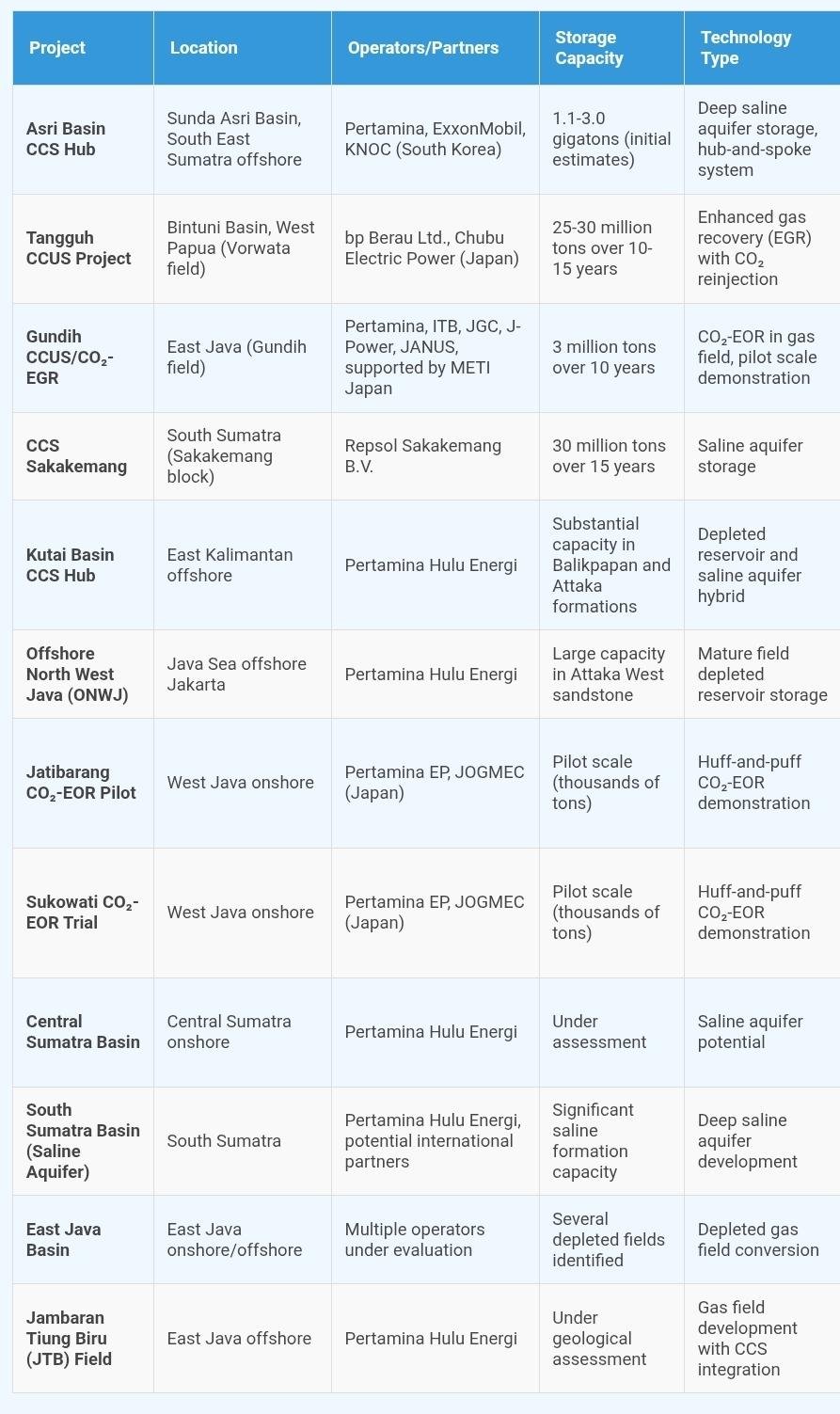
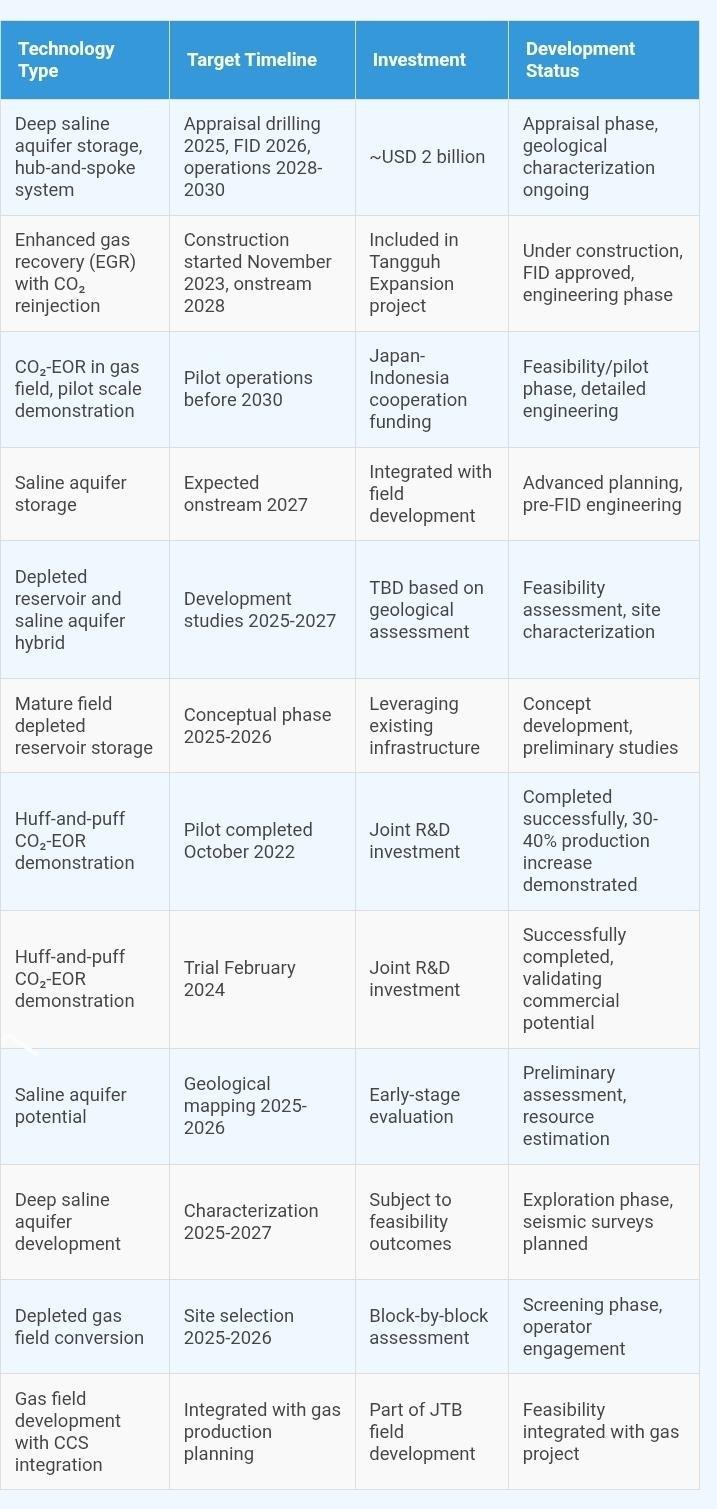
Pertamina Hulu Energi documented potential carbon storage capacity 7.3 gigatons across saline aquifers and depleted oil/gas fields in various regions, positioning state energy company as central player Indonesian CCS ecosystem through multiple hub-and-satellite development model. Strategy emphasizes creating regional CCS hubs at optimal geological locations (Asri Basin, Kutai Basin, ONWJ) equipped with major infrastructure supporting multiple injection sites, connected to satellite facilities at smaller storage locations through pipeline networks, and accessible to international emitters through marine CO₂ transport enabling cross-border business development. Hub approach reduces unit costs through infrastructure sharing, enables phased capacity additions responding to market demand growth, provides redundancy and flexibility accommodating different CO₂ sources and volumes, and creates network effects attracting additional emitters and service providers building integrated ecosystem.
Tangguh CCUS Project operated by bp in West Papua's Bintuni Basin represents most advanced Indonesian development with final investment decision approved, construction commenced November 2023, and operations targeted 2028 capturing CO₂ from natural gas processing and reinjecting into Vorwata gas field for enhanced gas recovery while permanently storing processed volumes. Project expects capture and store 25-30 million tons over 10-15 year operational period, with bp signing Memorandum of Understanding with Japan's Chubu Electric Power exploring CCS value chain connecting Japanese industrial emissions to Indonesian storage positioning Tangguh as potential international hub. Natural gas processing CCS offers lowest capture costs (USD 30-60 per ton) given high CO₂ concentrations (2-15%) in raw gas streams requiring separation anyway for LNG specifications, making early projects economically viable without substantial subsidies required for power generation or industrial capture facing higher costs and lower CO₂ concentrations.
Business Models and Revenue Streams for CCS Operations
Commercially viable CCS deployment requires multiple revenue streams offsetting substantial capital investments (capture facilities, pipelines, injection wells, monitoring systems) and ongoing operational expenditures (energy consumption, maintenance, monitoring, regulatory compliance) given captured CO₂ possesses limited intrinsic value unlike extracted petroleum generating direct commodity sales. Primary business models emerging globally and applicable Indonesian context include enhanced oil or gas recovery where CO₂ injection increases hydrocarbon production generating revenue offsetting capture and storage costs, carbon credit monetization under compliance schemes or voluntary markets rewarding verified emissions reductions, storage-as-a-service charging third-party emitters (domestic or international) for permanent CO₂ disposal, government incentives including capital grants, operational subsidies, tax credits, and guaranteed offtake agreements, and industrial decarbonization enabling continued facility operation under emissions regulations mandating reductions otherwise forcing facility closure.
Enhanced oil recovery using CO₂ flooding represents most commercially proven CCS application globally with over 70 projects operating primarily in United States Permian Basin and decades operational experience demonstrating technical feasibility and economic returns. CO₂-EOR involves injecting compressed CO₂ into depleted oil reservoirs reducing oil viscosity, maintaining reservoir pressure, and mobilizing residual oil trapped after conventional production, potentially recovering additional 10-20% original oil in place while permanently storing 40-60% injected CO₂ in reservoir (remainder returns to surface with produced oil requiring separation and reinjection). Pertamina's pilot trials at Jatibarang (October 2022) and Sukowati (February 2024) fields in West Java conducted jointly with Japan's JOGMEC demonstrated 30-40% production increases validating commercial potential for Indonesian mature fields supporting continued oil revenue while providing CO₂ storage capacity and operational experience informing larger-scale deployment.
CCS Business Models and Revenue Sources:
Enhanced Oil/Gas Recovery (EOR/EGR):
• Mechanism: CO₂ injection improving hydrocarbon recovery from mature fields
• Revenue source: Incremental oil or gas production sold at market prices
• CO₂ storage efficiency: 40-60% injected CO₂ permanently retained in formation
• Production increase: Typically 10-20% original oil in place (OOIP), Pertamina trials showing 30-40%
• Economics: Self-financing when oil price >USD 50-70/barrel depending on CO₂ costs
• Advantages: Proven technology, direct revenue generation, no carbon price dependency
• Limitations: Requires suitable mature oil fields, partial CO₂ recycling, limited storage capacity
• Applications: Jatibarang and Sukowati pilots (Indonesia), Permian Basin (US), Weyburn project (Canada)
Carbon Credit Monetization:
• Compliance markets: EU ETS carbon prices €80-100 per ton, potential Indonesia carbon tax/trading system
• Voluntary markets: Carbon removal credits USD 50-200+ per ton depending on permanence and verification
• Methodology: ISO 27916 CCS quantification standards, CDM methodologies, national protocols
• Verification: Third-party validation, monitoring/reporting/verification (MRV) systems, registry enrollment
• Revenue timing: Annual credit issuance following verified storage, long-term monitoring obligations
• Market risks: Price volatility, regulatory changes, additionality demonstration requirements
• Indonesia framework: Carbon trading regulations under development, international market access potential
• Credit volume: 1 ton CO₂ permanently stored = 1 carbon credit (varies by protocol and permanence classification)
Storage-as-a-Service:
• Fee structure: Typically USD 30-80 per ton CO₂ depending on location, capacity, services included
• Customer segments: Domestic industrial emitters, international sources (Singapore, Japan, Korea)
• Services included: Injection, monitoring, regulatory compliance, liability assumption post-closure
• Contract terms: 10-25 year agreements matching emitter facility lifetimes
• Capacity allocation: Firm commitments versus interruptible service, take-or-pay versus actual usage
• Risk allocation: Operator bears geological risk, emitter retains emissions compliance obligations
• Cross-border premium: International storage may command 20-40% premium versus domestic given limited alternatives
• Indonesia advantage: 30% import capacity allowance, regional geological advantage, strategic location
Government Incentives and Support:
• Capital subsidies: Infrastructure development grants, equipment cost-sharing, exploration funding
• Operational support: Direct payments per ton stored (US 45Q tax credit USD 85/ton for permanent storage)
• Tax incentives: Corporate tax holidays, accelerated depreciation, import duty exemptions
• Cost recovery: Indonesia PSC contractors recover CCS operational costs reducing net investment
• Offtake agreements: Government guarantees purchasing carbon credits or storage capacity
• Regulatory streamlining: Expedited permitting, simplified approval processes, one-stop service
• Research funding: Pilot project support, demonstration grants, technology development programs
• International support: Multilateral development banks, bilateral climate finance, concessional lending
Storage-as-a-service model charges third-party emitters fees for permanent CO₂ disposal combining injection, monitoring, regulatory compliance, and long-term liability management into comprehensive service offering enabling emitters focus on core operations while outsourcing carbon management complexity. Fee structures typically range USD 30-80 per ton depending on location, storage site characteristics, services included, contract terms, and market competition, with international cross-border storage potentially commanding premium pricing given emitter nations' limited alternatives. Indonesia's strategic advantages including vast geological capacity, existing infrastructure, favorable regulatory framework allowing 30% international allocations, and lower operational costs compared to developed economies position competitive pricing attracting regional demand while generating attractive returns for storage operators justifying substantial capital investments. Pertamina International Shipping developing specialized LCO₂ (liquefied CO₂) carrier fleet and reception terminal capabilities supporting marine transport infrastructure essential enabling cross-border business serving Singapore, Japan, and Korea sources.
Government incentives prove determining factor CCS commercial viability given current absence meaningful carbon pricing in most jurisdictions and substantial upfront investments required without guaranteed revenue streams. United States' 45Q tax credit expanded 2018 provides USD 85 per ton captured and permanently stored (USD 60 per ton for EOR or alternative uses) for 12 years from project commencement, spurring dozens new project announcements representing billions dollars investment previously uneconomic. European Union Innovation Fund financed from ETS revenues allocates approximately USD 1.5 billion to CCUS projects supporting capital cost reduction, while national governments including Netherlands (USD 7.3 billion), Denmark (USD 1.2 billion), United Kingdom (multi-billion pound support for industrial clusters), and Norway (funding entire Longship project value chain) demonstrate commitment recognizing CCS necessity achieving climate targets. Indonesia developing comparable incentive frameworks including potential carbon tax reduction for CCS implementers, fiscal incentives under investment laws, and cost recovery provisions for PSC contractors reducing effective project costs.
Economic Analysis: Costs, Investments, and Financial Viability
Carbon capture and storage costs vary dramatically depending on CO₂ source concentration and capture technology, transport distance and mode, storage type and location, project scale enabling economies, and financing terms affecting capital recovery. Natural gas processing offers lowest capture costs USD 30-60 per ton given high CO₂ concentrations (2-15%) requiring separation anyway for pipeline or LNG specifications, utilizing physical or chemical absorption in large-scale facilities processing millions tons annually amortizing capital costs. Power generation faces higher costs USD 50-100 per ton for coal plants (10-15% CO₂ in flue gas) or USD 60-120 for gas plants (3-5% CO₂) due to lower concentrations, atmospheric pressure operation, and large volumes requiring massive equipment, while industrial sources including cement USD 80-150, steel USD 80-200, and chemicals USD 70-180 vary by process specifics and integration opportunities.
Transport costs depend primarily on distance, volume, and infrastructure availability with pipelines offering lowest unit costs at scale though requiring high upfront capital investment. New pipeline construction costs USD 50,000-150,000 per kilometer for typical 300-600 mm diameter depending on terrain, regulatory requirements, and population density affecting routing, with operational costs including compression energy (primary expense), monitoring, and maintenance adding USD 2-5 per ton per 100 kilometers. Existing oil and gas pipeline repurposing dramatically reduces costs to 10% new construction expense (approximately USD 5,000-15,000 per kilometer) assuming compatible materials and necessary modifications, creating substantial advantages in regions with extensive hydrocarbon infrastructure like Indonesia's mature producing basins. Marine transport via specialized CO₂ carriers becomes economical for distances exceeding 500-1,000 kilometers or offshore destinations lacking pipeline access, with costs ranging USD 10-30 per ton short distances (under 500 km) to USD 30-80 per ton regional scale (1,000-3,000 km) depending on vessel availability, loading/unloading infrastructure, and utilization rates.
CCS Cost Components and Ranges:
Capture Costs by Source Type:
• Natural gas processing: USD 30-60/ton (high concentration 2-15%, physical separation, mature technology)
• Ammonia/fertilizer production: USD 30-70/ton (high purity streams, straightforward capture)
• Coal-fired power (post-combustion): USD 50-100/ton (10-15% CO₂, chemical absorption, 20-30% energy penalty)
• Gas-fired power (post-combustion): USD 60-120/ton (3-5% CO₂, large volumes, lower concentration)
• Cement kilns: USD 80-150/ton (15-30% CO₂ but high temperature, particulates, integration complexity)
• Steel production (blast furnace): USD 80-200/ton (variable concentrations, process integration challenges)
• Chemical/petrochemical: USD 70-180/ton depending on specific process and CO₂ characteristics
• Direct air capture: USD 200-600/ton currently (410 ppm atmospheric concentration, massive throughput needs)
Transport Costs:
• Pipeline (new construction): USD 50,000-150,000 per km capital, USD 2-5/ton per 100 km operational
• Pipeline (repurposed existing): USD 5,000-15,000 per km capital, similar operational costs
• Marine transport (short distance <500 km): USD 10-30/ton including loading/unloading
• Marine transport (regional 1,000-3,000 km): USD 30-80/ton for dedicated CO₂ carriers
• Rail or truck: USD 50-150/ton limited to small volumes and short distances
• Compression for transport: 100-150 bar pressure, 60-70% of pipeline transport costs
• Liquefaction for shipping: -50°C at 7 bar or -30°C at 15 bar, additional energy requirements
• Infrastructure amortization: 20-30 year economic life spreading capital costs
Storage Costs:
• Depleted oil/gas reservoir: USD 5-20/ton (characterized geology, existing wells, proven sealing)
• Deep saline aquifer: USD 10-30/ton (exploration drilling, characterization, uncertainty)
• Onshore storage: USD 5-15/ton lower costs versus offshore
• Offshore storage: USD 15-30/ton higher well costs, marine logistics, monitoring
• Well drilling: USD 5-20 million per injection well depending on depth (1,000-3,000 m) and location
• Well count: 5-10 wells for 30-50 million ton capacity over 20-30 years
• Monitoring systems: USD 5-15 million capital, USD 0.5-2 million annual operational
• Post-closure surveillance: 10 years under Indonesia regulations, USD 1-5 million total
Total System Costs (Integrated Projects):
• Natural gas processing CCS: USD 40-90/ton total system (capture + transport + storage)
• Power generation CCS: USD 70-150/ton total depending on fuel type and configuration
• Industrial CCS: USD 100-220/ton varying by sector and capture complexity
• Cross-border regional hub: USD 80-180/ton including international transport premium
• Economies of scale: 50%+ cost reduction from 1 million ton/year to 5+ million ton/year projects
• Learning curve: 10-20% cost reduction per doubling cumulative capacity historically
• Competitiveness threshold: Requires carbon price USD 80-120/ton or equivalent subsidy without revenue offsets
• EOR integration: Can reduce net cost to USD 10-40/ton or achieve profitability depending on oil prices
Storage costs prove relatively modest USD 5-30 per ton compared to capture and transport given geological formations provide essentially free disposal capacity once accessed, with expenses primarily comprising well drilling (USD 5-20 million per injection well depending on depth and location), injection facilities (compression, manifolds, controls), and monitoring systems (seismic surveys, pressure sensors, geochemical sampling). Depleted oil and gas reservoirs offer lowest storage costs USD 5-20 per ton benefiting from characterization data, potentially reusable wells, and proven sealing demonstrated through hydrocarbon retention, though limited capacity compared to deep saline aquifers requiring exploration drilling and characterization adding USD 10-30 per ton. Onshore storage generally costs less than offshore given simpler logistics and lower well costs, though offshore locations often provide proximity to coastal industrial emitters and enable marine CO₂ import infrastructure supporting regional hub business models justifying incremental expenses.
Integrated CCS project economics combining all cost components indicate total levelized costs ranging USD 40-90 per ton for natural gas processing (optimal initial applications), USD 70-150 per ton for power generation, and USD 100-220 per ton for industrial sources before considering revenue offsets from EOR, carbon credits, or government incentives. These costs require either carbon pricing mechanisms (carbon taxes, emissions trading systems) establishing comparable costs for unabated emissions, regulatory mandates requiring emissions reductions regardless of costs, or direct government subsidies covering cost differentials making CCS competitive with business-as-usual operations. Current carbon prices in European Union ETS (approximately EUR 80-100 per ton or USD 85-110) approach competitiveness thresholds for power generation and some industrial applications, while voluntary carbon markets paying USD 50-200+ per ton for high-quality permanent removal credits provide alternative monetization pathways particularly attractive for storage-as-a-service business models serving corporate net-zero commitments.
Scale economics prove determining factor with 50% or greater cost reductions achievable increasing capture capacity from 1 million ton per year (small commercial scale) to 5+ million tons (large scale) through fixed cost amortization, equipment optimization, and operational learning. Hub development leveraging shared infrastructure across multiple emitters captures these economies while reducing individual project risks through diversified revenue sources and flexible capacity utilization. Indonesia's positioning emphasizing regional hubs at Asri Basin, Kutai Basin, and ONWJ aligns with scale economic principles, targeting multi-gigaton capacities serving dozens potential emitters domestically and internationally rather than isolated single-source projects facing higher costs and concentrated risks. Technology learning curves historically demonstrate 10-20% cost reductions per doubling cumulative capacity as industries mature, optimize designs, standardize equipment, develop specialized supply chains, and accumulate operational experience, suggesting current costs substantially declining as global CCUS deployment accelerates from present 50 million ton per year to hundreds of millions required achieving climate targets.
Economic Case Study: Asri Basin CCS Hub Financial Analysis
Project Parameters and Assumptions:
Storage capacity: 3.0 gigatons total geological capacity
Operational capacity: 30 million tons per year CO₂ injection (100-year theoretical capacity)
Phase 1 development: 150 million tons over 25 years (6 million tons/year average)
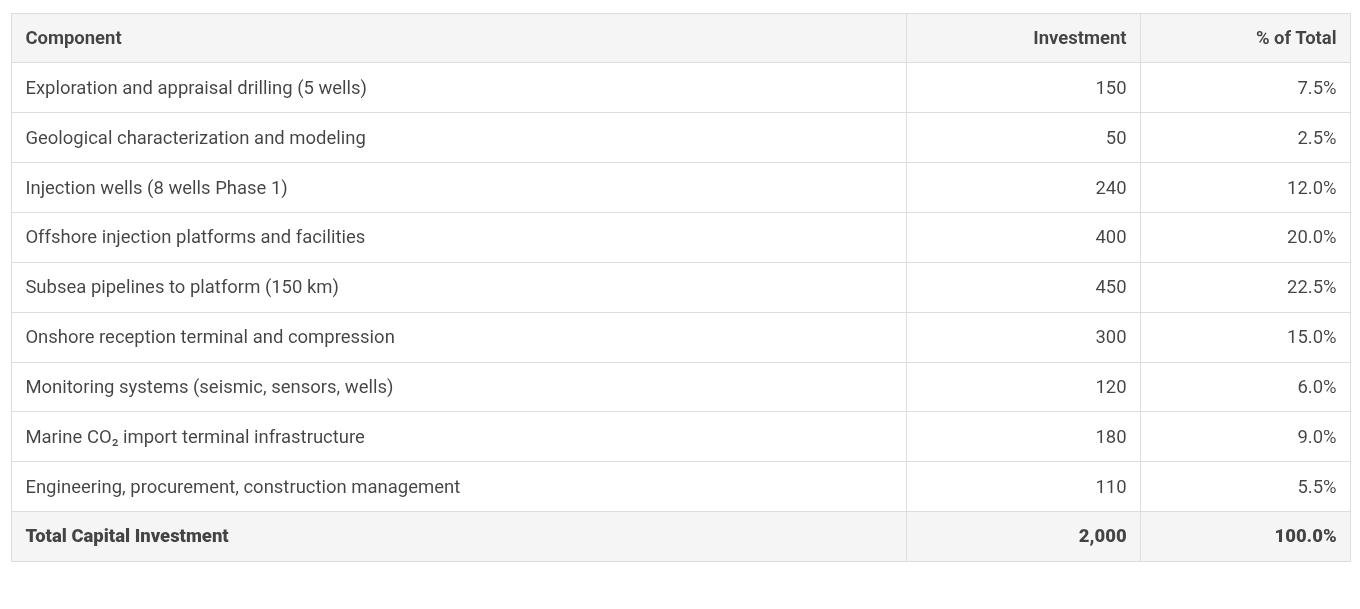
Capital investment: USD 2 billion including capture, transport, injection, monitoring infrastructure
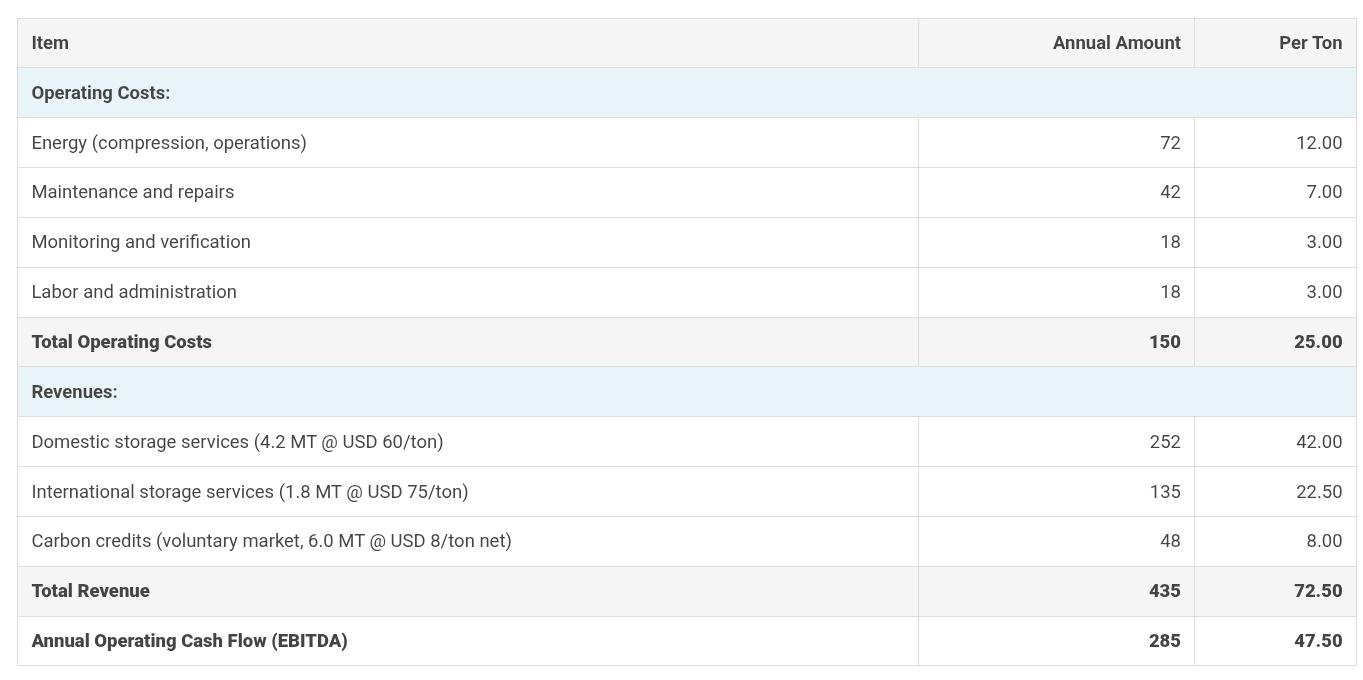
Operational expenditure: USD 25/ton including energy, maintenance, monitoring, labor
Revenue model: Storage service fees USD 65/ton (domestic USD 60, international USD 75 weighted average)
Capacity allocation: 70% domestic industrial emitters, 30% international sources (Singapore, Korea, Japan)
Financial structure: 40% equity (Pertamina, ExxonMobil, KNOC), 60% project finance debt at 7% interest, 25-year project life
Capital Investment Breakdown (USD Millions):
Annual Operating Costs and Revenues (Year 10 Steady State, USD Millions):
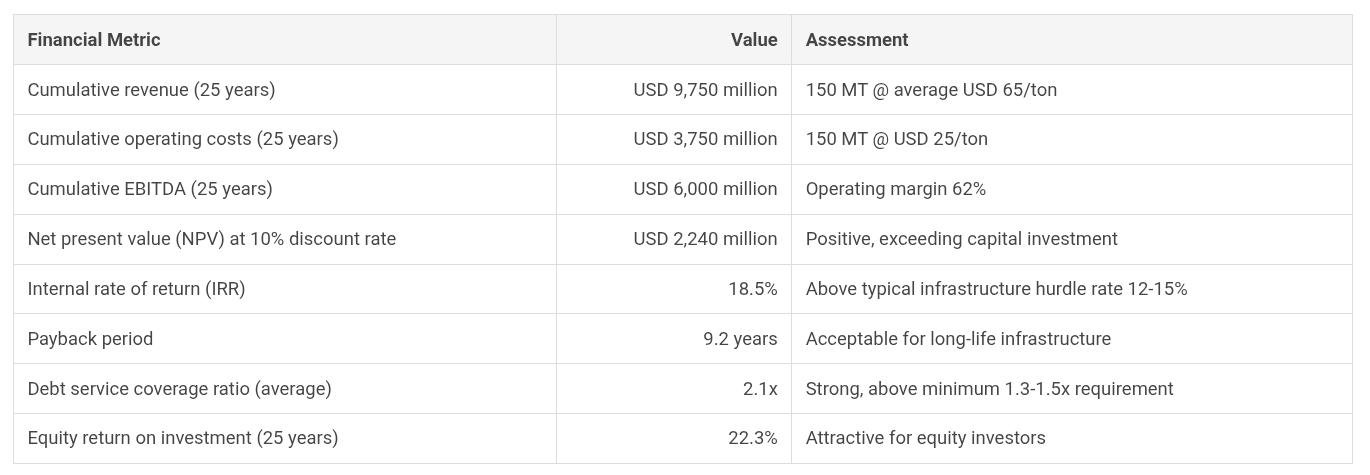
Project Financial Returns Analysis (25-Year Projection):
Financial Viability Conclusion:
Analysis demonstrates Asri Basin CCS Hub achieves commercial viability under assumed storage fee structure (USD 60-75 per ton) without requiring government operational subsidies, though project depends on achieving contractual commitments for capacity utilization and maintaining cost discipline during construction and operations. Financial returns exceed typical infrastructure project thresholds with 18.5% IRR and positive NPV supporting investment by partners Pertamina, ExxonMobil, and KNOC. Key success factors include securing long-term storage contracts with domestic and international emitters before final investment decision, optimizing capital costs through experienced contractors and equipment standardization, managing operational efficiency achieving assumed USD 25 per ton costs, and establishing favorable fiscal treatment under Indonesian regulations including cost recovery provisions for PSC-related activities and tax incentives for CCS infrastructure. Sensitivity analysis indicates project remains viable with 15-20% revenue reductions or cost increases, providing reasonable buffer against market uncertainties and operational challenges typical for first-of-kind regional hub development.
Cross-Border CCS Collaboration: Regional Hub Development
Indonesia's geological storage advantages combined with neighboring countries' emissions challenges and limited domestic storage capacity create compelling rationale for cross-border CO₂ transport and storage serving regional decarbonization requirements. Singapore generates approximately 50 million tons annual CO₂ emissions from power generation, refining, petrochemicals, and other industrial activities while possessing virtually no suitable geological storage given 733 square kilometer land area and shallow geology unsuitable for permanent CO₂ sequestration. Climate commitments targeting 65% emissions reduction by 2050 require substantial decarbonization technologies including hydrogen adoption, electrification, and CCS for residual hard-to-abate emissions, necessitating international storage solutions absent domestic alternatives. Japan emits approximately 1.1 billion tons annually with limited onshore storage though potential offshore capacity in Sea of Japan sedimentary basins requiring significant development, while South Korea's 650 million ton annual emissions face similar constraints with limited domestic geological options.
Indonesia-Singapore CCS partnership represents most advanced cross-border framework with governments signing Letter of Intent 2024 committing negotiate legally binding bilateral agreement enabling CO₂ export from Singapore to Indonesian storage facilities. Framework addresses complex issues including international legal liability for stored CO₂, customs and border procedures for CO₂ shipments, monitoring and verification protocols acceptable to both jurisdictions, financial mechanisms ensuring storage permanence, and dispute resolution procedures governing multi-decade agreements outlasting typical government terms. Singapore's proximity to Indonesian storage sites (Asri Basin approximately 400 kilometers from Singapore, reachable via marine transport at USD 25-40 per ton) provides cost-competitive solution compared to theoretical domestic storage requiring extensive offshore exploration uncertain yielding adequate capacity. Singapore Ministry of Sustainability and Environment actively engaging CCS providers globally while Indonesian government sees substantial revenue opportunity potentially storing 10-20 million tons annually from Singapore generating USD 600 million to USD 1.5 billion annual storage service fees.
Cross-Border CCS Framework Elements:
Indonesia-Singapore Bilateral Agreement (Under Negotiation):
• Legal foundation: Letter of Intent signed 2024, binding agreement targeted 2025-2026
• Scope: Framework enabling CO₂ export from Singapore to Indonesian storage sites
• Volume potential: 10-20 million tons per year from Singapore industrial emitters
• Storage locations: Asri Basin (nearest at 400 km), other basins as capacity develops
• Transport mode: Marine using specialized CO₂ carriers, potential pipeline if volumes justify
• Storage fees: Estimated USD 60-80 per ton competitive with alternative international options
• Liability provisions: Long-term stewardship transfer mechanisms after closure verification
• Regulatory harmonization: Monitoring standards, reporting requirements, verification protocols
South Korea Participation (KNOC in Asri Basin):
• Partnership: KNOC signed framework agreement with Pertamina and ExxonMobil for Asri Basin
• Purpose: Potential South Korean industrial CO₂ injection into shared storage infrastructure
• Korean emissions: 650 million tons annual with limited domestic storage options
• Policy drivers: Carbon neutrality by 2050 requiring substantial CCS deployment
• Technology collaboration: Korean engineering companies, shipping expertise, project finance
• Government support: Korean carbon pricing system creating compliance demand
• Volume potential: 5-15 million tons per year from Korean heavy industries
• Economic benefit: Indonesia receives storage fees, Korea achieves climate targets
Japan Collaboration (Multiple Projects):
• Tangguh: bp partnered with Chubu Electric Power exploring CCS value chain Japan-Indonesia
• Gundih: Japanese entities JOGMEC, JGC, J-Power, JANUS collaborating with Pertamina
• METI support: Japan Ministry of Economy, Trade and Industry funding feasibility studies
• Japanese emissions: 1.1 billion tons annual requiring massive CCS deployment for net-zero 2050
• Offshore potential: Japan's domestic sea bed storage under development but limited capacity
• LCO₂ shipping: Japan possesses advanced marine transport capability for CO₂ carriers
• Technology transfer: Japanese engineering expertise, equipment, project management
• Financial participation: Development finance, commercial investment, offtake agreements
Legal and Regulatory Framework Requirements:
• London Protocol: 2009 amendment permitting cross-border CO₂ transport for storage (Indonesia ratification needed)
• National legislation: Host country laws enabling foreign CO₂ imports (Indonesia PR 14/2024 provides 30% allocation)
• Liability provisions: Clear assignment of long-term stewardship responsibilities
• Monitoring standards: Internationally compatible measurement, reporting, verification protocols
• Environmental assessment: Transboundary impact evaluation, public consultation procedures
• Customs procedures: CO₂ classification, inspection requirements, documentation standards
• Financial guarantees: Bonding or insurance ensuring storage permanence and liability coverage
• Dispute resolution: International arbitration mechanisms for long-duration agreements
Japan's participation through multiple channels including Chubu Electric's Tangguh collaboration and METI-supported Gundih project demonstrates substantial interest leveraging Indonesia's geological advantages addressing domestic constraints. Japan Ministry of Economy, Trade and Industry allocated significant funding supporting feasibility studies, technology development, and pilot demonstrations throughout Asia recognizing CCS necessity achieving 2050 carbon neutrality commitments while maintaining industrial competitiveness. Japanese engineering companies and equipment manufacturers possess world-leading capabilities in capture technologies, offshore development, marine transport, and monitoring systems creating mutually beneficial partnerships where Japan provides technology and expertise while Indonesia offers geological storage and operational infrastructure. Potential volumes from Japan could reach 20-50 million tons annually from LNG terminals, refineries, power plants, and industrial facilities along coastal areas facing domestic storage limitations and regulatory pressures mandating emissions reductions.
Regional hub business model envisions Indonesia providing storage-as-a-service to multiple regional emitters through shared infrastructure optimizing costs and flexibility. Pertamina International Shipping developing specialized LCO₂ carrier fleet and reception terminal capabilities creates essential transport infrastructure connecting regional sources to Indonesian storage sites, with ship-based transport offering flexibility serving multiple origins and destinations compared to fixed pipelines requiring dedicated point-to-point connections. Hub-and-spoke configuration positions coastal reception terminals accepting marine CO₂ deliveries from Singapore, Malaysia, Japan, and Korea, connecting via pipeline networks to offshore storage platforms serving multiple injection sites across geological basins, enabling capacity additions responding to market growth and providing operational redundancy improving reliability. Total regional addressable market potentially exceeds 100 million tons annually considering combined emissions from Singapore, South Korea, Japan, and other Southeast Asian nations lacking adequate domestic storage, representing multi-billion dollar annual revenue opportunity for Indonesia's CCS industry if supportive policies and infrastructure investments materialize.
Frequently Asked Questions About Carbon Capture and Storage in Indonesia
1. How does Indonesia's 400-600 gigaton storage capacity compare to regional and global requirements?
Indonesia's estimated 400-600 gigaton geological storage capacity positions nation among largest potential CCS providers globally, exceeding by orders of magnitude projected regional requirements through 2060 even under aggressive decarbonization scenarios. For perspective, International Energy Agency Clean Technology Scenario requires cumulative 107 gigatons CO₂ permanently stored globally through 2060, meaning Indonesia's capacity theoretically accommodates four-to-six times entire global requirement though practical limitations including site characterization, infrastructure development, and economic viability constrain actually accessible portion. Asia-Pacific region including Indonesia, Australia, China, India, Japan, and Southeast Asian nations emits approximately 18 billion tons CO₂ annually with hard-to-abate sectors potentially requiring 1-3 billion tons annual CCS by 2050, implying Indonesia's capacity could theoretically serve regional requirements for centuries. However, capacity represents geological potential rather than immediately deployable infrastructure, with actual utilization depending on site-by-site development, permitting, financing, and commercial arrangements determining pace and scale of deployment over coming decades.
2. What distinguishes CCS from CCUS and why does terminology matter for Indonesian projects?
Carbon Capture and Storage (CCS) refers specifically to capturing CO₂ from emission sources or atmosphere and permanently storing underground in geological formations without intermediate utilization, achieving direct emissions reduction or atmospheric carbon removal. Carbon Capture, Utilization and Storage (CCUS) encompasses broader range including using captured CO₂ in industrial processes or products before any remaining CO₂ undergoes permanent storage, with utilization pathways including enhanced oil recovery, chemical manufacturing (methanol, plastics), building materials (carbonated concrete), and greenhouse agriculture. Distinction matters significantly for Indonesian regulatory framework since MEMR Regulation 2/2023 differentiates treatment: CCS activities receive straightforward operational cost recovery under PSCs while CCUS involving EOR or other revenue-generating utilization requires more complex accounting separating storage costs from production revenue. Additionally, carbon credit eligibility differs with pure CCS generally receiving full credit for captured volumes while CCUS credits may require lifecycle analysis demonstrating net emissions reduction accounting for utilization pathway emissions. Enhanced oil recovery particularly requires careful analysis since CO₂ enables additional oil production generating combustion emissions potentially offsetting storage climate benefits, though Pertamina's trials demonstrating 40-60% CO₂ retention indicates substantial net carbon reduction especially when displacing new exploration and production. Projects should clearly distinguish CCS versus CCUS applications from outset given regulatory, financial, and environmental assessment implications affecting project structure and economics.
3. How do MEMR Regulation 2/2023 and Presidential Regulation 14/2024 differ in scope and applicability?
MEMR Regulation 2/2023 issued March 2023 specifically governs CCS and CCUS implementation within existing upstream oil and gas working areas operated under production sharing contracts (PSCs) with SKK Migas or BPMA, enabling PSC contractors leverage geological knowledge, existing infrastructure, and established regulatory relationships facilitating deployment. Regulation provides detailed operational requirements including development planning, technical standards, monitoring obligations, and cost recovery provisions allowing contractors treat CCS operational expenses as recoverable costs under PSC terms, creating favorable economics but limiting participation to entities holding upstream oil and gas rights. Presidential Regulation 14/2024 enacted January 2024 serves as umbrella framework establishing broader national policy covering CCS activities anywhere in Indonesia whether within PSC areas or designated carbon storage permit areas (WIPK), enabling participation by non-PSC entities including independent storage providers, power generators, industrial emitters, and international partners establishing Indonesian operations. PR 14/2024 establishes high-level policy principles, institutional authorities, cross-border provisions, and directions for subordinate regulations while MEMR 2/2023 provides specific technical implementation details for PSC context. Subsequently, MEMR Regulation 16/2024 effective December 2024 implements PR 14/2024 by establishing detailed procedures for WIPK designation, exploration and storage operation permits, tender processes, and technical requirements for entities operating outside PSC framework. These three regulations form hierarchical structure with PR 14/2024 providing overall policy, MEMR 2/2023 governing PSC applications, and MEMR 16/2024 enabling independent carbon storage operations, together creating comprehensive framework accommodating diverse business models and participants.
4. What technical and financial capabilities do entities need for participating in Indonesian CCS tenders?
MEMR Regulation 16/2024 establishes prequalification requirements for WIPK carbon storage permit area tenders emphasizing demonstrated technical and financial capabilities in oil and gas, mining, geothermal, or CCS sectors. Technical requirements include geological characterization expertise through previous exploration experience, reservoir engineering capabilities for storage capacity assessment and injection optimization, well drilling and completion expertise ensuring safe operations, monitoring technology proficiency for verification and environmental protection, and project management track record delivering complex energy infrastructure on schedule and budget. Financial capabilities require demonstrating sufficient capital for exploration commitments (typically USD 10-50 million depending on area size and complexity), ability to secure project financing for development phase (hundreds of millions to billions for major hubs), working capital for sustained operations, and financial guarantees or bonding covering long-term monitoring and potential remediation obligations. Entities meeting prequalification criteria join MEMR shortlist receiving preferential treatment in subsequent tenders including invitation to direct selection processes and streamlined evaluation focusing on exploration work commitments rather than requiring recertification of financial and technical capabilities. Consortium structures explicitly permitted combining complementary strengths (e.g., international major providing technical expertise and project finance partnering with Indonesian entity possessing local knowledge and relationships), though requiring clear delineation of management responsibilities and liability allocation. Foreign entities must establish Indonesian presence through incorporated entity or permanent establishment for permit holding, creating opportunities for joint ventures, license agreements, or management contracts structuring international participation while satisfying local content and technology transfer objectives supporting Indonesian CCS industry development.
5. How will Indonesia handle long-term liability for stored CO₂ after project closure?
Presidential Regulation 14/2024 establishes framework where CCS operators bear responsibility for monitoring, reporting, and verification (MRV) activities throughout operational period and continuing 10 years following closure, after which liability transfers to Indonesian government through MEMR and Directorate General of Oil & Gas assuming responsibility for long-term stewardship. Ten-year post-closure monitoring requirement aims demonstrating storage permanence through plume stability confirmation, formation pressure dissipation, absence of detectable leakage, and groundwater quality protection before government acceptance. Operators must reserve financial provisions (bonds, trusts, or other security mechanisms) covering anticipated monitoring costs and potential remediation needs during this period, preventing orphaned sites requiring government expenditure if operators default or dissolve. However, regulations stop short of explicitly stating government assumes all liability for CO₂ leakage occurring after post-closure period expires, creating uncertainty potentially concerning project developers, lenders, and international partners seeking definitive liability closure enabling removal of provisions from balance sheets and termination of insurance coverage. International precedents including Norway's petroleum regulations and Alberta's Carbon Capture and Storage Liability Management Framework provide models for explicit liability transfer with government assumption of perpetual stewardship responsibilities following rigorous site assessment and financial security receipt, though these developed-nation frameworks may require adaptation to Indonesian institutional context and fiscal constraints. Clarity on final liability allocation proves necessary attracting international investment in storage-as-a-service business models where long-term uncapped liability exposure could render projects unfinanceable or require risk premiums substantially increasing costs. Forthcoming implementing regulations expected address these details establishing procedures for closure certification, financial adequacy determination, transfer documentation, and government institutional arrangements managing transferred liabilities perpetually without creating unreasonable future fiscal burdens.
6. What carbon pricing mechanisms or incentives will support commercial CCS viability in Indonesia?
Indonesia currently lacks comprehensive carbon pricing mechanism comparable to European Union ETS or California's cap-and-trade system creating direct compliance value for emissions reductions, though Taxation Harmonization Law 7/2021 establishes legal foundation for carbon tax with rates and implementation details subject to government regulation not yet fully implemented. Initial carbon tax proposals suggest starting rate approximately USD 2-5 per ton CO₂ for coal-fired power generation (lowest internationally and insufficient driving CCS adoption given typical costs USD 70-150 per ton for power applications), with intentions increasing rates progressively toward levels incentivizing emissions reduction investments. Government developing broader emissions trading system potentially including power sector, heavy industry, and eventually transportation, though timeline and design details remain under discussion with stakeholders. Without meaningful carbon price near-term, Indonesian CCS development depends on alternative incentives including PSC cost recovery provisions under MEMR 2/2023 enabling upstream contractors treat CCS as operational expense, capital grants or subsidies for demonstration projects (potential development finance from World Bank, Asian Development Bank, or bilateral sources), tax incentives including holidays and accelerated depreciation under investment regulations, international carbon credit revenues from voluntary markets (potentially USD 50-200 per ton for high-quality permanent removal), cross-border storage service fees (USD 60-80 per ton for regional emitters), enhanced oil recovery revenue offsets, and regulatory mandates eventually requiring industrial emissions reductions regardless of costs. Pertamina's multiple project development suggests state enterprise willing accept below-market returns on initial investments recognizing strategic positioning benefits and eventual commercial viability as carbon pricing matures, while international partners including ExxonMobil, bp, and Asian entities participate partly anticipating future policy development creating favorable economics and partly securing first-mover advantages in emerging market. Government statements emphasize commitment achieving net-zero 2060 and 29% reduction by 2030 suggest eventual carbon pricing or regulatory mechanisms necessary drive substantial CCS deployment supporting climate commitments, though detailed implementation remains work in progress requiring stakeholder consultation, administrative capacity building, and political consensus.
7. How does Indonesia's CCS development timeline compare to global leaders like Norway and United States?
Indonesia's CCS development follows accelerated trajectory compared to global pioneers though starting from later baseline, with comprehensive regulatory framework established 2023-2024 versus Norway's decades-long incremental development beginning 1990s and United States' gradual evolution through enhanced oil recovery applications before climate-focused policies. Norway operates world's longest-running dedicated storage project (Sleipner field capturing 1 million tons annually since 1996 from natural gas processing) and recently launched Longship full-chain CCUS covering Norcem cement plant capture, transport infrastructure, and offshore storage in Northern Lights project accepting international CO₂ from 2024. United States possesses over 8,000 kilometers CO₂ pipelines and 50+ operational CCS projects primarily serving EOR applications, with recent 45Q tax credit expansion stimulating new wave climate-focused storage projects including massive Gulf Coast Blue hydrogen facilities and industrial capture initiatives. Indonesia's regulatory advancement within 2-3 years establishing frameworks enabling both PSC and independent storage operations represents rapid policy development potentially enabling faster deployment once initial projects demonstrate technical and commercial viability. However, actual operational capacity lags global leaders with Indonesia's first large-scale projects (Tangguh, Asri Basin) targeting late 2020s commissioning versus Norway and US decades operational experience, and technical capacity requiring substantial development through pilot projects, workforce training, supply chain establishment, and learning-by-doing addressing Indonesia-specific geological and operational challenges. Indonesia's strategic advantages include newer regulatory framework potentially avoiding legacy limitations in mature jurisdictions, substantial untapped storage capacity not constrained by existing utilization, and regional market opportunity serving neighboring nations' demands creating scale enabling faster cost reduction through experience curves. If Indonesian government maintains policy commitment, streamlines permitting without sacrificing environmental rigor, attracts continued international partnership bringing technology and finance, and successfully launches initial flagship projects demonstrating capability, Indonesia could plausibly emerge as Asia-Pacific CCS leader within 10-15 years comparable to Norway's current position in Europe, though sustained execution over extended period necessary converting potential to realized capacity and establishing reputation supporting commercial-scale industry.
8. What role can CCS play in Indonesia's broader energy transition beyond fossil fuel sectors?
While CCS primarily discussed in context enabling continued fossil fuel utilization through emissions mitigation, technology possesses broader applications supporting comprehensive energy transition including blue hydrogen production, bioenergy with CCS enabling negative emissions, industrial process decarbonization independent of fuel choice, and direct air capture removing legacy atmospheric CO₂. Blue hydrogen produced from natural gas reforming with carbon capture offers lower-cost pathway versus green hydrogen from renewable electrolysis, potentially serving as transition technology enabling hydrogen economy development before renewable capacity sufficient supplying green hydrogen at scale and competitive costs. Indonesia's substantial natural gas reserves combined with CCS capability could position nation as major blue hydrogen exporter serving regional demand from Japan, Korea, and potentially Europe if economics prove favorable. Bioenergy with CCS (BECCS) combining biomass power generation or biofuel production with carbon capture achieves net-negative emissions since biomass absorbs atmospheric CO₂ during growth then permanently storing combustion/fermentation emissions, creating pathway potentially offsetting hard-to-abate residual emissions from aviation, shipping, or industrial processes lacking alternatives. Indonesia's agricultural and forestry sectors generate substantial biomass potentially supporting BECCS while providing rural economic development though careful sustainability assessment required ensuring biomass production doesn't drive deforestation or food security impacts. Industrial process emissions from cement, steel, and chemicals occur regardless of energy source given chemical reactions inherent to production (e.g., limestone calcination producing CO₂ in cement manufacture), requiring CCS, material substitution, or production relocation for deep decarbonization, with CCS often most economically and technically feasible option. Direct air capture technology removing CO₂ directly from atmosphere remains expensive (USD 200-600 per ton currently) but provides flexibility locating facilities with optimal storage access and enabling addressable distributed or legacy emissions, potentially becoming important complement as costs decline through innovation and scale. Indonesia's CCS strategy should integrate these broader applications beyond fossil fuel focus, recognizing technology's role enabling comprehensive net-zero pathway combining emissions reduction from energy transition with carbon removal offsetting remaining emissions and providing pathway addressing historical atmospheric accumulation contributing climate change. Balanced portfolio approach utilizing renewable energy expansion, energy efficiency improvements, electrification of end uses, hydrogen adoption, sustainable biomass, AND carbon capture across appropriate applications provides maximum flexibility achieving climate objectives while maintaining energy security, economic growth, and industrial competitiveness through complex multi-decade transition.
9. What monitoring technologies and protocols ensure stored CO₂ remains securely contained permanently?
Comprehensive monitoring programs integrate multiple technologies providing redundant verification stored CO₂ remains contained within target formations without leaking to overlying groundwater aquifers or atmosphere, with monitoring continuing throughout injection operations and post-closure period (10 years in Indonesia regulations) before liability transfer. Time-lapse 3D seismic surveys repeated at 1-5 year intervals image subsurface CO₂ plume migration and distribution demonstrating containment within injection zone, with high-resolution surveys distinguishing CO₂ from brine and detecting potential migration pathways through caprock or faults. Permanent downhole monitoring systems installed in injection wells and offset observation wells continuously measure pressure, temperature, and fluid chemistry at reservoir depth and overlying formations, providing real-time data on CO₂ movement and formation response with early warning of anomalous conditions requiring investigation or intervention. Surface monitoring includes atmospheric CO₂ measurements establishing baseline natural variability before injection and detecting any surface expression of leakage, soil gas sampling measuring CO₂ concentrations in shallow subsurface indicating potential migration, and groundwater chemistry analysis from aquifers overlying storage formation ensuring water quality protection. Microseismic monitoring using sensitive seismometer arrays detects minor seismicity potentially indicating formation stress changes or fault reactivation from pressure increases, enabling injection rate adjustments preventing induced seismicity concerns. Satellite-based techniques including InSAR (Interferometric Synthetic Aperture Radar) detect millimeter-scale ground surface deformation potentially indicating pressure changes or fluid migration, providing wide-area surveillance complementing point-based measurements. Tracer testing periodically injects chemical markers with CO₂ enabling tracking migration pathways and distinguishing native CO₂ from injected sources if encountered in offset wells or monitoring points. Modeling and simulation integrating monitoring data with geological characterization enables prediction of future plume behavior, assessment of monitoring system adequacy, and evaluation of different leakage scenarios supporting adaptive management and contingency planning. International standards including ISO 27914 (Geological Storage of CO₂), ISO 27916 (Quantification and Reporting), and national regulations establish minimum monitoring requirements ensuring consistency across projects and jurisdictions, with Indonesia regulations requiring monitoring plans approved by MEMR specifying techniques, frequency, parameters, quality assurance, and reporting obligations. Well-designed and rigorously implemented monitoring programs provide high confidence in storage security addressing public and stakeholder concerns while satisfying regulatory requirements and supporting carbon credit certification verifying permanent emissions reduction claimed by projects.
10. How can Indonesian companies without oil and gas background participate in CCS industry development?
CCS value chain encompasses diverse specialized services beyond traditional upstream oil and gas operations creating opportunities for companies across sectors including geological consulting firms conducting site characterization and reservoir modeling, geophysical contractors providing seismic surveys and data interpretation, drilling companies specializing in deep wells for injection and monitoring, engineering and construction firms designing and building capture, transport, and injection facilities, equipment manufacturers and suppliers providing specialized compressors, separators, instrumentation, and materials, environmental consulting and monitoring services conducting assessments and surveillance programs, certification and verification bodies validating storage permanence for carbon credit issuance, transportation and logistics providers operating CO₂ carriers, pipelines, and handling infrastructure, legal and financial advisory firms structuring contracts and project finance, and training and capacity building institutions developing workforce capabilities. MEMR Regulation 16/2024 explicitly permits non-PSC entities participate in CCS through WIPK carbon storage permit areas, enabling specialized storage providers, power generators, industrial emitters, or dedicated CCS companies entering sector without requiring upstream oil and gas heritage. Companies can participate through direct permit applications as primary operators if possessing requisite capabilities, joint ventures or consortia combining complementary strengths (e.g., Indonesian firm with local knowledge partnering international technical specialist), service contracts providing specialized capabilities to primary operators, equipment supply chains manufacturing or distributing CCS-specific technology, or financial participation as project investors without operational roles. Government emphasis local content and technology transfer creates opportunities for Indonesian firms building capabilities through partnerships with international leaders, with requirements typically including Indonesian personnel employment and training, local procurement of goods and services where available at competitive quality and price, and technology transfer through license agreements, joint ventures, or training programs building sustainable domestic industry. Industry associations and professional societies potentially emerging around CCS development provide networking, knowledge sharing, and advocacy functions supporting new entrants understanding requirements and connecting with partnership opportunities. Educational institutions and research centers conducting CCS-related research, training programs, and demonstration projects create pathways for Indonesian engineers and scientists developing expertise positioning them for industry employment or entrepreneurial ventures as sector scales. Government should consider specific programs supporting small-medium enterprise participation including financial assistance, technical training, preferential procurement policies, and matchmaking between major project developers and qualified local service providers ensuring benefits broadly distributed while building diverse, resilient domestic CCS ecosystem not dominated exclusively by international majors or state enterprise.
Strategic Recommendations and Future Outlook for Indonesian CCS
Indonesia's successful emergence as Asia-Pacific CCS leader requires sustained commitment across multiple dimensions including policy continuity and enhancement, regulatory streamlining without compromising environmental protection, international partnership cultivation, technical capacity building, financial mechanism development, public engagement and acceptance, and coordinated government-industry collaboration driving ecosystem development. Government should prioritize finalizing implementing regulations addressing outstanding details in PR 14/2024 framework including storage fee calculation methodologies, certification procedures, safety standards, and liability transfer protocols providing clarity enabling investment decisions. Carbon pricing mechanism development either through emissions trading system or carbon tax ramping toward meaningful levels (USD 50-100 per ton by 2030) creates direct economic incentive for CCS adoption rather than relying solely on government subsidies or regulatory mandates with uncertain funding or enforcement.
Accelerated geological mapping and site characterization building comprehensive database of storage capacity, injectivity, and site-specific characteristics enables rational project development and reduces exploration risk for developers. Indonesia Carbon Capture and Storage Centre (ICCSC) should receive enhanced resources conducting systematic basin assessment, maintaining data repositories accessible to qualified developers, and providing technical guidance on best practices adapted to Indonesian geological conditions. Public information campaigns explaining CCS technology, addressing safety and environmental concerns, showcasing domestic and international success stories, and communicating climate benefits builds social license essential for permitting and community acceptance. Learning from global experiences where opposition delayed or prevented projects (including some European initiatives), proactive transparent engagement with stakeholders including local communities, environmental organizations, academic institutions, and media proves necessary countering misinformation and building trust in responsible project development and oversight.
Strategic international partnerships with Singapore, South Korea, Japan, and potentially other regional nations should advance from current memoranda of understanding and framework agreements to binding commercial contracts providing revenue certainty justifying infrastructure investments. Indonesia possesses strong negotiating position given geological advantages but should balance maximizing storage service revenues against broader strategic benefits including technology access, project finance participation, and regional leadership positioning. Offering competitive pricing (potentially USD 50-70 per ton versus USD 80-100+ for limited alternatives) while ensuring adequate returns for Indonesian operators creates win-win arrangements supporting partner nations' climate commitments while establishing Indonesia as reliable regional service provider potentially expanding to other environmental services including renewable hydrogen, renewable electricity export, or nature-based carbon credits complementing geological storage offerings.
Technology development priorities should emphasize areas where Indonesia can build competitive advantages including capture from industrial sources relevant to Indonesian manufacturing base (cement, steel, chemicals, refineries), tropical climate applications addressing high temperature and humidity impacts on capture systems, offshore development and marine logistics leveraging Indonesian archipelagic capabilities and oil and gas heritage, and integration with existing infrastructure repurposing platforms, pipelines, and wells reducing costs versus greenfield development. Partnerships with research institutions globally combined with domestic research programs at Indonesian universities and BRIN (National Research and Innovation Agency) accelerate knowledge building while developing Indonesian expertise and intellectual property potentially supporting future technology export to other developing nations facing similar conditions and constraints.
Financial mechanism innovation supports diverse project financing needs including large-scale hub developments requiring billions dollars, mid-scale industrial capture projects needing hundreds millions, and smaller pilot demonstrations supporting technology validation and workforce development. Development finance institutions (World Bank, ADB, bilateral development agencies) provide concessional financing, partial guarantees, or first-loss equity catalyzing commercial participation in early projects establishing track records supporting subsequent purely commercial financing. Indonesia Infrastructure Guarantee Fund potentially expanding mandate covering CCS projects reduces risk perceived by private lenders concerned about novel technology, regulatory uncertainty, or demand volatility. Green bonds, climate funds, and ESG-focused investment vehicles increasingly seeking climate solution investments should be actively marketed Indonesia's CCS opportunities as attractive risk-adjusted returns supporting measurable emissions reductions and sustainable development.
Integration with broader energy transition strategy ensures CCS complements rather than substituting for renewable energy deployment, energy efficiency improvement, and sustainable biomass development. CCS enables continued operation of existing hydrocarbon infrastructure and hard-to-abate industrial facilities while renewable energy and efficiency reduce emissions where technically and economically superior. Balanced portfolio approach recognizing different technologies serve different applications (CCS for baseload power and industry, renewables for variable generation, hydrogen for high-temperature processes, electrification for transportation and buildings) provides maximum flexibility achieving net-zero 2060 target while maintaining energy security, industrial competitiveness, and economic growth. Indonesia's geographic and resource diversity enables different pathways for different regions (Java with industrial concentration and offshore storage, Sumatra with oil and gas heritage and pipeline infrastructure, Kalimantan and Papua with frontier resources and greenfield development) rather than one-size-fits-all national solution.
References and Data Sources:
1. International Energy Agency (IEA). (2025). CCUS Projects Around the World Are Reaching New Milestones – Analysis.
https://www.iea.org/commentaries/ccus-projects-around-the-world-are-reaching-new-milestones
2. International Energy Agency (IEA). (2020). CCUS in Clean Energy Transitions – Energy Technology Perspectives Special Report.
https://www.iea.org/reports/ccus-in-clean-energy-transitions
3. International Energy Agency (IEA). Carbon Capture Utilisation and Storage – Energy System.
https://www.iea.org/energy-system/carbon-capture-utilisation-and-storage
4. International Energy Agency (IEA). The Role of CO₂ Storage – Analysis.
https://www.iea.org/reports/the-role-of-co2-storage
5. Norton Rose Fulbright. (2025). Understanding Carbon Capture and Storage in Indonesia.
https://www.nortonrosefulbright.com/en/knowledge/publications/0a53935e/understanding-carbon-capture-and-storage-in-indonesia
6. Ashurst. (2025). Indonesia Issues Further Regulations for CCS and CCUS Deployment.
https://www.ashurst.com/en/insights/indonesia-issues-further-regulations-for-ccs-and-ccus-deployment/
7. Ashurst. (2025). Indonesia CCS – New Regulation on Carbon Storage.
https://www.ashurst.com/en/insights/indonesia-ccs-new-regulation-on-carbon-storage/
8. King & Spalding. (2023). Indonesia Introduces CCS/CCUS Regulation.
https://www.kslaw.com/news-and-insights/indonesia-introduces-ccsccus-regulation
9. ARMA Law. (2024). Indonesia Introduces CCS and CCUS Regulations.
https://www.arma-law.com/news-event/newsflash/indonesia-introduces-ccu-and-ccus-regulations
10. Construction Review Online. (2025). Indonesia Prepares 19 Oil and Gas Blocks for Carbon Storage.
https://constructionreviewonline.com/indonesia-prepares-19-oil-and-gas-blocks-for-carbon-storage-energy-majors-signal-interest
11. Decarbonfuse. (2024). Indonesia's Ambitious Carbon Capture and Storage Plans: The Pertamina-ExxonMobil Partnership.
https://decarbonfuse.com/posts/indonesia-s-ambitious-carbon-capture-and-storage-plans-a-closer-look-at-the-pertamina-exxonmobil-partnership
12. ExxonMobil Indonesia. (2025). Carbon Capture: A Transformative Business for Indonesia.
https://corporate.exxonmobil.com/locations/indonesia/newsroom/2025/a-transformative-business-for-indonesia
13. Tanahair.net. (2025). PHE Develops CCS Hub and Satellites to Tap Domestic and Global Carbon Markets.
https://tanahair.net/phe-develops-ccs-hub-and-satellites-to-tap-domestic-and-global-carbon-markets/
14. ScienceDirect. (2024). Carbon Capture, Utilization, and Storage in Indonesia: An Update on Storage Capacity, Current Status, Economic Viability, and Policy.
https://www.sciencedirect.com/science/article/pii/S2666759224000507
15. Earthdoc (EAGE). (2025). Pertamina's CCS Hub Development in Indonesia: Driving Net Zero and Regional Carbon Storage Leadership.
https://www.earthdoc.org/content/papers/10.3997/2214-4609.2025644048
16. Offshore Energy. (2025). Indonesia's Pertamina International Shipping Readies to Capture CCS/CCUS Sweet Spot.
https://www.offshore-energy.biz/indonesias-pertamina-international-shipping-readies-to-capture-ccs-ccus-sweet-spot/
17. International & Indonesia CCS Forum. (2025). Accelerating Carbon Capture and Storage Implementation in Indonesia.
https://iiccsforum.com/
Comprehensive Glossary of Carbon Capture and Storage Terms
Essential terminology for understanding CCS technology, regulations, and implementation in Indonesian context
AMDAL (Analisis Mengenai Dampak Lingkungan)
Indonesian Environmental Impact Assessment required for major development projects including CCS facilities, involving baseline environmental studies, impact prediction and evaluation, mitigation measures, monitoring programs, and stakeholder consultation processes ensuring environmental protection and regulatory compliance.
Amine Absorption
Most widely deployed chemical absorption technology for post-combustion CO₂ capture using amine-based solvents (typically monoethanolamine MEA, diethanolamine DEA, or methyldiethanolamine MDEA) that selectively bind CO₂ from flue gas at low temperature, releasing captured CO₂ upon heating for compression and transport while regenerated solvent returns to absorption process.
Aquifer (Saline)
Deep underground geological formation containing brine (saltwater) rather than fresh water, offering substantial storage capacity for CO₂ injection. Saline aquifers provide estimated 10,000+ gigatons global storage potential though requiring exploration and characterization given limited historical data compared to depleted hydrocarbon reservoirs. Indonesia possesses 400-600 gigatons saline aquifer capacity across multiple sedimentary basins.
Bionenergy with CCS (BECCS)
Technology combining biomass energy production (power generation, biofuel manufacturing) with carbon capture and storage, achieving net-negative emissions since biomass absorbs atmospheric CO₂ during growth then permanently storing combustion or fermentation CO₂, providing pathway for offsetting hard-to-abate residual emissions from other sectors. Requires sustainable biomass sourcing avoiding deforestation or food security impacts.
Blue Hydrogen
Hydrogen produced from natural gas or coal through steam methane reforming or gasification processes with carbon capture and storage applied to CO₂ byproducts, creating low-carbon hydrogen at costs typically lower than green hydrogen from renewable electrolysis, serving as transition technology enabling hydrogen economy development before renewable capacity sufficient for mass green hydrogen production.
BPMA (Badan Pengelola Migas Aceh)
Aceh Migas Organizational Body managing upstream oil and gas activities in Aceh special province, serving parallel role to SKK Migas for oil and gas working areas located onshore or offshore Aceh (1-12 nautical miles). CCS regulations reference BPMA authority for projects within Aceh jurisdiction alongside national SKK Migas oversight elsewhere in Indonesia.
Caprock
Impermeable geological layer (typically shale, mudstone, or evaporite formations) overlying CO₂ storage reservoir preventing upward migration, providing essential sealing mechanism ensuring long-term containment. Caprock integrity assessment through seismic surveys, well logging, and rock mechanics testing proves necessary confirming storage security and obtaining regulatory approvals for injection operations.
Carbon Credit
Tradeable certificate representing verified reduction or removal of one metric ton CO₂ equivalent emissions, monetizable under compliance markets (emissions trading systems, carbon taxes) or voluntary markets serving corporate net-zero commitments. CCS projects generate carbon credits through third-party verified permanent storage with credits tradeable to entities requiring emissions offsets, providing revenue stream supporting project economics typically USD 50-200 per ton depending on market and credit quality.
CCS (Carbon Capture and Storage)
Process of capturing carbon dioxide from emission sources or directly from atmosphere, transporting captured CO₂, and permanently storing underground in suitable geological formations preventing atmospheric release. Term specifically refers to permanent storage without intermediate utilization, distinguished from CCUS involving CO₂ use in industrial processes before storage. Indonesian regulations differentiate treatment with implications for cost recovery, carbon credits, and regulatory approvals.
CCUS (Carbon Capture, Utilization and Storage)
Broader term encompassing CO₂ capture followed by utilization in industrial processes (enhanced oil recovery, chemical manufacturing, building materials) before any remaining CO₂ undergoes permanent storage. Indonesian MEMR Regulation 2/2023 distinguishes CCUS from CCS with different regulatory treatment particularly regarding enhanced oil recovery applications and revenue accounting under production sharing contracts.
CO₂-EOR/EGR (Enhanced Oil/Gas Recovery)
Technique injecting CO₂ into depleted oil or gas reservoirs improving hydrocarbon recovery through reduced viscosity, maintained reservoir pressure, and mobilization of residual resources, potentially recovering additional 10-20% original hydrocarbons while permanently storing 40-60% injected CO₂. Pertamina trials at Jatibarang and Sukowati fields demonstrated 30-40% production increases validating commercial potential. Provides revenue offsetting CCS costs making early projects economically viable without carbon pricing.
Direct Air Capture (DAC)
Technology extracting CO₂ directly from atmosphere (currently 420 ppm concentration) using chemical sorbents or solvents, enabling carbon removal offsetting unavoidable emissions or addressing legacy atmospheric accumulation. Current costs USD 200-600 per ton substantially exceed point-source capture though declining through innovation and scale. Provides location flexibility and addresses distributed emissions from transportation, agriculture, or historic combustion lacking point-source capture opportunities.
Final Investment Decision (FID)
Formal commitment by project sponsors to proceed with construction following completion of feasibility studies, engineering design, permitting, financing arrangements, and offtake agreements providing confidence in technical viability and commercial returns. FID represents major project milestone triggering substantial capital commitments and construction mobilization. Indonesia's Tangguh CCUS achieved FID 2023 with construction commenced; Asri Basin targeting FID 2026 following appraisal drilling and geological characterization.
Gigaton (Gt)
Unit of mass equal to one billion metric tons or 1,000 million metric tons, typically used quantifying large-scale CO₂ storage capacity or cumulative emissions. Indonesia's estimated 400-600 gigaton geological storage capacity represents centuries of potential regional industrial emissions at current rates. For perspective, global annual CO₂ emissions approximately 37 gigatons from fossil fuel combustion and industrial processes, requiring cumulative 107 gigatons storage through 2060 under IEA Clean Technology Scenario.
Hydraulic Fracturing (Fracking)
Technique injecting fluid under high pressure to create fractures in low-permeability rock formations improving injectivity or productivity. Generally avoided in CO₂ storage to prevent caprock damage compromising seal integrity, though controlled fracturing occasionally employed in specific scenarios under rigorous monitoring. Injection pressures carefully managed remaining below fracturing thresholds ensuring formation integrity and long-term containment security.
ICCSC (Indonesia Carbon Capture and Storage Centre)
National institution under Ministry of Energy and Mineral Resources providing technical coordination, geological data management, capacity building, and policy advisory supporting CCS development across Indonesia. ICCSC conducts basin assessments, maintains storage capacity database, develops technical standards, and coordinates with international entities advancing Indonesian CCS deployment toward regional hub positioning.
Injectivity
Measure of injection well capacity to accept CO₂ at specified pressure, determined by formation permeability, thickness, and fluid properties. High injectivity (>50-100 millidarcies permeability) enables economic injection rates minimizing well count and capital costs, while low injectivity formations may require multiple wells, hydraulic stimulation, or alternative storage sites. Quantified through well testing and reservoir simulation informing injection system design and operational planning.
LCO₂ (Liquefied Carbon Dioxide)
CO₂ compressed and cooled to liquid state (typically -50°C at 7 bar or -30°C at 15 bar) for marine transport, reducing volume versus gas phase enabling economic long-distance shipment. Specialized carriers similar to LPG or LNG vessels transport LCO₂ from emission sources to storage sites, with Indonesia's Pertamina International Shipping developing fleet capabilities supporting cross-border CCS business serving Singapore, Japan, and South Korea requiring marine CO₂ transport infrastructure.
MEMR (Ministry of Energy and Mineral Resources)
Indonesian government ministry with primary regulatory authority over CCS activities under Presidential Regulation 14/2024, responsible for issuing implementing regulations, designating carbon storage permit areas (WIPK), approving development plans, conducting tender processes, and providing operational oversight ensuring technical competence and environmental protection throughout CCS project lifecycles.
MEMR Regulation 2/2023
Indonesian ministerial regulation issued March 2023 governing CCS and CCUS implementation within upstream oil and gas working areas operated under production sharing contracts, establishing technical requirements, development planning procedures, monitoring obligations, cost recovery provisions, and monetization options enabling PSC contractors develop CCS integrated with hydrocarbon operations leveraging existing infrastructure and geological knowledge.
MEMR Regulation 16/2024
Indonesian ministerial regulation effective December 2024 implementing Presidential Regulation 14/2024 by establishing procedures for carbon storage in designated permit areas (WIPK) outside existing oil and gas working areas, enabling non-PSC contractors including specialized storage providers, power generators, and international entities participate through competitive tender or direct selection processes obtaining exploration and storage operation permits.
Monitoring, Reporting, and Verification (MRV)
Comprehensive surveillance protocols tracking injected CO₂ plume migration, verifying permanent storage without leakage, and reporting results to regulators and carbon credit registries. Combines multiple technologies including seismic surveys, downhole sensors, groundwater monitoring, and atmospheric measurements providing redundant verification. Indonesian regulations require MRV continuing 10 years post-closure before liability transfer to government, with operators reserving financial provisions covering monitoring costs and potential remediation needs.
Net-Zero Emissions
Balance between greenhouse gas emissions produced and removed from atmosphere, achieved through drastic emissions reductions combined with carbon removal technologies (CCS, BECCS, direct air capture, nature-based solutions) offsetting residual emissions impossible or impractical to eliminate. Indonesia commits achieving net-zero emissions by 2060 consistent with Paris Agreement, requiring substantial CCS deployment addressing hard-to-abate industrial sectors, power generation, and enabling atmospheric carbon removal.
Oxy-Fuel Combustion
Combustion process using high-purity oxygen (>95% O₂) rather than air producing flue gas with 80-98% CO₂ concentration simplifying capture versus dilute post-combustion flue gas (3-15% CO₂). Requires energy-intensive cryogenic air separation producing oxygen, though resulting high-purity CO₂ reduces capture system size and cost. Applicable to power plants, cement kilns, and industrial boilers with purpose-built or modified equipment. Limited retrofitting potential for existing facilities given substantial equipment modifications required.
Post-Combustion Capture
CO₂ separation from flue gas after fuel combustion using chemical absorption (amine solvents), physical absorption, or membrane technologies. Most widely applicable capture approach given retrofitability to existing power plants and industrial facilities without major process modifications, though facing challenges including low CO₂ concentrations (3-15%), atmospheric pressure operation requiring large equipment, and energy penalty (20-30% power output reduction) from solvent regeneration. Cost typically USD 50-150 per ton depending on source characteristics and scale.
Pre-Combustion Capture
CO₂ separation before fuel combustion through gasification converting fuel to synthesis gas (hydrogen + carbon monoxide), followed by water-gas shift reaction producing hydrogen and CO₂ streams enabling physical separation at elevated pressure. Offers higher capture efficiency (90-98%) and lower energy penalty versus post-combustion capture given favorable conditions (high CO₂ concentration 15-40%, elevated pressure 30-70 bar). Requires gasification infrastructure unsuitable for retrofitting existing facilities, primarily applicable to new integrated gasification combined cycle (IGCC) power plants or hydrogen production facilities.
Presidential Regulation 14/2024 (PR 14/2024)
Indonesian umbrella regulation enacted January 2024 establishing comprehensive national framework for carbon capture and storage activities including organizational authorities, implementation pathways (PSC contractors and independent entities), licensing procedures, cross-border provisions, long-term liability arrangements, and directions for subordinate ministerial regulations. Sits atop regulatory hierarchy above MEMR Regulations 2/2023 and 16/2024 providing overall policy foundation enabling diverse CCS business models and participants.
PSC (Production Sharing Contract)
Contractual arrangement between Indonesian government (represented by SKK Migas) and oil/gas companies (contractors) whereby contractor bears exploration and development costs recovering expenses through production revenue sharing according to negotiated terms. Indonesian CCS regulations enable PSC contractors implement CCS within working areas with operational costs recoverable under PSC provisions, creating favorable economics compared to independent storage operators bearing full costs without recovery mechanisms. Approximately 19 existing PSC blocks identified for potential CCS conversion.
Reservoir
Porous and permeable geological formation capable of storing and transmitting fluids including hydrocarbons, water, or injected CO₂. Suitable CCS reservoirs require adequate porosity (void space, typically >10-20%), permeability (fluid flow capability, >50-100 millidarcies), thickness (>10-30 meters), and overlying seal (caprock) preventing migration. Depleted oil and gas reservoirs offer proven storage given hydrocarbon retention over geological time, while deep saline aquifers provide vast capacity though requiring characterization confirming suitability.
SKK Migas (Satuan Kerja Khusus Pelaksana Kegiatan Usaha Hulu Minyak dan Gas Bumi)
Special Task Force for Upstream Oil and Gas Business Activities serving as Indonesian government representative managing production sharing contracts with oil and gas contractors, providing operational oversight, and ensuring compliance with regulations. Under CCS framework, SKK Migas approves contractor CCS development plans, monitors implementation, and administers cost recovery provisions for CCS activities within PSC working areas outside Aceh special province (where BPMA holds parallel authority).
Supercritical CO₂
Phase of carbon dioxide existing at conditions exceeding critical point (31.1°C temperature, 73.8 bar pressure) where CO₂ behaves as dense fluid rather than distinct liquid or gas phases. Geological storage at depths >800-1,000 meters naturally maintains supercritical conditions with CO₂ density 600-800 kg/m³ providing efficient storage while maintaining sufficient mobility for injection and plume migration. Transport pipelines maintain supercritical conditions through compression to 100-150 bar minimizing volume and enabling efficient transmission.
Storage-as-a-Service
Business model where specialized providers operate CO₂ storage facilities charging third-party emitters fees for permanent disposal services, enabling emitters focus on core operations while outsourcing carbon management complexity. Typical fee structures USD 30-80 per ton include injection, monitoring, regulatory compliance, and long-term liability management. Indonesian framework enables storage-as-a-service through WIPK permits allowing independent entities operate dedicated storage infrastructure serving domestic and international customers, with 30% capacity allocation for cross-border imports supporting regional hub development.
```html
WIPK (Wilayah Izin Penyimpanan Karbon / Carbon Storage Permit Area)
Designated geographical area determined by MEMR for carbon storage activities outside existing oil and gas working areas, awarded through competitive tender or direct selection to qualified entities obtaining exploration permits (for site characterization) convertible to storage operation permits (for commercial injection and monitoring). MEMR Regulation 16/2024 establishes comprehensive framework for WIPK designation, licensing procedures, and technical requirements enabling independent CCS development beyond PSC contractor regime.
ZTI (Zona Target Injeksi / Target Injection Zone)
Specific geological formation or interval within broader storage complex designated for CO₂ injection based on favorable characteristics including porosity, permeability, depth, seal integrity, and capacity. ZTI determination requires comprehensive geological assessment, reservoir modeling, and regulatory approval before injection operations commence. Multiple ZTIs may exist within single storage permit area enabling phased development and operational flexibility responding to market demand and technical considerations.
45Q Tax Credit
United States federal tax incentive providing USD 85 per ton credit for CO₂ captured and permanently stored (USD 60 per ton for EOR or alternative uses) for 12 years from project commencement, expanded through 2018 legislation spurring substantial new CCS project announcements. Represents successful policy model demonstrating government financial incentives' effectiveness driving commercial CCS deployment, potentially informing Indonesia's incentive framework development supporting domestic project economics absent meaningful carbon pricing.
4D Seismic (Time-Lapse Seismic)
Repeated 3D seismic surveys at different time intervals imaging changes in subsurface conditions over time, enabling tracking of injected CO₂ plume migration and distribution within storage formation. Differencing sequential surveys reveals fluid movement and saturation changes distinguishing CO₂ from background brine, providing essential monitoring data verifying containment within target formations and informing injection strategy optimization. Typically repeated at 1-5 year intervals throughout operational and post-closure monitoring periods.
Acid Gas Injection
Process injecting mixtures of CO₂ and hydrogen sulfide (H₂S) from sour gas processing into deep geological formations for permanent disposal, representing specialized form of CCS addressing both greenhouse gas emissions and toxic H₂S management. Widely practiced in Western Canada with hundreds of wells operating since 1990s. Requires additional safety considerations versus pure CO₂ given H₂S toxicity, though geological storage principles remain comparable with similar monitoring and regulatory oversight requirements.
Additionality
Carbon credit certification principle requiring demonstrated emissions reductions would not have occurred absent project intervention, ensuring credits represent genuine additional climate benefit beyond business-as-usual scenario. CCS projects must prove implementation depends on carbon credit revenue or would be financially unviable under existing regulations and market conditions without credit monetization. Rigorous additionality demonstration through financial analysis, regulatory assessment, and barrier identification proves necessary qualifying for voluntary carbon market credits commanding premium pricing.
Anthropogenic Emissions
Greenhouse gas emissions resulting from human activities including fossil fuel combustion, industrial processes, agriculture, deforestation, and waste management, distinguished from natural emissions from volcanic activity, ocean-atmosphere exchange, or biological respiration. Global anthropogenic CO₂ emissions approximately 37 billion tons annually from energy and industry plus 6 billion tons from land use change, requiring substantial reduction achieving Paris Agreement temperature targets limiting warming to 1.5-2.0°C above pre-industrial levels.
ARAR (Applicable or Relevant and Appropriate Requirements)
Environmental regulatory standards applicable to specific activities or site conditions, ensuring CCS projects comply with existing laws protecting public health, groundwater quality, air quality, and environmental values. Indonesian CCS projects must satisfy ARARs including environmental impact assessment requirements (AMDAL), water quality standards, occupational safety regulations, and land use restrictions, with comprehensive regulatory compliance demonstration necessary obtaining operational permits and maintaining good standing throughout project lifecycle.
Baseline and Credit System
Carbon market mechanism establishing emissions baseline representing business-as-usual scenario, with credits issued for reductions below baseline verified through monitoring. CCS projects establish baseline as emissions without capture, earning credits for tonnes CO₂ permanently stored. Differs from cap-and-trade systems imposing absolute emissions limits with allowance trading, instead rewarding voluntary reductions through credit generation monetizable to entities requiring offsets supporting compliance obligations or corporate commitments.
Basin
Large-scale geological depression filled with sedimentary rocks accumulated over millions of years, often containing hydrocarbon resources and offering CO₂ storage potential in porous formations sealed by impermeable layers. Indonesia's major sedimentary basins including Central Sumatra, South Sumatra, East Java, Kutai, Northwest Java, and Bintuni provide estimated 400-600 gigatons storage capacity across onshore and offshore locations. Basin-scale assessment combining seismic surveys, well data, and geological modeling identifies optimal storage sites for development.
Carbon Intensity
Greenhouse gas emissions per unit of economic output, energy produced, or product manufactured, typically expressed as kg CO₂ per kWh electricity, tons CO₂ per ton cement, or kg CO₂ per dollar GDP. CCS reduces carbon intensity of fossil fuel power generation from 800-1,000 kg CO₂/MWh (unabated coal) to 100-200 kg CO₂/MWh (90% capture efficiency), approaching renewable energy intensity levels enabling continued fossil fuel utilization within climate constraints. National carbon intensity targets drive policy incentives for decarbonization technologies including CCS.
Carbon Neutrality
State where entity's net greenhouse gas emissions equal zero through combination of emissions reductions and carbon removal offsetting residual emissions. Distinguished from "net-zero" encompassing broader greenhouse gases including methane and nitrous oxide beyond CO₂ only. Organizations, facilities, or nations achieve carbon neutrality through operational emissions reduction, renewable energy adoption, energy efficiency, and purchasing carbon removal credits from CCS, BECCS, DAC, or nature-based solutions compensating unavoidable emissions from activities lacking viable alternatives.
Capture Rate
Percentage of CO₂ in emission stream successfully captured by separation technology, with modern systems typically achieving 85-95% capture efficiency depending on source characteristics and system design. Higher capture rates require disproportionately more energy and capital investment given diminishing returns, with optimal economic capture rate balancing maximum capture against cost increases. Regulations may specify minimum capture rates (e.g., 90% for specific applications) ensuring meaningful emissions reduction justifying CCS investment and policy support.
Cement Industry Emissions
Global cement production generates approximately 8% of anthropogenic CO₂ emissions (~2.8 billion tons annually) from limestone calcination (chemical process producing CO₂) and fuel combustion for high-temperature kilns. Process emissions from calcination represent approximately 60% of total cement emissions unavoidable using current production methods, requiring CCS, alternative binders, or carbon mineralization achieving deep decarbonization. Cement plants offer relatively favorable CCS economics given high CO₂ concentrations (15-30%) in kiln exhaust and stationary point sources enabling capture system installation.
Certification
Third-party verification process confirming CCS project design, implementation, and performance meet specified standards enabling carbon credit issuance, regulatory compliance demonstration, or financing requirements. Certification bodies assess project additionality, quantify emissions reductions through approved methodologies, verify monitoring adequacy, and conduct periodic audits ensuring continued compliance. Major certification standards include ISO 27916 for CCS quantification, Verified Carbon Standard (VCS), Gold Standard, and emerging national protocols under development including Indonesia's framework supporting domestic carbon trading system.
Conformance
Degree to which injected CO₂ plume behavior matches predictions from reservoir simulation models, indicating geological characterization accuracy and model reliability supporting operational decisions and long-term performance forecasts. High conformance validates site understanding enabling confident capacity estimates and safe injection rate determination, while poor conformance necessitates model updates, additional characterization, or operational modifications ensuring continued safe effective storage. Conformance assessment compares monitoring data against model predictions identifying discrepancies requiring investigation and resolution.
Depleted Reservoir
Oil or gas field where production ceased or declined substantially below peak rates due to pressure depletion and hydrocarbon depletion, offering proven geological storage for CO₂ given demonstrated seal integrity over geological timeframes, extensive characterization data from production, and potentially reusable infrastructure reducing development costs. Pressure depletion creates capacity for CO₂ injection without exceeding original reservoir pressure avoiding fracturing risks, while residual hydrocarbons may be mobilized through EOR providing revenue offsetting storage costs and accelerating commercial viability.
Energy Penalty
Reduction in net power output from power plant or increase in energy consumption from industrial facility due to CCS system operation, primarily from CO₂ separation energy requirements (solvent regeneration, compression) and auxiliary equipment operation. Post-combustion capture typically incurs 20-30% energy penalty reducing 500 MW gross capacity plant to 350-400 MW net output, requiring larger initial capacity or purchasing replacement power from grid increasing costs and potentially shifting emissions. Pre-combustion capture offers lower penalties (~15-20%) while oxy-fuel combustion ranges 15-25% depending on oxygen production efficiency and integration.
Fault
Fracture or discontinuity in geological formations where rock masses displaced relative to each other, potentially providing pathways for fluid migration if permeable or creating barriers if sealed by mineral precipitation. Fault characterization proves necessary CCS site assessment determining whether faults penetrate caprock potentially compromising containment or remain sealed ensuring storage security. Monitoring during injection detects potential fault reactivation from pressure changes enabling operational adjustments preventing induced seismicity or unexpected migration pathways threatening storage integrity.
Flue Gas
Exhaust gas from combustion processes in power plants, industrial boilers, cement kilns, or other facilities containing CO₂, water vapor, nitrogen, oxygen, and various trace compounds including sulfur dioxide, nitrogen oxides, and particulates. Post-combustion CO₂ capture treats flue gas separating CO₂ from other components, with flue gas characteristics (CO₂ concentration, temperature, pressure, contaminants) profoundly influencing capture technology selection, system design, and costs. Coal combustion produces 10-15% CO₂ concentration while natural gas generates 3-5%, affecting capture difficulty and economics.
Formation
Distinct layer of sedimentary rock with recognizable characteristics and boundaries, serving as fundamental unit for geological description and reservoir engineering analysis. CCS storage formations require adequate thickness (>10-30 meters), porosity (>10-20%), permeability (>50-100 millidarcies), depth (>800 meters for supercritical conditions), and overlying seal ensuring containment. Named formations in Indonesian basins including Upper Talang Akar, Balikpapan, and Attaka West sandstones represent specific targets for CCS development based on favorable characteristics confirmed through exploration and production history.
Greenfield Development
New CCS project constructed from scratch without existing infrastructure, requiring complete development of capture facilities, transport networks, storage wells, and monitoring systems. Contrasts with brownfield projects leveraging existing oil and gas facilities, pipelines, or wells reducing capital requirements and accelerating deployment. Greenfield developments offer design optimization opportunities and location flexibility but face higher costs and longer timelines versus brownfield retrofits, with choice depending on available infrastructure, geological targets, emission source locations, and economic tradeoffs between capital efficiency and technical optimization.
Hard-to-Abate Sectors
Industries facing technical or economic challenges achieving deep emissions reductions through conventional decarbonization approaches including electrification or fuel switching, primarily comprising cement, steel, chemicals, heavy transport (aviation, shipping), and agriculture. These sectors represent approximately 30% of global emissions requiring specialized solutions including CCS, hydrogen, sustainable biomass, or novel process innovations achieving climate targets. CCS particularly applicable for industrial process emissions (cement calcination, steel blast furnace reactions) unavoidable under current production methods, offering only commercially viable near-term pathway maintaining industrial output while reducing emissions.
Hub-and-Spoke Model
Infrastructure configuration where multiple emission sources (spokes) connect through pipeline networks to central facility or storage location (hub) providing shared services including CO₂ compression, transport, injection, and monitoring. Model reduces unit costs through infrastructure sharing, enables phased capacity additions responding to demand growth, provides operational flexibility serving diverse sources, and attracts additional participants through network effects creating economies of scale. Indonesia's CCS strategy emphasizes hub development at Asri Basin, Kutai Basin, and ONWJ serving regional domestic and international emitters through integrated infrastructure.
Induced Seismicity
Minor earthquakes triggered by human activities including fluid injection, extraction, or reservoir impoundment causing stress changes in geological formations potentially activating existing faults. CO₂ injection can induce seismicity if pressure increases exceed thresholds for fault reactivation, though properly designed and operated CCS projects maintain pressures below critical thresholds and monitor microseismic activity enabling injection rate adjustments preventing felt seismicity. Experience from decades of wastewater injection, natural gas storage, and EOR operations provides understanding managing induced seismicity risks through pressure limits, injection rate control, and continuous monitoring.
Integrated Gasification Combined Cycle (IGCC)
Power generation technology gasifying coal or heavy hydrocarbons producing synthesis gas (hydrogen and carbon monoxide) burned in gas turbine with waste heat driving steam turbine, offering higher efficiency versus conventional combustion and enabling pre-combustion CO₂ capture at favorable conditions. IGCC with CCS achieves 90-98% capture efficiency with lower energy penalty versus post-combustion capture on conventional plants, though high capital costs and technical complexity limited deployment to handful commercial facilities globally. Technology offers pathway for continued coal utilization with low emissions supporting energy security and resource utilization in coal-dependent regions.
London Protocol
International treaty regulating ocean dumping and marine environmental protection, amended 2009 explicitly permitting transboundary CO₂ transport for sub-seabed geological storage enabling international CCS value chains. Amendment entered force 2019 after ratification by sufficient parties, providing legal foundation for cross-border CCS projects like Indonesia-Singapore partnership requiring marine CO₂ shipment. Countries must ratify amendment domestically enabling participation in international CCS arrangements, with Indonesia's ratification status relevant determining timeline for cross-border storage service implementation serving regional emitters.

Expert Carbon Capture and Storage Consulting Services
SUPRA International provides comprehensive consulting services for carbon capture and storage project development, feasibility studies, regulatory compliance, technology selection, geological site assessment, business model optimization, and international partnership facilitation supporting Indonesian entities pursuing CCS opportunities. Our multidisciplinary team combines geological expertise, engineering capabilities, regulatory knowledge, and commercial experience delivering practical solutions navigating Indonesia's evolving CCS landscape.
Services encompass feasibility assessments evaluating technical viability and economic returns, regulatory compliance support navigating MEMR regulations and permitting processes, geological site characterization and capacity estimation, capture technology selection and system design, transport infrastructure planning, storage operation protocols, monitoring program development, carbon credit certification, project finance structuring, and international partnership development connecting Indonesian operators with regional emitters requiring storage services. Whether you are a PSC contractor integrating CCS into existing operations, independent entity pursuing WIPK permit, industrial emitter seeking storage solutions, or international partner exploring Indonesian opportunities, we provide strategic advisory and technical support advancing successful project implementation.
Exploring Carbon Capture and Storage Opportunities in Indonesia?
Contact us to discuss CCS project development, regulatory strategy, and business model optimization
Share:
If you face challenges in water, waste, or energy, whether it is system reliability, regulatory compliance, efficiency, or cost control, SUPRA is here to support you. When you connect with us, our experts will have a detailed discussion to understand your specific needs and determine which phase of the full-lifecycle delivery model fits your project best.