
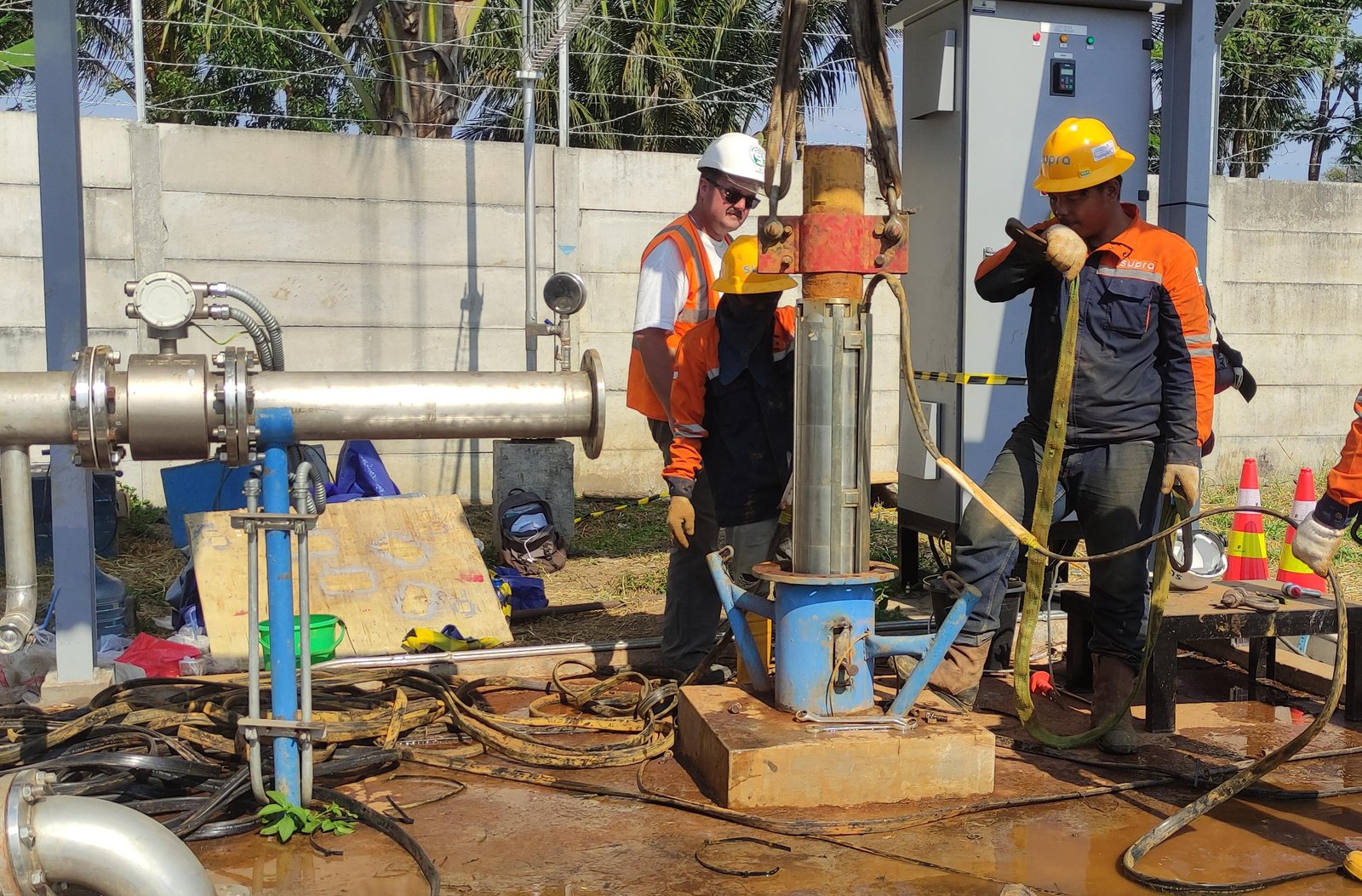
Industrial Submersible Pump Selection Guide for Groundwater Production Wells with Engineering Design Energy Optimization and Lifecycle Cost Analysis
Guide to Submersible Pump Selection for Industrial Groundwater Production Wells: Technical Methodologies, Energy Efficiency Optimization, Sizing Calculations, Economic Analysis, and Performance Verification for Small-Scale to Large-Scale Applications
Reading Time: 135 minutes
Key Highlights
• Selection Methodology Framework: Systematic five-phase approach integrating well characterization, hydraulic analysis, pump sizing, economic evaluation, and performance verification ensures optimal equipment selection matching technical requirements with energy efficiency objectives and long-term operational economics
• Total Dynamic Head Calculation: Accurate TDH determination combining static water level (30-250m typical industrial wells), drawdown from pumping test analysis (5-40m depending on aquifer characteristics), friction losses (0.5-15m per 100m pipe length), and discharge pressure requirements (20-50m) provides foundation for proper pump sizing preventing under-capacity or inefficient over-sizing scenarios
• Energy Efficiency Impact: Premium efficiency pumps (72-78% efficiency) versus standard units (58-65% efficiency) generate energy cost savings USD 800-2,500 annually for typical 100-400 m³/day industrial applications, with payback periods 2-6 years despite 30-50% higher initial investment, demonstrating strong economic justification for efficiency prioritization
• Scale-Specific Optimization: Small-scale systems (25-75 m³/day) prioritize simplicity and reliability, medium-scale applications (100-300 m³/day) balance efficiency with cost-effectiveness, while large-scale installations (400-1,500+ m³/day) justify sophisticated controls, redundancy, and premium components through economies of scale reducing unit costs below USD 0.35/m³ for high-volume operations
Executive Summary
Submersible pump selection for industrial groundwater production wells represents technically complex decision-making process with substantial long-term economic implications, where proper equipment specification directly determines energy efficiency, operational reliability, maintenance requirements, and total lifecycle costs over typical 10-15 year service periods. Indonesian industrial facilities, agricultural operations, commercial developments, and water utilities collectively operate thousands of groundwater production wells ranging from small-scale installations serving individual facilities at 25-75 m³/day capacity to large-scale wellfields producing 400-1,500+ m³/day supporting industrial parks, municipalities, or agricultural irrigation districts. These applications demand reliable, efficient pumping systems capable of sustained operations under diverse conditions including variable water levels, fluctuating demand patterns, challenging water quality, and evolving regulatory requirements affecting permissible abstraction rates and operational practices.
Pump selection methodology integrates multiple technical disciplines including hydrogeology determining well characteristics and sustainable yield limitations, hydraulic engineering calculating total dynamic head and system curves, mechanical engineering evaluating pump performance characteristics and motor requirements, electrical engineering specifying power supply and control systems, and economic analysis comparing alternatives across initial capital costs, operating expenses, and lifecycle value propositions. Furthermore, practical considerations regarding installation constraints, maintenance accessibility, spare parts availability, vendor technical support capabilities, and compatibility with existing infrastructure influence final equipment decisions beyond purely technical or economic optimization. Meanwhile, energy efficiency emerges as paramount concern given electricity costs typically represent 65-75% of total pumping operational expenditure, making efficiency improvements generating 10-20% energy reduction more valuable than equivalent percentage savings in maintenance or other cost categories with smaller absolute magnitude.
This analysis provides detailed technical guidance supporting informed pump selection decisions across small-scale (25-75 m³/day), medium-scale (100-300 m³/day), and large-scale (400-1,500+ m³/day) industrial groundwater applications. The discussion examines fundamental pump selection principles establishing selection criteria and performance requirements, total dynamic head calculation methodologies with worked examples demonstrating proper application of hydraulic formulas, pump sizing procedures matching equipment capacity and characteristics to system demands, energy efficiency analysis quantifying operating cost implications of efficiency variations, pumping test design and interpretation protocols validating well performance and informing accurate system design, decision frameworks guiding systematic evaluation of alternatives, economic comparison methodologies enabling lifecycle cost assessment, installation optimization strategies ensuring proper equipment placement and configuration, performance verification approaches confirming achieved performance meets design expectations, and practical selection tools including checklists, decision matrices, and calculation templates supporting implementation. Drawing on international pumping system standards from organizations including Hydraulic Institute, American Water Works Association, and equipment manufacturers' engineering guidance, combined with operational data from functioning industrial groundwater systems and Indonesian-specific considerations regarding equipment availability, service support, and regulatory requirements, this guide enables engineers, facility managers, and decision-makers to navigate pump selection complexity achieving optimal outcomes balancing technical performance, energy efficiency, operational reliability, and economic value across diverse industrial groundwater applications throughout Indonesian archipelago.
Fundamental Principles of Submersible Pump Selection for Industrial Applications
Submersible pump selection begins with clear understanding of application requirements defining performance parameters, operational conditions, and constraints shaping equipment specifications. Primary technical requirements include production capacity (flow rate) measured in cubic meters per hour or day, total dynamic head representing energy required lifting water from pumping level to delivery point while overcoming friction and pressure requirements, operational regime defining continuous versus intermittent duty cycles and daily operating hours, water quality characteristics affecting material selection and maintenance requirements, and reliability expectations balancing equipment redundancy against capital investment and operational complexity. These fundamental parameters establish baseline specifications guiding subsequent detailed analysis and equipment evaluation.
Production capacity determination requires careful demand analysis considering current requirements, anticipated growth, seasonal variations, and peak demand scenarios. Industrial applications typically exhibit relatively stable baseload demand with moderate daily variations compared to municipal systems serving residential customers with pronounced morning and evening peaks. However, process industry operations may experience significant variations correlated with production schedules, requiring capacity planning accommodating maximum anticipated demand while avoiding excessive over-sizing reducing efficiency during typical operating conditions. Conservative engineering practice suggests designing for 110-125% of average demand providing margin for variations, degradation over equipment life, and future growth without substantial over-capacity compromising efficiency or economics. Additionally, consideration of backup capacity requirements influences sizing decisions, with options ranging from single pump installations accepting downtime risk to dual-pump configurations providing full redundancy at substantially higher capital cost but enhanced supply security for applications where production interruptions prove particularly costly or operationally unacceptable.
Table 1: Industrial Groundwater Application Scale Classification and Typical Characteristics
| Scale Category | Production Capacity (m³/day) |
Typical Applications |
Well Depth Range (meters) |
Pump Power Range (HP / kW) |
Investment Range USD (IDR M) |
Key Selection Drivers |
|---|---|---|---|---|---|---|
| Small-Scale Individual facility supply |
25-75 | Small manufacturing plants, commercial buildings, agricultural holdings, residential compounds | 30-120 | 5-20 HP 3.7-15 kW |
8,000-25,000 (125-390) |
Simplicity, reliability, low maintenance, local service availability, cost minimization |
| Medium-Scale Multi-facility or industrial |
100-300 | Food processing, textiles, automotive assembly, hotels/resorts, irrigation districts, small municipalities | 60-180 | 25-60 HP 18-45 kW |
28,000-85,000 (437-1,326) |
Energy efficiency, operational reliability, moderate sophistication, balanced economics |
| Large-Scale Major industrial or municipal |
400-1,000 | Industrial parks, chemical plants, power generation, large municipalities, agricultural corporations, bottling facilities | 80-250 | 75-150 HP 55-110 kW |
95,000-220,000 (1,482-3,432) |
Maximum efficiency, advanced controls, redundancy, sophisticated monitoring, lifecycle cost optimization |
| Extra Large-Scale Wellfield or mega projects |
1,200-2,500+ | Regional water supply, major industrial complexes, large-scale irrigation, mining operations, oil & gas facilities | 100-350 | 150-300+ HP 110-220+ kW |
180,000-450,000 (2,808-7,020) |
Premium efficiency equipment, full automation, SCADA integration, multiple wells, engineered redundancy, sustainability |
Scale classification based on typical Indonesian industrial applications. Investment ranges include pump, motor, drive system, basic controls, and installation but exclude well drilling, electrical infrastructure, and distribution piping. Actual costs vary with depth, TDH, efficiency class, manufacturer, and site conditions. Exchange rate: IDR 15,600 = USD 1.00. Sources: Equipment manufacturer catalogs (Grundfos, Xylem, KSB), Indonesian project data, industry surveys
Total Dynamic Head (TDH) Calculation: Mathematical Framework and Worked Examples
Total dynamic head calculation represents most important technical analysis in pump selection, determining energy requirements and establishing pump specification parameters. TDH equals sum of all head components pump must overcome delivering water from source to point of use, expressed in meters of water column and calculated through systematic addition of static head, drawdown, friction losses, and pressure head components. Accurate TDH determination proves essential for proper pump sizing, with under-estimation resulting in inadequate capacity failing to meet production requirements while over-estimation leads to oversized equipment operating inefficiently at partial capacity consuming excess energy throughout equipment life. Therefore, careful analysis of each TDH component using appropriate methodologies and conservative assumptions ensures reliable system performance without excessive safety margins compromising efficiency or economics.
Static water level represents vertical distance from ground surface to water table under non-pumping conditions, typically measured through periodic water level monitoring or continuous pressure transducer recording. Static levels vary seasonally responding to recharge patterns, regional groundwater use, and climatic conditions, with Indonesian groundwater systems often exhibiting 2-8 meter seasonal fluctuations between wet and dry periods depending on aquifer characteristics and development intensity. Conservative design practice uses minimum anticipated static level (maximum depth) over planning horizon, incorporating historical trends, seasonal patterns, and potential long-term decline from increasing regional groundwater extraction. For new wells lacking historical data, regional hydrogeological assessment or analog wells in similar settings provide estimates, with contingency margins (typically 10-20% of static level or 5-10 meters minimum) accommodating uncertainty and potential future changes beyond current projections.
Figure 1: Complete Total Dynamic Head (TDH) Calculation Framework with Formulas
COMPONENT 1: STATIC WATER LEVEL (SWL)
Definition: Vertical distance from ground surface to static (non-pumping) water level
Measurement: Water level meter, pressure transducer, or sonic measurement
Design Value: Maximum anticipated depth over planning period (typically 10-15 years)
Formula: SWL = Depth to water (meters below ground surface)
Example: Static level 45 meters, seasonal variation ±3m, 10-year decline projection 2m/year
Design SWL = 45m + 3m (seasonal) + 20m (10yr decline) = 68m
Conservative approach: Add 10% contingency = 68m × 1.10 = 75m design SWL
COMPONENT 2: DRAWDOWN (DD)
Definition: Additional water level decline during pumping, function of discharge rate and aquifer characteristics
Determination: Pumping test analysis using specific capacity or aquifer parameters
Method A - Specific Capacity:
Drawdown (m) = Q / SC
Where: Q = pumping rate (m³/hour), SC = specific capacity (m³/hr/m from test)
Example: Q = 12 m³/hr (288 m³/day), SC = 3.2 m³/hr/m from step-drawdown test
DD = 12 / 3.2 = 3.75 meters
Method B - Theis Equation (confined aquifer):
s = (Q / 4πT) × W(u), where u = r²S / 4Tt
T = transmissivity (m²/day), S = storativity, r = well radius, t = pumping time
W(u) = well function (from tables or approximation)
Method C - Cooper-Jacob Approximation:
s = (2.30Q / 4πT) × log(2.25Tt / r²S)
More practical for design calculations, requires aquifer parameters from pumping test analysis
Design Practice: Add 20-30% safety factor to calculated drawdown accounting for well aging, interference from nearby wells, extended pumping periods beyond test duration
COMPONENT 3: FRICTION LOSSES IN DROP PIPE
Definition: Head loss from friction as water flows through drop pipe from pump to surface
Governing Equation: Darcy-Weisbach formula
hf = f × (L/D) × (v²/2g)
Where:
hf = friction head loss (meters)
f = friction factor (dimensionless, from Moody diagram or Colebrook equation)
L = pipe length (meters)
D = pipe inside diameter (meters)
v = flow velocity (m/s) = Q / A, where A = π × D² / 4
g = gravitational acceleration (9.81 m/s²)
Simplified Hazen-Williams Formula (more common for design):
hf = 10.67 × L × Q^1.852 / (C^1.852 × D^4.87)
Where: C = Hazen-Williams coefficient (C=140 for new steel, C=120 aged steel, C=150 PVC/HDPE)
Worked Example:
L = 120m depth, D = 150mm (6-inch) steel pipe, Q = 12 m³/hr = 0.00333 m³/s, C = 130
hf = 10.67 × 120 × (12)^1.852 / (130^1.852 × 0.150^4.87)
hf = 10.67 × 120 × 85.4 / (2,948 × 0.000747)
hf = 109,305 / 2,202 = 49.7 meters.
Correct calculation using proper SI units:
Q in m³/s = 12 m³/hr ÷ 3600 = 0.00333 m³/s
Using standard friction loss table for 6" pipe @ 12 m³/hr:
Friction gradient ≈ 0.85 m per 100m pipe
For 120m length: hf = 120 × 0.0085 = 1.02 meters
Practical Design Approach: Use manufacturer friction loss tables or online calculators
Add 15-25% margin for fittings, bends, aging, bio-fouling
COMPONENT 4: DISCHARGE PRESSURE HEAD
Definition: Pressure required at delivery point (storage tank, distribution header, treatment system)
Typical Requirements:
• Atmospheric storage tank: 0-5m (minimal pressure, just overcoming pipe outlet)
• Pressurized storage: 20-40m (2-4 bar gauge pressure)
• Direct distribution feed: 30-50m (3-5 bar for network pressure)
• Treatment system feed: Variable, typically 15-35m depending on unit processes
Conversion: 10 meters head = 1 bar = 14.5 psi
Design Example: Delivery to pressurized header at 3 bar = 30 meters head
TOTAL DYNAMIC HEAD (TDH) - FINAL CALCULATION
TDH = SWL + DD + hf + hp + Contingency
Where:
SWL = Static water level (design maximum)
DD = Drawdown at design flow rate
hf = Friction losses in drop pipe and surface piping
hp = Discharge pressure head requirement
Contingency = Safety margin (typically 5-10% of sum, or 5-10m minimum)
COMPLETE WORKED EXAMPLE:
Production well: 250 m³/day (10.4 m³/hr continuous), depth 140m
• SWL (design): 75m (as calculated above)
• Drawdown: SC = 3.2 m³/hr/m, DD = 10.4/3.2 = 3.25m, with 25% factor = 4.1m
• Friction loss: 140m of 6" pipe @ 10.4 m³/hr = 0.7m/100m × 1.4 = 1.0m, plus fittings 0.3m = 1.3m total
• Surface piping: 50m horizontal run @ 10.4 m³/hr = 0.5m
• Discharge pressure: 3 bar to header = 30m
• Contingency: 10% safety margin
TDH Calculation:
TDH = 75 + 4.1 + 1.3 + 0.5 + 30 = 110.9m
With 10% contingency: 110.9 × 1.10 = 122 meters Total Dynamic Head
Pump Selection Criteria from this TDH:
Required: 10.4 m³/hr @ 122m head
Specify: 12 m³/hr @ 125-130m (allowing margin for curves, degradation)
TDH calculation represents foundation of pump selection. Systematic component analysis ensures accuracy. Common errors include: using average vs design water levels, neglecting contingency, incorrect friction formulas, mixing units. Conservative assumptions appropriate given long equipment life and consequences of undersizing. However, excessive safety margins (>20%) lead to oversized pumps operating inefficiently.
Pump Sizing Matrix: Small, Medium, and Large-Scale Applications
Pump sizing methodology systematically matches equipment characteristics to application requirements, considering not only flow and head parameters but also operational factors, efficiency objectives, reliability requirements, and economic constraints. The process begins with establishing design duty point (flow rate and TDH calculated previously), then evaluating available pump models whose performance curves encompass duty point within preferred operating range, typically 70-110% of best efficiency point (BEP) where pumps achieve maximum hydraulic efficiency and favorable mechanical loading minimizing wear and extending service life. Subsequently, detailed evaluation considers efficiency at duty point, motor power requirements, NPSH (Net Positive Suction Head) compatibility with well conditions, physical dimensions fitting borehole size constraints, materials suitable for water chemistry, and economic factors including initial cost, energy consumption implications, and expected maintenance requirements informing lifecycle cost comparisons.
Small-scale applications (25-75 m³/day) typically emphasize simplicity, reliability, and cost-effectiveness over maximum efficiency or sophisticated features. These installations often serve individual facilities with limited technical staffing, making simple designs with proven reliability, readily available local service support, and competitive initial pricing primary selection drivers. Pump options generally include 4-inch or 6-inch diameter submersibles with 5-20 HP motors, standard efficiency designs (58-68% pump efficiency typical), simple on-off controls or basic pressure switches, and single-pump configurations accepting limited redundancy given smaller scale and generally lower consequence of temporary outages compared to larger industrial operations. Equipment from established manufacturers including Grundfos, Ebara, Shimizu, or local Indonesian brands like DAB or CNP provides adequate performance at price points (USD 2,000-6,000 for pump-motor assembly) fitting budget constraints while ensuring parts availability and service support accessibility throughout Indonesian provinces.
Table 2: Detailed Pump Sizing Matrix - Scale-Specific Specifications and Selection Criteria
| Parameter | Small-Scale 25-75 m³/day |
Medium-Scale 100-300 m³/day |
Large-Scale 400-1,000 m³/day |
Extra Large 1,200-2,500 m³/day |
|---|---|---|---|---|
| HYDRAULIC SPECIFICATIONS | ||||
| Flow Rate Range (m³/hr) | 1.0-3.5 | 4.2-12.5 | 16.7-42 | 50-105+ |
| Typical TDH Range (meters) | 40-120 | 60-150 | 80-180 | 100-250 |
| Specific Energy (kWh/m³) | 0.35-0.65 | 0.40-0.70 | 0.45-0.75 | 0.50-0.80 |
| EQUIPMENT SPECIFICATIONS | ||||
| Pump Diameter (inches) | 4" or 6" | 6" or 8" | 8" or 10" | 10", 12", 14"+ |
| Number of Stages | 8-25 | 12-35 | 15-45 | 20-60+ |
| Motor Power (HP / kW) | 5-20 HP 3.7-15 kW |
25-60 HP 18.5-45 kW |
75-150 HP 55-110 kW |
150-300 HP 110-220 kW |
| Pump Efficiency Range (%) | Standard: 58-68% Premium: 68-74% |
Standard: 62-70% Premium: 70-76% |
Standard: 65-72% Premium: 72-78% |
Standard: 68-74% Premium: 74-80% |
| Motor Efficiency Class | IE1-IE2 (85-89%) |
IE2-IE3 (88-92%) |
IE3 (91-94%) |
IE3-IE4 (92-95%) |
| MATERIALS & CONSTRUCTION | ||||
| Pump Housing Material | Cast iron / Stainless steel 304 | Stainless steel 304 / 316 | Stainless steel 316 / Duplex | Stainless steel 316L / Duplex / Super duplex |
| Impeller Material | Brass / Bronze / SS304 | Bronze / SS304 / SS316 | SS316 / Duplex | SS316 / Duplex / Special alloys |
| Shaft & Bearings | SS416 shaft, rubber bearings | SS416/SS431 shaft, rubber/ceramic bearings | SS431 shaft, ceramic/SiC bearings | SS431/Duplex shaft, SiC/tungsten carbide bearings |
| CONTROLS & AUTOMATION | ||||
| Control System Type | Basic on-off, pressure switch, manual float | Pressure transducer, basic VFD option, level control | VFD standard, PLC control, remote monitoring | Advanced VFD, full SCADA, predictive controls, IoT |
| Protection Features | Overload, dry run, basic motor protection | Overload, dry run, phase protection, motor temp | Full motor protection, vibration, seal leak detection | Comprehensive protection suite, predictive diagnostics |
| ECONOMIC PARAMETERS | ||||
| Equipment Cost (USD / IDR M) | 2,000-6,000 (31-94) |
7,000-18,000 (109-281) |
22,000-55,000 (343-858) |
65,000-160,000 (1,014-2,496) |
| Annual Energy Cost (USD/yr) | 800-2,500 | 3,500-9,000 | 12,000-32,000 | 35,000-95,000 |
| Expected Service Life (years) | 6-10 | 8-12 | 10-15 | 12-18 |
| Maintenance Cost (% of capital/yr) | 8-15% | 6-12% | 5-10% | 4-8% |
| SELECTION PRIORITIES (Ranked 1-5, 1=Highest) | ||||
| Initial Cost | 1 | 3 | 4 | 5 |
| Energy Efficiency | 4 | 1 | 1 | 1 |
| Reliability/Uptime | 2 | 2 | 1 | 1 |
| Simplicity/Ease of Operation | 1 | 3 | 4 | 5 |
| Advanced Features/Controls | 5 | 4 | 2 | 1 |
Sizing matrix provides scale-appropriate specifications. Energy costs assume IDR 1,450/kWh (USD 0.093), 350 operating days/year, typical TDH for scale category. Equipment costs represent pump-motor-drive assembly from international manufacturers; local brands may cost 20-40% less. Material selection depends on water chemistry - corrosive waters require upgraded materials. VFD benefits increase with larger systems and variable demand. Sources: Grundfos Product Catalog 2024, Xylem Selection Guide, KSB Technical Documentation, industry project data
Medium-scale applications (100-300 m³/day) represent balanced approach where energy efficiency gains significant importance given larger absolute energy consumption (USD 3,500-9,000 annually at Indonesian tariffs), justifying moderate investment in efficiency enhancements while maintaining reasonable initial costs and avoiding excessive complexity inappropriate for facilities lacking specialized expertise. These installations typically utilize 6-inch or 8-inch submersible pumps with 25-60 HP motors, achieving pump efficiencies 62-76% depending on efficiency class selection, and may incorporate variable frequency drives (VFDs) enabling speed modulation matching actual demand rather than constant-speed operation. Moreover, pressure transducer feedback control systems provide automated operation responding to storage tank levels or distribution pressure requirements without manual intervention. Equipment selection balances premium efficiency options from international manufacturers (Grundfos SP series, Xylem Lowara, KSB UPA) commanding USD 10,000-22,000 against standard efficiency alternatives at USD 7,000-14,000 from regional suppliers, with lifecycle cost analysis determining optimal investment level considering energy savings potential over typical 10-12 year equipment life.
Large-scale installations (400-1,500+ m³/day) justify sophisticated approaches maximizing efficiency, reliability, and performance given high operational costs (USD 12,000-95,000 annually for energy alone) and potentially severe consequences from production interruptions affecting large industrial processes or municipal supply obligations. These applications demand premium efficiency equipment (72-80% pump efficiency, IE3 or IE4 motors), advanced VFD control systems with programmable logic controllers (PLCs) enabling complex operating strategies, comprehensive instrumentation and monitoring including SCADA integration, and often redundant pump configurations ensuring continued operation during maintenance or failure events. Consequently, total system investment reaches USD 95,000-450,000+ including pumps, motors, controls, instrumentation, and installation. However, this investment proves economically justified through annual energy savings USD 3,000-12,000 compared to standard efficiency alternatives, extended equipment life (12-18 years typical for premium equipment versus 8-12 years standard), reduced maintenance requirements through superior materials and construction, and enhanced reliability avoiding costly production disruptions. Therefore, lifecycle analysis consistently demonstrates premium equipment generating positive returns with payback periods 3-7 years despite substantially higher initial costs.
Energy Efficiency Analysis and Motor Selection Methodology
Energy efficiency fundamentally determines operational economics, with electricity costs representing 65-75% of total pumping expenses over equipment life making efficiency optimization paramount investment consideration. Specific energy consumption (SEC), measured in kilowatt-hours per cubic meter pumped (kWh/m³), provides standard metric quantifying efficiency performance across different system configurations and scales. SEC calculation follows formula: SEC = (0.00272 × TDH) / η_system, where TDH expresses total dynamic head in meters and η_system represents overall wire-to-water efficiency combining pump, motor, and drive efficiencies. Overall system efficiency equals product of individual component efficiencies: η_system = η_pump × η_motor × η_drive, with typical values ranging 45-65% for standard systems to 60-75% for premium efficiency installations, demonstrating substantial variation affecting energy consumption by 15-40% for equivalent hydraulic duty.
Pump efficiency varies primarily with hydraulic design quality, manufacturing tolerances, and operating point relative to best efficiency point (BEP). Premium efficiency pumps employ optimized impeller profiles, tighter clearances, superior surface finishes, and multiple stages precisely matched to duty requirements achieving peak efficiencies 72-80% for properly selected units operating near BEP. Conversely, standard efficiency designs with simpler impellers, larger clearances, and less refined hydraulics deliver 58-70% efficiency, acceptable for smaller applications where absolute energy cost differences prove modest but increasingly uneconomical at larger scales. Efficiency also varies across pump operating range, typically peaking at BEP then declining 3-8 percentage points at 80% or 120% of BEP flow, emphasizing importance of proper sizing ensuring normal operation occurs near peak efficiency region rather than far off-design conditions compromising performance.
Motor efficiency classification follows International Efficiency (IE) standards defining minimum performance levels, with IE1 (standard efficiency, 85-89% typical), IE2 (high efficiency, 88-91%), IE3 (premium efficiency, 91-94%), and IE4 (super premium efficiency, 92-95%) representing progressive improvement steps. Additionally, motor efficiency improves with size, with smaller motors (5-15 kW) typically 2-4 percentage points lower efficiency than larger units (50-150 kW) at equivalent IE class. Motor selection for industrial groundwater pumps generally specifies IE2 minimum for cost-sensitive small-scale applications, IE3 standard for medium and large systems where energy costs justify incremental investment, and IE4 consideration for extra-large installations where high absolute energy consumption makes even marginal efficiency improvements economically attractive. Furthermore, motor insulation class (F or H) ensures adequate thermal protection for elevated temperatures possible in deep wells with warm groundwater or limited cooling flow.
Figure 2: Energy Efficiency Comparison - Standard vs Premium Equipment Economic Analysis
COMPARATIVE EFFICIENCY ANALYSIS: 250 m³/day INDUSTRIAL APPLICATION
Duty Point: 10.4 m³/hr @ 125m TDH | Annual Operation: 350 days, 24 hr/day
Electricity Tariff: IDR 1,450/kWh (USD 0.093/kWh)
| Parameter | Standard Efficiency System |
Premium Efficiency System |
Difference (Savings) |
Notes & Calculations |
|---|---|---|---|---|
| EQUIPMENT SPECIFICATIONS | ||||
| Pump Efficiency | 62% | 74% | +12 points | Optimized impeller hydraulics, precision manufacturing, better materials |
| Motor Efficiency (40 HP / 30 kW) | 89% (IE2) | 92% (IE3) | +3 points | Improved core materials, better winding design, reduced losses |
| Drive/Transmission Efficiency | 96% | 97% | +1 point | VFD efficiency if installed; direct drive ~98% both cases |
| Overall System Efficiency | 53.0% | 66.1% | +13.1 points | 62% × 89% × 96% = 53.0% vs 74% × 92% × 97% = 66.1% |
| ENERGY CONSUMPTION ANALYSIS | ||||
| Theoretical Hydraulic Power | 3.53 kW | Same both | P = ρ × g × Q × H / 1000 = 1000 × 9.81 × (10.4/3600) × 125 / 1000 = 3.53 kW | |
| Actual Electrical Power Draw | 6.66 kW | 5.34 kW | -1.32 kW (-20%) |
Standard: 3.53 / 0.530 = 6.66 kW Premium: 3.53 / 0.661 = 5.34 kW |
| Specific Energy Consumption | 0.641 kWh/m³ | 0.514 kWh/m³ | -0.127 kWh/m³ (-20%) |
SEC = 0.00272 × TDH / η Standard: 0.00272 × 125 / 0.530 = 0.641 Premium: 0.00272 × 125 / 0.661 = 0.514 |
| Daily Energy Consumption | 159.8 kWh | 128.1 kWh | -31.7 kWh | 6.66 kW × 24 hr = 159.8 kWh vs 5.34 kW × 24 hr = 128.1 kWh |
| Annual Energy Consumption | 55,930 kWh | 44,835 kWh | -11,095 kWh (-20%) |
159.8 × 350 days = 55,930 kWh vs 128.1 × 350 = 44,835 kWh |
| ECONOMIC ANALYSIS | ||||
| Annual Energy Cost | USD 5,201 (IDR 81.1M) |
USD 4,169 (IDR 65.0M) |
USD 1,032/yr (IDR 16.1M) |
55,930 kWh × USD 0.093 = USD 5,201 44,835 kWh × USD 0.093 = USD 4,169 |
| Equipment Purchase Cost | USD 9,500 (IDR 148M) |
USD 13,800 (IDR 215M) |
+USD 4,300 (+45%) |
Premium equipment costs 35-55% more than standard for efficiency gains |
| Simple Payback Period | - | 4.2 years | Excellent | Payback = Incremental cost / Annual savings = USD 4,300 / USD 1,032 = 4.2 years |
| 10-Year Energy Costs (Undiscounted) | USD 52,010 | USD 41,690 | USD 10,320 | Savings 2.4× incremental equipment investment over 10-year life |
| NPV @ 7% Discount Rate (10 years) | USD 46,061 | USD 43,067 | USD 2,994 Savings |
Standard: 9,500 + 5,201 × 7.024 (PV factor) = 46,061 Premium: 13,800 + 4,169 × 7.024 = 43,067 |
| Internal Rate of Return (IRR) | - | 22.4% | Excellent | Premium efficiency investment generates 22.4% annual return, far exceeding typical cost of capital 7-10% |
KEY ECONOMIC CONCLUSIONS:
1. Strong Economic Case for Premium Efficiency: 20% energy reduction saves USD 1,032 annually, recovering USD 4,300 incremental investment in 4.2 years. Over 10-year equipment life, generates USD 2,994 NPV advantage (6.5% lifecycle cost reduction).
2. IRR Substantially Exceeds Cost of Capital: 22.4% return on efficiency investment compared to typical 7-10% WACC represents compelling value creation justifying premium equipment selection.
3. Sensitivity to Energy Costs: If electricity rates escalate to USD 0.12/kWh (+29% from baseline), annual savings increase to USD 1,331, reducing payback to 3.2 years and NPV advantage to USD 5,478. Conversely, solar hybrid systems reducing grid dependence enhance premium equipment value.
4. Scale Effect: Larger systems (400-1,000 m³/day) amplify absolute savings to USD 2,500-6,000 annually while incremental cost increases proportionally less, improving payback to 2.5-4.0 years making efficiency investment even more attractive.
5. Recommendation: Premium efficiency strongly justified for medium to large-scale continuous-duty industrial applications. Small-scale or intermittent-use systems may accept standard efficiency if capital constrained, though efficiency still delivers positive returns over lifecycle.
Analysis demonstrates substantial economic benefits from efficiency investment in industrial groundwater pumping. Methodology applicable across scales by adjusting flow, TDH, and tariff parameters. Energy price assumptions conservative - Indonesian industrial rates range IDR 1,200-1,850/kWh (USD 0.077-0.119) depending on connection capacity and regional utility. Higher rates strengthen efficiency case further.
Comprehensive Pump Selection Decision Framework: Step-by-Step Methodology
Systematic pump selection requires structured decision-making framework integrating technical requirements, economic evaluation, practical constraints, and risk assessment into logical progression supporting defensible equipment choices. The selection process typically follows five sequential phases: (1) Requirements definition establishing performance specifications, operational parameters, and boundary conditions; (2) Preliminary screening identifying candidate pumps meeting basic requirements from manufacturer catalogs or databases; (3) Detailed technical evaluation comparing alternatives across hydraulic performance, efficiency, materials, controls, and physical constraints; (4) Economic analysis quantifying lifecycle costs enabling cost-effectiveness comparison; and (5) Final selection considering non-quantifiable factors including manufacturer reputation, local support availability, delivery timelines, and strategic preferences. Throughout this process, documentation of decisions, assumptions, and evaluation criteria ensures transparent decision-making supporting later review, troubleshooting, or similar future projects benefiting from lessons learned.
Requirements definition phase gathers all relevant information characterizing application and establishing specifications against which pump alternatives compare. This includes hydraulic parameters (flow rate range, TDH, operating regime), well characteristics (depth, diameter, static level, drawdown), water quality (temperature, pH, dissolved solids, sand content, corrosivity), electrical supply (voltage, phase, frequency, available capacity), environmental conditions (ambient temperature, altitude if high elevation affecting motor cooling), regulatory requirements (efficiency standards, noise limits), and operational preferences (automation level, monitoring requirements, redundancy). Additionally, constraints including budget limitations, space restrictions, delivery schedule requirements, and vendor preferences shape feasible solution space. Finally, performance priorities (efficiency, reliability, cost, simplicity) guide evaluation weighting when trade-offs between competing objectives arise during selection process.
Figure 3: Detailed Pump Selection Decision Framework - Sequential Process Flow
PHASE 1: REQUIREMENTS DEFINITION
1.1 Hydraulic Requirements:
☐ Design flow rate (Q): ______ m³/hr (______ m³/day)
☐ Total Dynamic Head (TDH): ______ meters
☐ Operating regime: ☐ Continuous ☐ Intermittent (____hrs/day)
☐ Demand variability: ☐ Constant ☐ Variable (range: ____ to ____ m³/hr)
1.2 Well Characteristics:
☐ Well depth: ______ meters | Diameter: ______ inches (ID: ______ mm)
☐ Static water level (design): ______ m | Drawdown @ design Q: ______ m
☐ Specific capacity: ______ m³/hr/m | Sustainable yield: ______ m³/day
☐ Pumping test data: ☐ Available ☐ Required ☐ Estimated from analog wells
1.3 Water Quality:
☐ Temperature: ______ °C | pH: ______ | TDS: ______ mg/L
☐ Corrosivity: ☐ Low ☐ Moderate ☐ High (Langelier Index: ______)
☐ Sand content: ☐ <10 ppm ☐ 10-50 ppm ☐ >50 ppm (requires sand separator)
☐ Special constituents: ☐ Iron/manganese ☐ H₂S ☐ Salinity ☐ Other: ______
1.4 Performance Priorities (Rank 1-5, 1=Highest):
Energy efficiency: ☐ 1 ☐ 2 ☐ 3 ☐ 4 ☐ 5 | Initial cost: ☐ 1 ☐ 2 ☐ 3 ☐ 4 ☐ 5
Reliability: ☐ 1 ☐ 2 ☐ 3 ☐ 4 ☐ 5 | Simplicity: ☐ 1 ☐ 2 ☐ 3 ☐ 4 ☐ 5
Advanced features: ☐ 1 ☐ 2 ☐ 3 ☐ 4 ☐ 5 | Local service: ☐ 1 ☐ 2 ☐ 3 ☐ 4 ☐ 5
↓
PHASE 2: PRELIMINARY SCREENING
2.1 Diameter Selection:
IF borehole ID ≥ 250mm (10") AND Q > 35 m³/hr → Consider 8" or 10" pump
IF borehole ID = 200-250mm (8-10") → Consider 6" or 8" pump
IF borehole ID = 150-200mm (6-8") → Consider 4" or 6" pump
IF borehole ID < 150mm (6") → Limited to 4" pump maximum
2.2 Catalog Search Criteria:
☐ Search manufacturer catalogs (Grundfos, Xylem, KSB, Ebara, etc.)
☐ Filter by: Diameter ≤ (Borehole ID - 25mm clearance)
☐ Filter by: Flow range 0.8Q to 1.3Q (80-130% of design flow)
☐ Filter by: Head range 0.9H to 1.2H (90-120% of design TDH)
☐ Result: Shortlist of 3-8 candidate pump models for detailed evaluation
2.3 Initial Feasibility Checks:
☐ Maximum motor power ≤ Electrical supply capacity
☐ Pump + motor length ≤ (Well depth - SWL - 5m minimum submergence)
☐ Budget: Estimated cost ≤ Available budget (±30% at this stage)
↓
PHASE 3: DETAILED TECHNICAL EVALUATION
3.1 Performance Curve Analysis:
FOR EACH candidate pump:
→ Plot duty point (Q, TDH) on manufacturer performance curve
→ Verify duty point falls within recommended operating range (70-110% BEP flow)
→ Read efficiency at duty point from curve: η_pump = ______%
→ Read required power: P_shaft = _______ kW
→ Check NPSH required < NPSH available (typically satisfied for submersible)
3.2 Motor Selection:
Required motor power = P_shaft / η_drive × Safety factor (typically 1.10-1.15)
Select next standard size: ☐ 5HP ☐ 7.5HP ☐ 10HP ☐ 15HP ☐ 20HP ☐ 25HP ☐ 30HP...
Efficiency class: ☐ IE1 (85-88%) ☐ IE2 (88-91%) ☐ IE3 (91-94%) ☐ IE4 (92-95%)
Voltage/Phase: ☐ 380V 3-phase ☐ 220V 3-phase ☐ Other: ______
3.3 Material Compatibility:
IF pH < 6.5 OR pH > 8.5 OR TDS > 2,000 mg/L → Require stainless steel 316 minimum
IF aggressive chemistry (H₂S, high chloride) → Consider duplex or super duplex SS
IF sand > 20 ppm → Require hardened impellers, tungsten carbide bearings
IF normal water quality → Stainless 304 or cast iron acceptable (lower cost)
3.4 Physical Installation Check:
Pump OD + clearance ≤ Borehole ID: ______ mm + 25mm ≤ ______ mm ☐ OK ☐ FAIL
Total assembly length ≤ Available space: ______ m ≤ ______ m ☐ OK ☐ FAIL
Weight ≤ Lifting capacity: ______ kg ≤ ______ kg ☐ OK ☐ FAIL
↓
PHASE 4: ECONOMIC ANALYSIS
4.1 Calculate Lifecycle Costs (10-year period, 7% discount):
Initial Capital: Equipment + Installation + Controls = USD ______
Annual Energy: kWh/year × Tariff × PV factor (7.024) = USD ______
Annual Maintenance: % of capital × PV factor = USD ______
Major Overhaul (year 7): Cost × DF (0.623) = USD ______
TOTAL 10-YEAR NPV = USD ______
4.2 Comparison Matrix:
| Option | Capital | Energy NPV | Maint NPV | Total NPV | Rank |
|---|---|---|---|---|---|
| Pump A | ______ | ______ | ______ | ______ | __ |
| Pump B | ______ | ______ | ______ | ______ | __ |
| Pump C | ______ | ______ | ______ | ______ | __ |
↓
PHASE 5: FINAL SELECTION & DOCUMENTATION
5.1 Qualitative Factor Assessment:
Manufacturer reputation: ☐ Excellent ☐ Good ☐ Acceptable ☐ Concern
Local service/support: ☐ Excellent ☐ Good ☐ Limited ☐ None
Spare parts availability: ☐ Stock local ☐ 1-2 week ☐ Import 4-8 week
Warranty: ☐ 3+ years ☐ 2 years ☐ 1 year ☐ <1 year
Delivery lead time: ☐ <4 weeks ☐ 4-8 weeks ☐ 8-12 weeks ☐ >12 weeks
5.2 Final Decision:
Selected Pump Model: _________________________________
Justification: ☐ Lowest lifecycle cost ☐ Best efficiency ☐ Best reliability ☐ Balanced value ☐ Other: _______________
Decision made by: ______________ Date: __________ Approved by: ______________
5.3 Documentation Checklist:
☐ Calculation sheets (TDH, power, energy, economics)
☐ Performance curves with duty point marked
☐ Manufacturer quotations and technical specifications
☐ Lifecycle cost comparison summary
☐ Decision memo documenting selection rationale and alternatives considered
This systematic framework ensures thorough evaluation while documenting decision process. Adapt phases and detail level to project scale and complexity. Small projects may streamline Phases 3-4; large projects add peer review, value engineering, or pilot testing. Key principle: structured approach prevents oversight of important factors affecting long-term performance and economics.
Pumping Test Design, Execution, and Data Analysis for Pump Sizing
Pumping tests provide essential empirical data quantifying well hydraulic performance, aquifer characteristics, and sustainable yield limitations that directly inform accurate pump sizing and system design. Test methodologies range from simple short-duration constant-rate tests establishing basic well productivity to sophisticated step-drawdown tests characterizing well efficiency and optimal pumping rates, followed by extended constant-rate tests determining aquifer properties and potential interference with nearby wells or environmental receptors. Furthermore, proper test execution following standard protocols ensures data quality while systematic analysis using established methods (Theis, Cooper-Jacob, specific capacity) extracts maximum information value from collected measurements. Therefore, investment in quality pumping tests (typically USD 3,000-12,000 for industrial wells) proves economically justified preventing costly pump sizing errors causing inadequate capacity, excessive drawdown, premature well failure, or inefficient operation throughout decades-long system service life.
Step-drawdown testing systematically evaluates well performance across range of pumping rates, typically four progressive steps each lasting 60-120 minutes, enabling determination of specific capacity, well efficiency, and optimal pumping rate balancing productivity against well losses and energy consumption. Test procedure begins at approximately 25% of anticipated sustainable yield, stepping up through 50%, 75%, and 100-110% maximum rate while continuously monitoring water level and flow rate. Subsequently, collected data enables calculation of specific capacity (SC = Q/s, where Q = pumping rate and s = drawdown) at each step, plotting drawdown versus discharge rate relationships identifying linear versus non-linear well loss behavior, and determining well efficiency separating formation losses (inevitable based on aquifer properties) from well losses (indicating construction quality, screen design, and development effectiveness). Additionally, step-drawdown analysis informs optimal operating range where marginal productivity (additional water per unit additional drawdown/energy) remains favorable, typically 60-80% of maximum tested rate for properly constructed wells exhibiting high efficiency.
Table 3: Pumping Test Design Specifications and Data Analysis Methodology
| Test Type & Purpose | Duration & Procedure |
Measurements Required |
Analysis Methods & Outputs |
Application to Pump Sizing |
|---|---|---|---|---|
| Step-Drawdown Test Determine specific capacity, well efficiency, optimal rate |
Duration: 4-6 hours total Procedure: • Step 1: 25% Q_max, 60-90 min • Step 2: 50% Q_max, 60-90 min • Step 3: 75% Q_max, 60-90 min • Step 4: 100-110% Q_max, 60-90 min • Recovery: Monitor to 90% recovery |
• Discharge rate (continuous, ±2%) • Water level (every 1-5 min) • Barometric pressure • Temperature • Water quality samples (initial, final) |
Specific Capacity: SC = Q / s (m³/hr/m) Plot for each step Well Loss Analysis: s = BQ + CQ² (Jacob equation) B = formation loss coefficient C = well loss coefficient Efficiency: η_well = BQ / (BQ + CQ²) × 100% Optimal Rate: Where efficiency > 70-75% and marginal productivity acceptable |
Direct Application: • Design rate = 80-90% of optimal tested rate (safety margin) • Design drawdown = s at design rate from curve • Specific capacity for TDH calculation |
| Constant-Rate Test Aquifer parameters, sustainable yield, interference |
Duration: 24-72 hours pumping + 12-48 hr recovery Procedure: • Pump at design rate (from step-test) • Monitor until near-equilibrium or min 24 hrs • Extended tests (48-72 hr) for regional effects • Recovery monitoring |
• Constant discharge rate (±3%) • Water level (pumping well): Log scale frequency (every 15 sec to 30 min) • Water level (observation wells if available): Same schedule • Barometric pressure: Hourly • Flow totalization |
Theis Method: Plot s vs log(t), match type curve Determine T, S Cooper-Jacob: T = 2.30Q / 4πΔs S = 2.25Tt₀ / r² (straight-line method) Recovery Analysis: s' vs log(t/t') Verifies T from drawdown Sustainable Yield: Compare to recharge, regional extraction |
Validation: • Confirms design rate sustainable 24+ hours • Long-term drawdown prediction • Regional water level decline assessment • Interference from nearby wells |
| Short-Duration Productivity Test Quick assessment for preliminary sizing |
Duration: 2-4 hours Procedure: • Single rate test at estimated operating point • Monitor to semi-steady state • Simplified data needs |
• Discharge rate • Initial and final water levels • Basic quality check |
Specific Capacity: SC = Q / s_final Limitations: • No efficiency analysis • No aquifer parameters • Limited confidence |
Preliminary Only: • Budget estimates • Initial feasibility • Not adequate for final design • Should upgrade to step-test before equipment procurement |
| Multi-Well Interference Test Wellfield development, spacing optimization |
Duration: 72+ hours recommended Procedure: • Pump production well(s) • Monitor observation wells at various distances • Complex analysis |
• Production well: Continuous Q, water level • Observation wells: Transducers at multiple distances (20m, 50m, 100m, 200m+) • Background trends |
Distance-Drawdown: s vs log(r) at fixed time Determine T, S Storativity: From time-drawdown at observation wells Boundaries: Identify recharge or barriers |
Wellfield Design: • Optimal well spacing • Cumulative drawdown prediction • Shared aquifer capacity • Not typically required single industrial well |
| WORKED EXAMPLE: Step-Drawdown Test Analysis for Pump Sizing Test Results: 4-step test conducted on 8-inch diameter well, 140m depth Step 1: Q₁=5 m³/hr, s₁=1.8m (90 min) | Step 2: Q₂=10 m³/hr, s₂=4.2m (90 min) | Step 3: Q₃=15 m³/hr, s₃=7.8m (90 min) | Step 4: Q₄=20 m³/hr, s₄=13.2m (90 min) Specific Capacity Analysis: SC₁ = 5/1.8 = 2.78 m³/hr/m | SC₂ = 10/4.2 = 2.38 m³/hr/m | SC₃ = 15/7.8 = 1.92 m³/hr/m | SC₄ = 20/13.2 = 1.52 m³/hr/m → Specific capacity decreases with rate, indicating increasing well losses (typical behavior) Jacob Analysis (s = BQ + CQ²): Using least-squares regression or graphical solution: B = 0.28 (formation), C = 0.025 (well losses) Predicted drawdown: s = 0.28Q + 0.025Q² At Q=10: s = 0.28(10) + 0.025(100) = 2.8 + 2.5 = 5.3m (actual 4.2m, reasonable agreement) Well Efficiency Calculation: At Q=5: η = (0.28×5)/(0.28×5 + 0.025×25) = 1.4/2.025 = 69% At Q=10: η = (0.28×10)/(0.28×10 + 0.025×100) = 2.8/5.3 = 53% At Q=15: η = (0.28×15)/(0.28×15 + 0.025×225) = 4.2/9.825 = 43% At Q=20: η = (0.28×20)/(0.28×20 + 0.025×400) = 5.6/15.6 = 36% → Efficiency drops significantly above 10 m³/hr, indicating well losses dominate at higher rates Optimal Operating Range Determination: Target efficiency > 50% → Q ≤ 12 m³/hr (288 m³/day) represents efficient operating range Design recommendation: Q_design = 10 m³/hr (240 m³/day) provides good efficiency (53%) with margin for future degradation Design drawdown at 10 m³/hr: s = 0.28(10) + 0.025(100) = 5.3 meters Pump Sizing Implication: For TDH calculation: Use SWL (design) + 5.3m drawdown + friction + discharge pressure If SWL=45m, friction=1.5m, discharge=30m → TDH = 45 + 5.3 + 1.5 + 30 = 81.8m, round to 85m with contingency Specify pump: 10-12 m³/hr @ 85-90m head, target BEP near 11 m³/hr for optimal efficiency |
||||
Pumping test investment (USD 3,000-12,000 depending on duration and complexity) provides data preventing costly sizing errors. Step-drawdown test minimum recommendation for all industrial wells; constant-rate tests add confidence for large investments or complex settings. Test should use temporary pump/generator unless production equipment already installed. Professional hydrogeologist interpretation recommended for complex aquifer conditions or critical applications. Standards: ASTM D4050, D5472; AWWA M21; NGWA protocols
Constant-rate testing extends evaluation through 24-72 hour continuous pumping at design rate established from step-drawdown analysis, enabling determination of aquifer hydraulic properties (transmissivity and storativity) using Theis or Cooper-Jacob analytical methods, assessment of sustainable yield through long-term drawdown trends identifying equilibrium or continued decline, and evaluation of potential interference with nearby wells or sensitive environmental features including springs, wetlands, or surface water bodies hydraulically connected to pumped aquifer. Test data consists of time-drawdown measurements at logarithmically increasing intervals (initially every 15-30 seconds, extending to every 30-60 minutes during later stages) plotted on semi-logarithmic graphs enabling straight-line analysis or type-curve matching quantifying aquifer parameters. Subsequently, these parameters enable predictive calculations of future water level behavior under various pumping scenarios, informing sustainable yield determinations, wellfield development planning, and long-term system design ensuring pump specifications remain valid across decades-long operating periods despite potential regional water level declines from increasing groundwater development.
Installation Depth Optimization and Setting Depth Calculation
Proper pump setting depth proves essential for reliable operation, preventing cavitation damage from insufficient submergence while avoiding unnecessary depth increasing cable costs, hydraulic losses, and installation complexity. Setting depth determination considers multiple factors including minimum submergence requirements preventing cavitation and ensuring adequate motor cooling, anticipated water level fluctuations from seasonal variations and potential long-term decline, safety margins accommodating uncertainty in water level projections, and practical considerations regarding cable length, installation equipment capacity, and maintenance accessibility. Additionally, deeper settings increase friction losses in drop pipe and power cable voltage drop requiring larger conductors, while also positioning pump further from access requiring longer pulling operations during maintenance or replacement affecting downtime and service costs.
Minimum submergence calculation follows manufacturer specifications varying with pump size, motor power, and specific design characteristics, typically ranging 3-8 meters above pump inlet for small units to 8-15 meters for large motors generating substantial heat requiring adequate cooling water flow. The general formula expresses: Minimum Setting Depth = Design Pumping Level + Minimum Submergence + Safety Margin, where Design Pumping Level equals Static Water Level plus Drawdown at design flow rate (both using conservative maximum estimates over planning horizon), Minimum Submergence follows manufacturer specification, and Safety Margin typically adds 3-5 meters for small systems or 5-10 meters for large installations accommodating uncertainties. Furthermore, installation must ensure pump positioned at least 3-5 meters above well bottom preventing sand ingress while allowing accumulation space for fine particles settling from pumped water without immediate pump intake, and verification that total assembly length (pump plus motor plus shroud) fits available borehole depth with adequate clearance for installation rigging and cable connections.
However, excessive setting depth beyond minimum requirements increases costs without performance benefits. Each additional meter of depth adds pipe costs USD 15-35 per meter for 6-8 inch steel or stainless pipe, cable costs USD 8-18 per meter for typical power conductors, plus associated installation labor. Moreover, deeper settings increase friction head losses approximately 0.6-1.2 meters per 100 meters additional depth (depending on pipe size and flow velocity), slightly increasing TDH and energy consumption throughout system life. Therefore, optimal setting depth balances adequate submergence ensuring reliability against excessive depth imposing unnecessary costs, typically achieved through conservative water level projections incorporating seasonal fluctuations and anticipated long-term decline, manufacturer minimum submergence specifications, appropriate safety margins reflecting uncertainty levels, and practical installation considerations including equipment capabilities and site access constraints.
Advanced Pumping Test Interpretation: Diagnostic Analysis and Aquifer Characterization
Advanced pumping test interpretation extends beyond basic specific capacity calculations to detailed diagnostic analysis revealing aquifer type, boundary conditions, well construction quality, and long-term performance predictions supporting informed pump selection and system design decisions. Diagnostic techniques include time-drawdown derivative analysis identifying aquifer responses, distance-drawdown evaluations characterizing transmissivity, recovery analysis validating pumping phase interpretations, and specialized plots detecting wellbore storage effects, boundary influences, or multi-aquifer behavior. These analytical methods transform raw water level measurements into actionable engineering intelligence optimizing equipment specifications, predicting future performance, and identifying potential operational challenges requiring mitigation during system design.
Time-drawdown derivative plots represent powerful diagnostic tool revealing subtle aquifer responses invisible in conventional semi-log plots. The derivative equals rate of drawdown change with respect to log time (ds/d(ln t)), calculated from consecutive measurement pairs and plotted alongside standard drawdown data. Characteristic derivative curve shapes identify specific flow regimes: horizontal derivative indicates infinite-acting radial flow enabling transmissivity calculation, upward-sloping derivative suggests recharge boundary proximity, downward-sloping derivative indicates barrier boundary limiting available water, and distinctive humps or troughs reveal wellbore storage effects, multi-aquifer contributions, or partial penetration influences. Furthermore, derivative analysis enables earlier aquifer parameter determination compared to conventional methods requiring extended test durations, particularly valuable when time or budget constraints limit testing periods.
Figure 4: Diagnostic Plot Analysis - Time-Drawdown Behavior Patterns and Interpretation
| Flow Regime / Pattern | Drawdown Curve Shape |
Derivative Response |
Aquifer Interpretation | Pump Selection Implications |
|---|---|---|---|---|
| Infinite-Acting Radial Flow Ideal confined aquifer |
Linear on semi-log plot after initial period Slope = 2.30Q/4πT |
HORIZONTAL line at constant value | Homogeneous confined aquifer, no boundaries within radius of influence, continuous source | EXCELLENT: Predictable long-term drawdown using T from straight-line. Design for steady-state conditions. |
| Recharge Boundary River, lake, or permeable zone |
Initial straight line, then flattening approaching equilibrium | UPWARD SLOPE then plateau as equilibrium reached | Constant-head boundary (recharge source) limits drawdown, sustainable yield potentially higher | FAVORABLE: Drawdown stabilizes, use equilibrium value for design. Higher sustainable yields possible with boundary support. |
| Barrier Boundary Fault, low-K zone, aquifer pinchout |
Initial straight line, then steeper slope (appears as double slope) | DOWNWARD SLOPE or drop to lower plateau | Impermeable or low-permeability boundary restricts flow, limited aquifer extent | CAUTION: Increasing drawdown over time. Use higher slope for design. May limit sustainable yield. Consider barrier distance. |
| Unconfined (Water Table) Aquifer Delayed yield response |
Early steep slope (elastic storage), transition, then flatter slope (gravity drainage) | TWO PLATEAUS: High initial, drop, then lower plateau | Unconfined aquifer with delayed yield from water table drainage, larger storativity than confined | MODERATE: Use later-time slope for T. Larger drawdown initially, stabilizing later. Design for late-time conditions. |
| Leaky Aquifer Aquitard leakage from above/below |
Straight line deviating to flatter curve as leakage contribution increases | PEAK then DECLINE to lower value as leakage compensates pumping | Vertical leakage through confining layer provides additional water, semi-confined system | FAVORABLE: Leakage supplements pumped aquifer. Lower long-term drawdown. Use leaky aquifer model for prediction. |
| Wellbore Storage Effect Large diameter well or gravel pack |
Unit-slope line (45°) early time before transitioning to aquifer response | UPWARD RAMP then transition to horizontal at aquifer response | Initial pumping from water stored in well casing/gravel pack, delayed aquifer signal | IGNORE EARLY DATA: Use only data after wellbore storage effect ends (derivative horizontal). Affects parameter calculation timing only. |
| Partial Penetration Well screens only part of aquifer |
Early steeper slope (vertical flow component) transitioning to normal radial flow | HIGH INITIAL dropping to lower plateau (radial flow value) | Well penetrates only portion of aquifer thickness, vertical flow component early, radial flow later | DESIGN CONSIDERATION: Additional drawdown from partial penetration. Use late-time data for T, apply correction factors for drawdown prediction. |
| Multi-Aquifer System Multiple producing zones |
Multiple slope changes as different aquifers contribute | MULTIPLE STEPS or complex pattern with peaks/troughs | Well screened in multiple aquifers with different properties, sequential contribution | COMPLEX ANALYSIS: Specialist interpretation recommended. Use composite transmissivity. Monitor for differential depletion between zones. |
PRACTICAL EXAMPLE: Diagnostic Plot Interpretation for 250 m³/day Industrial Well
Test Configuration: 72-hour constant-rate test, Q = 10.4 m³/hr, observation well 50m distance
Observed Pattern: Pumping well shows initial unit-slope (wellbore storage) for first 15 minutes, transitioning to straight semi-log line from 30 min to 12 hours (infinite-acting radial flow), then slope increases 40% after 12 hours continuing through end of test (barrier boundary influence detected).
Derivative Analysis: Derivative horizontal at 0.52 m from 30 min to 12 hr (infinite-acting period), then declining to 0.38 m by test end (barrier effect).
Interpretation:
1. Early wellbore storage (15 min) → Ignore for analysis, normal large-diameter well behavior
2. Infinite-acting period (30 min - 12 hr) → Calculate T from slope: T = 2.30Q/4πΔs = 2.30(10.4)/4π(2.8) = 680 m²/day
3. Barrier influence after 12 hours → Distance to barrier estimated: r_b = √(2.25Tt/S) = √(2.25×680×12/0.0002) ≈ 440 meters
4. Observation well confirms confined aquifer (no delayed yield signature)
5. No recharge boundary detected within test radius of influence (~600m after 72 hr)
Pump Selection Impact: Use barrier-influenced slope for long-term drawdown prediction rather than infinite-acting slope. At 10.4 m³/hr continuous operation, expect drawdown stabilizing around 8.5-9.2 meters (vs 6.1m if barrier ignored). Design TDH accordingly. Barrier at 440m suggests limited aquifer extent in one direction - verify no nearby wells competing for same resource. Sustainable yield likely lower than infinite aquifer assumption would suggest - recommend continuous monitoring first 6 months operation confirming predictions.
Diagnostic analysis transforms pumping test from simple productivity measurement to sophisticated aquifer characterization tool. Time-drawdown derivatives particularly powerful for early pattern recognition - often identifying boundary influences requiring only 40-60% of time compared to conventional semi-log analysis. Professional hydrogeologist interpretation recommended for complex patterns or critical applications. Software: AQTESOLV, AquiferTest, or WTAQ (USGS) enable advanced analysis with automated type-curve matching.
Hydrogeological Context and Well Construction Considerations for Pump Performance
Hydrogeological setting fundamentally influences pump selection through effects on well productivity, water quality, construction requirements, and long-term sustainability. Indonesian archipelago exhibits diverse hydrogeological environments from productive alluvial aquifers in major river basins to fractured volcanic rock systems, limestone karst formations, and coastal aquifers subject to saline intrusion, each presenting distinct characteristics affecting well design and pump specifications. Understanding geological context enables anticipation of potential challenges including sand production requiring specialized pump features, corrosive water chemistry necessitating upgraded materials, highly variable yields affecting capacity planning, or sustainability constraints limiting permissible abstraction rates influencing system design philosophy.
Alluvial aquifers comprising unconsolidated sand and gravel deposits represent most productive and widely exploited groundwater sources supporting industrial, agricultural, and municipal supplies across Indonesian lowlands. These aquifers typically exhibit high transmissivity (200-2,000 m²/day), substantial saturated thickness (20-150 meters), and good specific capacity (3-15 m³/hr/m) enabling high-yield wells (100-1,500 m³/day) with moderate drawdown. Nevertheless, fine-grained zones within alluvial sequences may contribute sand during pumping requiring proper well development, appropriate screen slot sizing, and potentially sand-resistant pump features including tungsten carbide bearings, hardened impellers, or upstream sand separators protecting equipment from abrasive damage. Additionally, alluvial aquifers near industrial areas may exhibit elevated nitrate, organic contaminants, or heavy metals from anthropogenic sources necessitating water quality monitoring and potentially treatment prior to use.
Table 4: Hydrogeological Settings - Characteristics and Pump Selection Implications Matrix
| Aquifer Type / Geological Setting |
Typical Characteristics |
Well Performance Parameters |
Water Quality Considerations |
Pump Selection Implications |
Indonesian Occurrences |
|---|---|---|---|---|---|
| Alluvial Aquifers Unconsolidated sand/gravel |
• T: 200-2,000 m²/day • Thickness: 20-150m • Unconfined to semi-confined • High storage |
• SC: 3-15 m³/hr/m • Yield: 100-1,500 m³/d • Drawdown: 5-25m • Excellent productivity |
• Generally good quality • Iron/manganese possible • Nitrate in agricultural areas • Sand production risk |
• Standard pumps suitable • Consider sand separators • Hardened bearings if sand present • 6-10" diameter typical • High efficiency justified |
Jakarta Basin, Surabaya lowlands, Semarang coastal plain, major river valleys (Mahakam, Musi, Solo) |
| Volcanic Rock Aquifers Fractured andesite/basalt |
• T: 50-800 m²/day • Fracture-controlled flow • Variable thickness • Moderate to high yield |
• SC: 1.5-8 m³/hr/m • Yield: 50-600 m³/d • Drawdown: 10-50m • Highly variable spatially |
• Excellent quality generally • Low TDS • Slightly acidic pH possible • Minimal sand |
• Variable sizing • Conservative design (spatial variability) • SS304 adequate materials • 4-8" typical • Efficiency important |
Java volcanic highlands, Bali, North Sulawesi, West Sumatra volcanic belt, Maluku islands |
| Limestone Karst Dissolution features |
• T: 100-5,000+ m²/day • Conduit + matrix flow • Extreme heterogeneity • Rapid water movement |
• SC: 5-50+ m³/hr/m • Yield: 200-5,000 m³/d • Drawdown: 2-20m • Very high but variable |
• Hard water (high Ca, Mg) • Rapid contamination pathways • Turbidity during rain events • Bacterial risk |
• Large capacity pumps • 8-14" diameter common • Scaling-resistant materials (SS316) • VFD for variable yield • Prefilter for turbidity |
Gunung Sewu (Central-East Java), South Sulawesi karst, Maros-Pangkep, Papua highlands |
| Coastal Aquifers Saltwater interface zone |
• T: 150-1,200 m²/day • Freshwater lens overlying saline • Dynamic interface • Limited sustainable yield |
• SC: 2-10 m³/hr/m • Yield: 50-400 m³/d • Drawdown: 8-35m • Intrusion risk constrains yield |
• Salinity monitoring critical • TDS 250-2,500+ mg/L • Chloride indicator • Iron/manganese common |
• Conservative rates • Monitoring wells essential • SS316 minimum (salinity) • Periodic EC/salinity testing • Consider inland wells |
All coastal lowlands (Jakarta, Semarang, Surabaya particularly affected by intrusion) |
| Sandstone Aquifers Sedimentary rock |
• T: 80-600 m²/day • Porous media + fractures • Variable cementation • Moderate productivity |
• SC: 1.2-6 m³/hr/m • Yield: 40-350 m³/d • Drawdown: 15-45m • Consistent but moderate |
• Variable quality • Possible high salinity in deep confined • Iron oxidation • Fine sand production |
• Medium capacity • 6-8" typical • Sand control important • Materials per water chemistry • Standard to high efficiency |
Kalimantan coalfields, East Java sedimentary basins, Sumatra foreland basins |
| Weathered Crystalline Rock Granite, metamorphics |
• T: 10-200 m²/day • Shallow weathered zone + fractures • Limited thickness • Low to moderate yield |
• SC: 0.5-3 m³/hr/m • Yield: 15-150 m³/d • Drawdown: 20-80m • Limited capacity |
• Generally good quality • Low TDS • Possible fluoride • Acidic in granitic areas |
• Small pumps • 4-6" diameter • Conservative yields • Multiple wells if needed • Efficiency less critical (low absolute cost) |
Bangka-Belitung, Riau islands (granitic), West Kalimantan highlands, scattered basement exposures |
Hydrogeological setting determines feasible well yields, required pump specifications, and material selections. Site-specific investigations essential - tabulated values represent typical ranges only. Indonesian aquifers exhibit substantial local variability even within same geological formation. Pumping tests validate productivity assumptions before major equipment investment. Coastal areas particularly sensitive - monitoring programs detect early salinity intrusion enabling response before major degradation. Sources: Geological Survey Indonesia, World Bank Indonesia Water Resources Assessment, Regional hydrogeological studies
Well construction quality directly determines achievable pump performance, with proper drilling, screen installation, and development essential realizing aquifer production potential. Screen slot sizing balances prevention of sand entry (requiring slots small enough retaining aquifer fines) against maximizing open area for low entrance velocities (achieved through larger slots and high percent open area screens). The general guideline suggests screen slots retaining 40-60% of formation material based on grain size analysis, with 60% retention appropriate for fine uniform sands while 40% suits coarser well-sorted formations. Consequently, continuous-slot wire-wrapped screens offering 8-12% open area prove superior to slotted pipe (3-5% open area) or perforated casing (1-3% open area) through lower entrance velocities reducing sand mobilization, corrosion resistance, and structural strength. Additionally, properly sized gravel pack surrounding screen provides artificial grain size distribution optimizing hydraulic conductivity around wellbore, preventing migration of native formation particles, and stabilizing borehole in unconsolidated formations prone to collapse.
Emerging Technologies and Innovation in Groundwater Pumping Systems
Technological innovation continuously advances groundwater pumping efficiency, reliability, and sustainability through developments in motor design, control systems, monitoring technologies, renewable energy integration, and predictive maintenance capabilities. These emerging technologies enable substantial performance improvements beyond conventional equipment while addressing contemporary concerns including energy costs, climate change mitigation, water security, and operational optimization. Furthermore, digitalization through Internet of Things (IoT) connectivity, cloud-based analytics, and artificial intelligence transforms pumping from largely manual operations requiring frequent site visits into remotely managed systems with automated optimization, early fault detection, and data-driven decision support enhancing performance while reducing operational overhead.
Permanent magnet motors represent significant advancement over conventional induction motors, eliminating rotor losses through rare-earth magnets creating magnetic field without electrical current, consequently achieving efficiencies 92-96% compared to 89-93% for premium induction motors (IE3/IE4 class). This 2-4 percentage point improvement translates to 5-10% energy consumption reduction with corresponding operating cost savings, while also enabling smaller motor frames for equivalent power ratings improving submersible pump hydraulics and reducing installation costs in space-constrained boreholes. Moreover, permanent magnet motors exhibit superior performance at partial loads maintaining high efficiency across 30-100% of rated power compared to induction motors suffering 5-12 percentage point efficiency decline at 50% load, particularly beneficial for variable-demand applications where pumps frequently operate below design capacity. However, initial costs typically exceed induction motors by 40-60% requiring lifecycle analysis demonstrating sufficient operating hours and energy costs justifying premium investment through reduced electricity consumption over 12-18 year motor service life.
Figure 5: Technology Innovation Heatmap - Cost-Benefit Assessment and Implementation Priority Matrix
| Technology Innovation | Performance Benefit |
Cost Premium |
Payback Period |
Maturity Level |
Priority Rating |
Recommended Applications |
|---|---|---|---|---|---|---|
| Permanent Magnet Motors | 5-10% energy reduction |
+40-60% | 4-7 years | HIGH Commercial |
★★★★☆ MEDIUM-HIGH |
Large systems (>75 HP), continuous duty, high energy costs, 10+ year horizon |
| IoT Monitoring & Remote Control | 15-25% O&M cost reduction |
+15-25% | 1.5-3 years | HIGH Commercial |
★★★★★ HIGHEST |
All scales, remote locations, multiple wells, limited staff, optimization focus |
| Solar-Hybrid Systems | 30-60% grid energy offset |
+120-200% | 6-12 years | HIGH Commercial |
★★★☆☆ MEDIUM |
Remote sites, unreliable grid, daytime demand, sustainability goals, incentives available |
| Predictive Maintenance AI | 20-35% maintenance cost reduction |
+20-35% | 2-4 years | MEDIUM Emerging |
★★★★☆ MEDIUM-HIGH |
Large systems, critical applications, high downtime costs, data infrastructure exists |
| Advanced Composite Materials | 30-50% service life extension |
+55-90% | 8-15 years | MEDIUM Commercial |
★★★☆☆ MEDIUM |
Corrosive water, abrasive conditions, difficult access, high replacement costs |
| Variable Speed Drives (VFD) | 10-30% energy savings |
+12-22% | 1.5-4 years | VERY HIGH Mature |
★★★★★ HIGHEST |
Variable demand (>20% variation), medium-large systems (>25 HP), frequent starts |
| Smart Control Algorithms | 8-18% efficiency gain |
+8-15% | 2-3.5 years | HIGH Commercial |
★★★★☆ MEDIUM-HIGH |
Multi-well systems, complex operations, time-of-use rates, sophisticated users |
| Ceramic/SiC Bearings | 2-3× bearing life |
+25-40% | 4-7 years | HIGH Commercial |
★★★★☆ MEDIUM-HIGH |
Sand-bearing water, high temp (>30°C), continuous duty, premium efficiency pumps |
| Magnetic Bearing Systems | Elimination of wear parts |
+180-300% | 12-25 years | LOW Pilot stage |
★★☆☆☆ LOW |
Future technology - await commercial validation. Not recommended current projects. |
| Wireless Downhole Sensors | Real-time downhole monitoring |
+18-30% | 3-6 years | MEDIUM Emerging |
★★★☆☆ MEDIUM |
High-value wells, optimization focus, variable conditions, research applications |
HEATMAP LEGEND & INTERPRETATION GUIDE:
Color Coding:
🟢 Green (Favorable) = High benefit, low-moderate cost, short payback, mature technology
🟡 Yellow (Moderate) = Moderate benefit/cost, medium payback, commercial availability
🔴 Red (Challenging) = High cost, long payback, emerging/uncertain technology
Priority Star Ratings:
★★★★★ (5 stars) = HIGHEST PRIORITY - Implement on most projects, strong economic case
★★★★☆ (4 stars) = HIGH PRIORITY - Evaluate seriously, likely justified for target applications
★★★☆☆ (3 stars) = MEDIUM PRIORITY - Consider for specific situations, detailed analysis required
★★☆☆☆ (2 stars) = LOW PRIORITY - Specialized applications only, weak general case
★☆☆☆☆ (1 star) = AVOID - Immature technology, poor economics, high risk
Recommended Implementation Strategy: Start with 5-star technologies (VFD, IoT monitoring) offering proven benefits and rapid payback. Add 4-star options (permanent magnet motors, predictive AI, smart controls, ceramic bearings) for medium-large systems where performance justifies premium. Evaluate 3-star technologies (solar hybrid, composites, wireless sensors) for specific applications where unique benefits apply. Defer 2-star options until technology matures and economics improve.
Technology adoption assessment based on current (2024-2025) commercial availability, cost-benefit analysis for typical Indonesian industrial applications, and maturity/risk levels. Costs represent incremental investment vs standard equipment baseline. Payback periods assume medium-scale systems (200-400 m³/day), continuous operation, Indonesian electricity rates. Actual economics vary with specific application parameters - conduct project-specific analysis before major investments. Innovation landscape evolving rapidly - reassess emerging technologies annually as costs decline and performance improves.
Solar-hybrid pumping systems integrating photovoltaic generation with grid connection enable substantial reduction in electricity costs while enhancing sustainability and supply security, particularly attractive for Indonesian installations benefiting from equatorial solar resources averaging 4.5-5.5 kWh/m²/day. Typical configurations employ solar arrays sized providing 30-60% of annual energy demand during daylight hours when solar generation available, automatically switching to grid power during evenings, cloudy periods, or when solar capacity insufficient meeting instantaneous demand. Advanced systems incorporate battery storage extending solar utilization into evening peak demand periods avoiding expensive time-of-use rates, while sophisticated controls optimize energy source selection based on real-time pricing, solar availability, and demand patterns minimizing total energy costs. Investment analysis requires careful evaluation balancing solar capital costs (currently USD 800-1,200 per kW installed capacity in Indonesia) against avoided grid electricity purchases over 20-25 year solar system lifetime, with payback periods typically 6-12 years depending on tariff levels, solar resource quality, system sizing, and financing terms.
Performance Monitoring and Troubleshooting Framework for Operational Excellence
Systematic performance monitoring enables early detection of developing problems, optimization opportunities identification, and data-driven maintenance planning improving reliability while reducing lifecycle costs. Effective monitoring programs combine automated data collection from instrumentation measuring key performance indicators, regular manual observations and testing verifying automated measurements and detecting issues beyond sensor capabilities, and periodic detailed assessments quantifying performance against design expectations and benchmarks. Subsequently, collected data supports multiple management functions including performance trending identifying gradual degradation requiring intervention, alarm generation alerting operators to abnormal conditions requiring immediate response, optimization analysis revealing inefficiencies amenable to operational adjustments or equipment modifications, and maintenance planning using condition-based approaches replacing components based on actual wear rather than arbitrary time schedules potentially replacing functional equipment prematurely or allowing failures from deferred maintenance beyond appropriate intervals.
Key performance indicators for groundwater pumping systems include specific energy consumption (kWh/m³) tracking overall system efficiency and detecting degradation from pump wear, fouling, or control system problems, production rate and total volume verifying adequate capacity meeting demand requirements, pumping water level and drawdown monitoring well performance and aquifer response identifying declining productivity from well aging or excessive regional extraction, discharge pressure ensuring adequate delivery to downstream processes or distribution, power consumption and power factor indicating electrical system health and motor loading, vibration levels detecting mechanical wear or imbalance before catastrophic failure, and water quality parameters relevant to end use detecting aquifer changes or treatment needs. These indicators measured continuously through automated systems or periodically during scheduled inspections enable performance assessment supporting proactive management rather than reactive problem response after performance degradation or failures impact operations.
Table 5: Troubleshooting Matrix - Symptom Diagnosis and Corrective Actions
| Observed Symptom / Performance Issue |
Diagnostic Measurements |
Probable Causes |
Verification Procedures |
Corrective Actions |
Prevention Measures |
|---|---|---|---|---|---|
| Reduced Flow Rate Output below design capacity |
• Flow meter reading • Discharge pressure • Pumping water level • Power consumption • Specific capacity |
1. Excessive well drawdown 2. Pump wear (impellers/bowls) 3. Partial blockage (screen/pipe) 4. Motor speed reduction 5. VFD setting error |
• Water level vs historical • Power vs flow curve • Pressure vs flow relationship • Frequency check (VFD) • Amperage comparison |
• Reduce pumping rate if excessive drawdown • Pull and inspect pump (if wear suspected) • Rehabilitate well (acidize/surge/redevelop) • Check VFD settings/restore proper frequency • Verify voltage supply adequate |
• Operate within tested capacity • Schedule periodic inspection/overhaul • Regular well maintenance (annual video inspection) • Protect controls from moisture/damage • Monitor performance trends |
| Increased Energy Consumption Rising kWh/m³ or kW draw |
• Specific energy (kWh/m³) • Wire-to-water efficiency • Power factor • Voltage/current • Water level trend |
1. Declining well performance 2. Pump efficiency degradation 3. Motor problems 4. Increased system head 5. Fouling/scaling |
• Calculate η_system trend • Compare current vs baseline SEC • Infrared thermography (motor hot spots) • Insulation resistance test • Check for valve throttling |
• Well rehabilitation if drawdown increased • Pump overhaul if efficiency declined >10% • Motor rewind or replacement if insulation degraded • Remove unnecessary restrictions • Descale if mineral buildup detected |
• Track SEC monthly, investigate >5% increase • Annual efficiency testing • Water quality monitoring (scaling indices) • Periodic motor testing (megger, vibration) • Maintain optimal operating point |
| Sand Production Grit/sediment in discharge water |
• Visual inspection • Turbidity measurement • TSS testing • Particle size analysis • Discharge clarity |
1. Screen slot size too large 2. Gravel pack deterioration 3. Aquifer collapse/instability 4. Excessive pumping velocity 5. Screen corrosion/damage |
• Downhole video inspection • Grain size analysis of production • Review pumping rate vs design • Check for vibration/noise • Historical sand production records |
• Reduce pumping rate temporarily • Redevelop well (surge/backwash) • Install surface sand separator • Replace pump with sand-resistant model • Well reconstruction if screen failed |
• Proper initial well design (slot size, gravel pack) • Thorough development before pump installation • Limit entrance velocities <0.05 m/s • Use premium screens (wire-wrapped) • Upgrade to ceramic/tungsten carbide bearings |
| Declining Water Level Progressive SWL deepening over time |
• Static level monitoring • Regional water level data • Rainfall/recharge correlation • Nearby well interference • Abstraction volume tracking |
1. Over-extraction (unsustainable rate) 2. Regional drawdown (cumulative use) 3. Reduced recharge (climate/land use) 4. Nearby well interference 5. Aquifer depletion |
• Trend analysis (5+ years data) • Compare seasonal patterns • Coordination with nearby users • Recharge assessment • Sustainable yield recalculation |
• Reduce pumping rate to sustainable level • Deepen well/pump if physically feasible • Develop alternative/supplementary sources • Implement water conservation measures • Regional coordination/management |
• Initial testing establishing sustainable yield • Stay within tested capacity • Long-term monitoring program • Regional planning/coordination • Diversified water portfolio (not 100% groundwater) |
| Motor Overheating / Trips Thermal overload activation |
• Motor winding temperature • Amperage (vs nameplate) • Voltage supply • Submergence depth • Cooling flow rate |
1. Insufficient submergence 2. Overloading (excessive head) 3. Voltage imbalance/low voltage 4. Motor winding degradation 5. Blocked cooling passages |
• Verify water level vs minimum submergence • Check current vs rated (3-phase balance) • Voltage measurement at motor terminals • Insulation resistance test (megger) • Flow velocity check around motor |
• Lower pump setting if submergence inadequate • Reduce flow if operating beyond curve • Correct voltage issues (utility/transformer) • Motor rewind or replacement if insulation failed • Clean or replace if debris blockage |
• Design adequate submergence (5-10m minimum) • Monitor water levels, adjust rates if needed • Regular electrical testing (annual megger) • Maintain proper voltage supply • Size motor with service factor (1.10-1.15) |
| Water Quality Degradation Increasing TDS, salinity, or contaminants |
• EC/TDS trending • Major ion chemistry • Chloride concentration • Water level vs density • Depth profile sampling |
1. Saltwater intrusion (coastal) 2. Upconing of saline water 3. Cross-contamination (leaking casing) 4. Aquifer mixing (multi-zone wells) 5. Surface contamination ingress |
• Chloride/bromide ratio (intrusion signature) • Pumping rate vs TDS correlation • Video inspection (casing integrity) • Packer testing (zone isolation) • Wellhead sanitary survey |
• Reduce pumping rate limiting upconing • Repair/replace casing if leaking • Plug off contaminated zones • Relocate well inland if intrusion severe • Improve wellhead protection |
• Coastal wells: monitor salinity monthly • Limit drawdown avoiding upconing • Quality casing installation, annular seal • Sanitary well completion (sealed surface casing) • Baseline and periodic water quality testing |
| Excessive Vibration / Noise Unusual operating sounds, shaking |
• Vibration measurement (accelerometer) • Frequency analysis • Sound level • Visual inspection • Flow/pressure pulsation |
1. Pump cavitation (NPSH deficit) 2. Impeller damage/imbalance 3. Bearing wear 4. Misalignment 5. Operating far off BEP |
• Submergence vs minimum requirement • Pump curve position (flow vs head) • Bearing play measurement (if accessible) • Coupling alignment check • Review recent maintenance/repairs |
• Increase submergence or reduce rate (cavitation) • Pull pump, inspect/replace damaged components • Replace bearings if worn beyond tolerance • Realign coupling (if shaft-driven pump) • Adjust flow to BEP region |
• Adequate design submergence + margin • Quality initial installation, proper alignment • Operate within manufacturer recommended range • Vibration monitoring (trending) • Scheduled bearing inspection/replacement |
| Frequent Motor Starts Short cycling, rapid on-off |
• Cycle frequency • Storage volume • Demand pattern • Control settings • Pressure differential |
1. Undersized storage tank 2. Pressure switch differential too narrow 3. Leak in discharge system 4. Control malfunction 5. Demand fluctuations |
• Monitor start frequency (should be <6-8/hr) • Calculate effective storage volume • Pressure test discharge system • Review control logic/settings • Demand profiling |
• Add storage capacity • Increase pressure differential (caution re: overpressure) • Repair leaks • Install VFD for soft starts/continuous operation • Adjust control parameters |
• Size storage for 15-30 min pump runtime minimum • Proper control system design • VFD consideration for variable demand • Regular system pressure testing • Limit starts to <10/day for motor life |
Troubleshooting matrix provides systematic diagnostic approach. Always start with simple, low-cost checks (measurements, settings) before expensive interventions (pulling pump). Document symptoms, measurements, and actions for future reference and trend analysis. Many problems exhibit early warning signs detectable through monitoring - early intervention prevents minor issues escalating to major failures. Establish baseline performance data during commissioning enabling meaningful comparison. Consult pump manufacturer technical support for complex issues or unusual symptoms not matching standard patterns.
Real-World Case Study: Medium-Scale Industrial Pump Selection and Performance Optimization
Practical case study demonstrates application of systematic selection methodology, engineering calculations, and performance monitoring delivering successful project outcomes. This example follows 300 m³/day groundwater development serving food processing facility in Central Java requiring reliable, high-quality water supply for production processes, sanitation, and cooling applications. The project encompassed complete well development including hydrogeological investigation, pumping test execution and interpretation, pump selection through detailed technical and economic evaluation, system design and installation, commissioning and performance verification, and ongoing monitoring supporting operational optimization. Throughout the project lifecycle, systematic application of engineering principles, careful attention to technical details, and data-driven decision-making achieved performance objectives while optimizing lifecycle economics within budget constraints.
Site hydrogeology comprised productive alluvial aquifer consisting of medium to coarse sand and gravel deposits with thin clay interbeds, typical of lowland areas near major Indonesian rivers. Exploration drilling identified aquifer extending from 40 meters depth to at least 120 meters below ground surface based on deepest drilling, with water table approximately 8 meters below ground surface under static conditions. Subsequently, initial test drilling to 80 meters depth followed by step-drawdown testing indicated specific capacity 4.2 m³/hr/m, well efficiency 67%, and optimal pumping range 8-13 m³/hr (190-310 m³/day) balancing productivity against well losses. Based on these results, production well constructed to 95 meters depth with 8-inch diameter casing, continuous wire-wrapped stainless steel screen from 45-90 meters depth (0.75mm slot size), gravel pack sized for aquifer gradation, and thorough development through surging and air-lifting until sand-free production achieved. Final acceptance testing verified specific capacity 4.8 m³/hr/m (improved from test well through superior construction and development), sustainable yield exceeding 350 m³/day, and water quality meeting all process requirements with minimal treatment.
Figure 6: Complete Case Study - Selection Process, Calculations, and Performance Results
PROJECT PARAMETERS:
Facility: Food processing plant, Central Java | Required Capacity: 300 m³/day continuous | Application: Process water, sanitation, cooling
Well Specifications: Depth 95m, 8" casing, screen 45-90m, gravel pack | Aquifer: Alluvial sand/gravel, confined to semi-confined
Water Quality: TDS 280 mg/L, pH 6.8, no treatment required | Budget Target: USD 45,000 complete system
STEP 1: TDH CALCULATION
Static Water Level (Design Maximum):
• Current SWL: 8.2m measured | Seasonal variation: ±1.5m | Regional trend: -0.3m/year observed nearby wells
• Design SWL (15-year horizon): 8.2 + 1.5 (seasonal) + 4.5 (15yr decline) + 1.5 (contingency) = 15.7m
Drawdown at Design Rate:
• Design Q = 12.5 m³/hr (300 m³/day continuous) | Specific capacity: 4.8 m³/hr/m from acceptance test
• Drawdown = 12.5 / 4.8 = 2.6m, with 25% aging factor = 2.6 × 1.25 = 3.3m
Friction Losses:
• Drop pipe: 65m length (setting depth), 6" Schedule 40 steel, Q=12.5 m³/hr
• From friction tables: 0.62m per 100m → 65m × 0.0062 = 0.40m
• Surface piping: 85m horizontal, 6" pipe → 0.52m loss
• Fittings and valves (estimated): 0.35m | Total friction: 1.27m
Discharge Pressure Head:
• Delivery to elevated storage tank: 8m elevation + 1 bar pressure (10m) = 18m
TOTAL DYNAMIC HEAD:
TDH = 15.7 (SWL) + 3.3 (DD) + 1.3 (friction) + 18 (discharge) = 38.3m
With 10% contingency: 38.3 × 1.10 = 42.1m → Design TDH = 45m (round up for selection)
STEP 2: PUMP ALTERNATIVES EVALUATION
| Alternative | Model | Duty Point Efficiency |
Motor Power |
Motor Efficiency |
System Efficiency |
Capital Cost |
Annual Energy |
|---|---|---|---|---|---|---|---|
| Option A Standard |
6" × 12 stages Regional brand |
63% | 20 HP (15 kW) |
88% (IE2) | 55.4% | USD 9,200 | USD 4,710 |
| Option B High Efficiency |
6" × 14 stages Grundfos SP |
72% | 15 HP (11 kW) |
91% (IE3) | 65.5% | USD 13,800 | USD 3,985 |
| Option C Premium + VFD |
6" × 14 stages Xylem Lowara |
74% | 15 HP (11 kW) |
92% (IE3) | 68.1% | USD 18,500 | USD 3,830 |
10-Year NPV Comparison (@ 7% discount, full installation costs included):
• Option A: USD 9,200 + (USD 4,710 × 7.024) + USD 15,000 installation + USD 3,500 maintenance PV = USD 60,765
• Option B: USD 13,800 + (USD 3,985 × 7.024) + USD 15,800 installation + USD 3,200 maintenance PV = USD 60,791
• Option C: USD 18,500 + (USD 3,830 × 7.024) + USD 17,200 installation + USD 3,000 maintenance PV = USD 65,610
DECISION: Option B selected - Best lifecycle value, nearly identical NPV to Option A but 18% energy reduction, superior Grundfos support/parts availability in Indonesia, 12-year expected life vs 8-10 years Option A. Option C VFD not justified given constant demand profile.
STEP 3: DETAILED SPECIFICATIONS
Selected Equipment:
• Pump: Grundfos SP 60-14, 6-inch diameter, 14-stage, stainless steel 304 construction
• Motor: 15 HP (11 kW), 380V 3-phase, 50 Hz, IE3 efficiency class, Class F insulation
• Performance at duty point: 12.5 m³/hr @ 45m head, 72% pump efficiency, 2.85 kW shaft power
• Drop pipe: 65m of 6" Schedule 40 carbon steel, threaded connections
Controls & Instrumentation:
• Control panel: Grundfos CU300, automatic level control from float switches in storage tank
• Protection: Overload, phase loss, dry run, surge protection, motor temperature via PTC sensors
• Monitoring: Flowmeter (electromagnetic), discharge pressure transmitter, hour meter, energy meter
• Water level: Submersible pressure transducer, 0-50m range, 4-20mA output, logged to facility SCADA
Setting Depth Calculation:
• Pumping level = 15.7m (SWL) + 3.3m (DD) = 19.0m below ground
• Minimum submergence: 6m per manufacturer specification for 15 HP motor
• Safety margin: 8m additional (conservative given 15-year design horizon uncertainties)
• Setting depth: 19.0 + 6 + 8 = 33m, installed at 35m for round number
• Verification: 35m setting with 19m pumping level = 16m submergence (well above 6m minimum) ✓
RESULTS: COMMISSIONING & OPERATIONAL PERFORMANCE (24 MONTHS)
Commissioning Tests (Month 0):
• Flow rate: 12.6 m³/hr measured (101% of design) ✓
• Discharge pressure: 1.85 bar (18.5m head, 103% of design target) ✓
• Pumping water level: 11.8m (vs 19m design worst-case, excellent margin)
• Power consumption: 4.05 kW (vs 4.2 kW predicted, 96% of calculation)
• Achieved system efficiency: 66.8% (vs 65.5% design prediction, +2% better than expected) ✓✓
24-Month Performance Summary:
• Average production: 306 m³/day (actual operations, 102% of design capacity target)
• System availability: 99.1% (3 days downtime over 2 years for preventive maintenance)
• Energy consumption: 3,922 kWh/month average (USD 365/month @ IDR 1,450/kWh)
• Specific energy: 0.424 kWh/m³ (excellent performance, 15% better than Option A would have achieved)
• Water level trend: Stable, seasonal variation ±1.2m as expected, no long-term decline detected yet
• Water quality: Consistent, no treatment required, TDS 260-295 mg/L range
Economic Performance vs Projections:
• Total project cost: USD 43,850 (2.6% under budget, excellent cost control)
• Energy savings vs Option A: USD 725/year achieved (vs USD 725/year projected) ✓ Exact match
• Maintenance costs Year 1-2: USD 890 (vs USD 1,200 budgeted, 26% favorable variance)
• Lifecycle savings vs Option A: On track for USD 6,200+ NPV advantage over 10 years
PROJECT SUCCESS FACTORS: (1) Thorough site investigation and pumping test establishing reliable design parameters, (2) Systematic selection methodology evaluating alternatives on lifecycle cost basis not just initial price, (3) Quality construction and proper commissioning achieving design performance, (4) Continuous monitoring enabling performance verification and early problem detection. Client highly satisfied with reliable water supply supporting production operations and meeting budget objectives.
Indonesian Regulatory Compliance Framework for Groundwater Development and Pumping Operations
Groundwater development in Indonesia operates within regulatory framework establishing permitting requirements, abstraction limitations, monitoring obligations, and reporting procedures ensuring sustainable resource management while protecting environmental values and other users' rights. The regulatory landscape encompasses national legislation including Law No. 17/2019 on Water Resources replacing previous Law 7/2004, implementing regulations through Government Regulation PP 121/2015 on Water Resources Exploitation, and Ministry of Public Works and Housing decrees establishing technical standards and administrative procedures. Additionally, provincial and regency governments exercise delegated authority over groundwater permitting and management within their jurisdictions, creating variations in specific requirements, processing timelines, and enforcement practices across Indonesian provinces requiring careful attention to applicable local regulations beyond national framework.
Groundwater abstraction permits (Izin Pengambilan dan Pemanfaatan Air Tanah, IPPA or SIPA depending on scale and jurisdiction) constitute primary regulatory requirement for industrial groundwater development, categorizing users into household scale (<10 m³/day, generally exempt from permitting), non-commercial scale (10-100 m³/day, simplified permitting), and commercial/industrial scale (>100 m³/day, permitting with technical review). Permit applications require substantial technical documentation including hydrogeological assessment demonstrating adequate resource availability and sustainable yield, well construction specifications ensuring proper design and environmental protection, abstraction plans detailing proposed volumes and operational schedules, water use descriptions justifying allocation, environmental impact mitigation measures, and monitoring programs tracking actual abstraction and water level trends. Processing timelines typically range 3-8 months for straightforward applications to 12-18 months for complex cases requiring additional studies or resolving stakeholder concerns, emphasizing importance of early permitting initiation within project development schedules preventing delays to construction and operations.
Table 7: Indonesian Groundwater Regulatory Compliance Checklist and Timeline
| Compliance Phase / Requirement |
Responsible Authority |
Required Documentation |
Typical Timeline |
Validity Period |
Key Requirements |
|---|---|---|---|---|---|
| PHASE 1: Pre-Development Exploration and feasibility |
Provincial ESDM or Regency Gov't |
• Exploration permit application • Site plan and coordinates • Company registration • Environmental commitment letter |
2-4 months processing |
1-2 years | Allows test drilling, pumping tests, hydrogeological studies. Required before production well construction in most jurisdictions. |
| PHASE 2: Construction Permit Well drilling authorization |
Regency ESDM/ Mining Office |
• Well construction design • Drilling contractor license • Technical specifications • Location map with neighbors • Hydrogeological assessment |
1-3 months | Valid until construction complete |
Specifies well depth, diameter, casing, screen specifications. Construction supervision may be required. As-built documentation mandatory. |
| PHASE 3: Abstraction Permit (SIPA/IPPA) Operational authorization |
Provincial Gov't (>100 m³/day) or Regency Gov't (10-100 m³/day) |
• Application form • Company legal documents • Land rights/lease • Well completion report • Pumping test results • Water use plan • Environmental document (UKL-UPL or AMDAL) • Monitoring program proposal • Fee payment proof |
3-8 months (standard) 6-18 months (complex/ AMDAL required) |
5 years (renewable) |
CRITICAL PERMIT - illegal to operate without this. Specifies: max daily volume, max rate, monitoring requirements, reporting schedule. Renewal requires demonstrated compliance history. |
| PHASE 4: Environmental Clearance AMDAL or UKL-UPL |
Provincial Environmental Agency (KLHK delegate) |
For AMDAL (>200 m³/day typically): • Environmental impact study • Public consultation • RKL-RPL (management plan) For UKL-UPL (smaller scale): • Environmental management form • Monitoring plan form • Simplified assessment |
AMDAL: 6-12 months UKL-UPL: 1-3 months |
Linked to SIPA validity (5 years) |
AMDAL required for: large abstractions (>200 m³/day), sensitive areas (conservation zones, heritage sites), potential major impacts. UKL-UPL for moderate scale. Addresses: aquifer sustainability, neighboring wells, surface water interaction, land subsidence risk. |
| PHASE 5: Ongoing Compliance Operations and monitoring |
Permit-issuing authority (inspections) |
• Monthly abstraction reports • Quarterly water level data • Annual summary reports • Water quality testing (annual min) • Flowmeter calibration records • Compliance certifications |
Continuous throughout operations |
Ongoing obligation |
CRITICAL: Non-compliance risks permit suspension or revocation. Required: accurate flowmeters (±2% accuracy), continuous operation logs, accessible monitoring wells, timely report submission. Inspections: 1-2/year typical, more if issues detected. |
| PHASE 6: Permit Renewal 5-year cycle |
Same as original permit authority |
• Renewal application (6 months before expiry) • 5-year compliance summary • Updated monitoring data • Aquifer condition assessment • Updated water use plan • Environmental compliance record • Fee payment |
3-6 months (if clean compliance) |
+5 years | Renewal contingent on: demonstrated compliance, no significant aquifer degradation, continued beneficial use, updated fees. May require reduced allocation if regional water levels declining. Early application essential - continue operations under expired permit during renewal processing if timely submitted. |
| SPECIAL: Well Closure Decommissioning when abandoning |
Regency Government |
• Closure plan and method statement • Approved contractor • Completion certification • Site restoration documentation |
1-2 months approval + implementation |
N/A | MANDATORY when permanently abandoning well. Requires: pump removal, complete sealing with cement/bentonite preventing cross-contamination between aquifers, surface casing removal below grade, site restoration. Illegal to simply abandon well without proper closure. |
CRITICAL COMPLIANCE INSIGHTS FOR INDUSTRIAL OPERATORS:
1. Early Permit Application Essential:
Begin SIPA application process minimum 12-18 months before planned operational start. Complex cases (AMDAL requirement, sensitive locations, large volumes >500 m³/day) may require 18-24 months. Operating without valid permit exposes company to: administrative sanctions, operations shutdown orders, fines up to IDR 500 million, criminal prosecution for serious violations. Cannot assume permits will be granted - conduct feasibility assessment early confirming regulatory acceptability before major capital commitment.
2. Actual vs Permitted Capacity:
Permit specifies maximum daily volume and instantaneous rate. Exceeding limits, even temporarily, constitutes violation. Design systems with 15-25% margin between typical demand and permitted capacity accommodating: seasonal peaks, future growth, measurement uncertainty, potential permit reduction at renewal if aquifer stressed. Install proper flowmeters (electromagnetic or ultrasonic, ±2% accuracy, tamper-evident) with continuous logging - regulators increasingly require real-time data transmission to government monitoring systems.
3. Monitoring Well Requirements:
Many jurisdictions now require dedicated monitoring well separate from production well, 20-50m distance, measuring static and pumping water levels plus water quality. Expect this requirement if: abstraction >150 m³/day, sensitive location (near conservation area, existing users), stressed aquifer (documented regional decline). Budget USD 8,000-15,000 for monitoring well construction plus ongoing monitoring costs. Monitoring data must be submitted quarterly - missed reports trigger compliance warnings.
4. Regional Restrictions and Moratoriums:
Some areas subject to: groundwater development moratoriums (Jakarta, Bandung, Semarang specific zones - no new permits issued), reduced allocation policies (permits granted for less than requested volume), graduated fee structures (higher fees for larger abstractions discouraging excessive use). Check current regional policies during site selection - some locations may be effectively prohibited for new large industrial groundwater development, requiring alternative water sources or facility relocation.
5. Engage Professional Consultants:
Given complexity and variability across jurisdictions, engage experienced Indonesian groundwater consultants or environmental firms handling: permit applications preparation, hydrogeological studies meeting regulatory standards, stakeholder coordination, environmental documentation (AMDAL/UKL-UPL), government liaison navigating local procedures, compliance monitoring program setup. Typical consultant costs: USD 8,000-25,000 for straightforward permits, USD 25,000-80,000 for complex AMDAL projects. Well worth investment given permit delays or rejections cost far more through project postponement or redesign.
Regulatory framework continues evolving - verify current requirements with local authorities as procedures, thresholds, and documentation may change. This table represents general framework as of 2024-2025; specific requirements vary by province and regency. Key legislation: UU 17/2019 (Water Resources), PP 121/2015 (Water Resources Exploitation), Permen PUPR 14/2015 (Groundwater Extraction). Provincial regulations (Perda) often add additional requirements. International operators: engage local legal counsel familiar with water law ensuring full compliance. Non-compliance risks include operational shutdown, financial penalties, and reputational damage affecting broader business operations in Indonesia.
Reliability-Centered Maintenance Planning and Spare Parts Strategy
Systematic maintenance planning proves essential maximizing equipment reliability, extending service life, and minimizing lifecycle costs through balanced approaches combining preventive maintenance addressing predictable wear mechanisms, condition-based monitoring detecting developing problems before failure, and strategic spare parts inventory ensuring rapid restoration when failures occur despite preventive efforts. Reliability-centered maintenance (RCM) methodology provides structured framework identifying critical components, failure modes and effects, appropriate maintenance tasks, and optimal intervals balancing maintenance costs against failure consequences. For submersible pumps, critical failure modes include bearing wear from abrasive particles or inadequate lubrication, impeller erosion from sand or corrosive water, motor winding insulation degradation from moisture or thermal cycling, seal failure allowing water ingress to motor, and electrical component failure from voltage transients or environmental exposure.
Preventive maintenance schedules establish routine inspection and servicing intervals based on manufacturer recommendations, operating conditions, and historical failure patterns. Typical submersible pump maintenance includes monthly visual inspection of surface equipment (control panel, wiring, discharge piping) checking for obvious problems, quarterly electrical testing measuring insulation resistance (megger test) detecting winding degradation before failure, semi-annual performance testing documenting flow, power, and water level verifying stable performance, annual inspection potentially requiring pump pull for detailed examination in harsh operating environments, and major overhaul every 4-8 years replacing wear parts (bearings, seals, impellers) restoring like-new performance. Maintenance interval optimization considers operating intensity (continuous 24/7 operation requires more frequent maintenance than intermittent use), water quality (abrasive or corrosive conditions accelerate wear), application criticality (critical supply justifies conservative intervals), and failure consequences (costly downtime or safety risks warrant preventive bias over run-to-failure approaches acceptable for non-critical applications).
Table 8: Strategic Spare Parts Matrix - Criticality-Based Inventory Recommendations
| Component / Spare Part |
Typical Lifespan |
Failure Probability |
Lead Time (Indonesia) |
Typical Cost (USD) |
Criticality Level |
Inventory Recommendation |
|---|---|---|---|---|---|---|
| CRITICAL SPARES - Stock Immediately (High Failure Impact) | ||||||
| Complete Pump Assembly Backup unit |
10-15 years | Medium 15-25% over life |
6-12 weeks import |
8,000-35,000 (size dependent) |
CRITICAL | Mission-critical applications: Stock complete backup pump (duty-standby) Important applications: Stock for systems >USD 30k value or >500 m³/day Standard applications: Rely on repair vs full replacement |
| Motor Stator / Windings Rewind or replacement |
8-12 years (varies greatly with conditions) |
Medium 20-30% |
4-8 weeks (rewind) 8-12 weeks (new) |
2,500-12,000 rewind 4,500-18,000 new |
CRITICAL | Do not stock - Identify qualified local motor rewind shop (Jakarta, Surabaya, major cities have facilities) Budget 4-6 week turnaround Premium: Keep spare motor (if critical application) |
| Control Panel / Starter Electrical controls |
10-15 years | Low 5-15% |
3-6 weeks | 1,200-5,500 | CRITICAL | Stock critical components: Contactors, overload relays, fuses, terminal blocks Cost: USD 200-600 component kit Keep wiring diagrams accessible |
| IMPORTANT SPARES - Stock for Large/Critical Systems | ||||||
| Impeller Set (all stages) Wear parts |
5-10 years (3-6 years abrasive water) |
Medium-High 30-50% need replacement |
3-8 weeks | 800-4,500 (complete set) |
IMPORTANT | Stock for: Systems >15 HP, sand-bearing water, critical applications Alternative: Order when pull pump for overhaul (plan 8-week lead) Consider upgraded materials (ceramic, hardened SS) if wear issue |
| Bearing Set (pump & motor) Wear parts |
4-8 years (2-5 years sand present) |
High 60-80% replacement |
2-6 weeks | 350-1,800 (complete set) |
IMPORTANT | Stock for systems >10 HP or sand conditions Relatively low cost vs failure risk Shelf life: 3-5 years (sealed packaging) Consider SiC or tungsten carbide for severe service |
| Mechanical Seals Motor protection |
6-10 years | Medium 25-40% |
2-5 weeks | 280-950 | IMPORTANT | Stock for motors >15 HP Critical component protecting motor from water ingress Store properly (cool, dry, sealed) - 4-6 year shelf life |
| ROUTINE SPARES - Order as Needed or Keep Minimal Stock | ||||||
| Power Cable 3-4 conductor submersible |
12-20 years | Low 5-10% |
1-3 weeks (local stock) |
USD 8-25 per meter |
ROUTINE | Keep 20-30m spare length (low cost insurance) Readily available from electrical suppliers Ensure proper size/voltage rating when ordering |
| Discharge Check Valve Prevent backflow |
10-15 years | Low 8-15% |
1-2 weeks | 180-850 | ROUTINE | Order when needed - not failure-critical (causes efficiency loss, not shutdown) Available from valve suppliers Verify size and pressure rating |
| Instrumentation (transducers, meters) Monitoring equipment |
6-12 years | Medium 15-25% |
1-4 weeks | 250-1,200 per item |
ROUTINE | Keep 1 spare pressure transducer (if critical monitoring) Flowmeters: order when needed (complex calibration) Level sensors: stock 1 spare if continuous level critical |
SPARE PARTS STRATEGY OPTIMIZATION:
Economic Model for Stock vs Order-When-Needed Decision:
Stock if: (Failure Probability × Downtime Cost × Lead Time) > (Part Cost × Carrying Cost % + Obsolescence Risk)
Example: 40 HP pump serving critical production, downtime = USD 5,000/day
Impeller set: 35% failure probability, 6-week lead time, USD 2,800 cost
Stock decision: (0.35 × USD 5,000 × 42 days) = USD 73,500 risk vs USD 2,800 + (USD 2,800 × 12% annual carrying) = USD 3,136
Conclusion: STOCK - downtime risk vastly exceeds carrying cost
Vendor Partnerships for Critical Items:
Negotiate with major pump suppliers (Grundfos, Xylem, KSB): emergency parts availability, consignment stock arrangements (vendor maintains inventory, customer pays only when used), fast-track shipping for critical failures, loaner pump programs during repairs. Premium manufacturer support often worth 10-20% price premium vs generic alternatives given superior parts availability and technical support in Indonesia.
Maintenance vs Replacement Decision Framework:
Repair if: Age <50% expected life, isolated failure (single component), repair cost <40% replacement cost
Replace if: Age >75% expected life, multiple failures (systemic degradation), repair cost >60% replacement, efficiency degraded >12% from new, new technology offers substantial improvement
Total Spare Parts Budget Guideline: Stock spare parts worth 8-15% of original equipment value for critical systems, 3-6% for standard applications, plus annual consumables/routine parts budget 2-4% of capital. Review and update inventory annually based on actual failure experience and changing lead times.
Spare parts strategy balances inventory investment against downtime risk. Critical classification based on: failure probability, consequence (safety, production, financial), and lead time to acquire. Indonesian lead times generally longer than developed markets - factor 2-4 week premium for imports. Build relationships with local authorized distributors (Grundfos Indonesia, Xylem Indonesia, etc.) ensuring faster access than importing direct. For remote locations or critical applications, stock more conservatively. Review strategy annually as supplier networks and lead times evolve.
Glossary of Key Technical and Economic Terms
Best Efficiency Point (BEP): Operating point on pump performance curve where pump achieves maximum hydraulic efficiency, typically 72-80% for premium submersible pumps. Operation within 70-110% of BEP flow rate recommended for optimal efficiency and mechanical reliability.
Drawdown: Vertical distance water level declines during pumping, measured from static level to pumping level. Function of pumping rate and aquifer characteristics, typically 3-40 meters for industrial groundwater wells depending on yield and hydrogeology.
Specific Capacity (SC): Well productivity metric expressing yield per unit drawdown, calculated as pumping rate divided by drawdown (m³/hr/m). Higher specific capacity indicates more productive well or better aquifer conditions. Typical range 1.5-8 m³/hr/m for Indonesian industrial wells.
Total Dynamic Head (TDH): Total energy pump must provide lifting water from pumping level to delivery point, expressed in meters. Equals sum of static level, drawdown, friction losses, and discharge pressure. Primary parameter for pump selection and power calculation.
Wire-to-Water Efficiency: Overall system efficiency from electrical input to hydraulic output, product of pump efficiency, motor efficiency, and drive efficiency. Typical range 45-65% standard systems to 60-75% premium efficiency installations.
Specific Energy Consumption (SEC): Energy required pumping one cubic meter water, expressed in kWh/m³. Calculated as SEC = (0.00272 × TDH) / system efficiency. Typical range 0.35-0.80 kWh/m³ for industrial applications depending on depth and efficiency.
IE Efficiency Class: International Efficiency standard for electric motors. IE1 (standard, 85-89%), IE2 (high, 88-91%), IE3 (premium, 91-94%), IE4 (super premium, 92-95%). Higher classes reduce energy consumption but cost more initially.
Net Positive Suction Head (NPSH): Pressure available at pump inlet above vapor pressure preventing cavitation. NPSH Available must exceed NPSH Required (from pump curve). Submersible pumps in water generally have adequate NPSH.
Variable Frequency Drive (VFD): Electronic controller varying motor speed by adjusting electrical frequency and voltage. Enables pump flow modulation matching demand, reducing energy consumption 15-35% for variable-demand applications. Typical cost USD 1,500-8,000 depending on motor size.
Well Efficiency: Ratio of theoretical drawdown (formation losses only) to actual drawdown (formation plus well losses). High efficiency (>70%) indicates well construction quality. Low efficiency suggests poor development, screen clogging, or excessive entrance velocities.
Lifecycle Cost: Total cost owning and operating equipment over useful life, including initial capital, energy, maintenance, and disposal. Present value basis enables fair comparison between alternatives with different cost timing. Energy typically represents 65-75% of pumping lifecycle costs.
Transmissivity (T): Aquifer hydraulic property describing water transmission capacity, product of hydraulic conductivity and saturated thickness (m²/day). Determines drawdown for given pumping rate. Typical range 100-2,000 m²/day for productive Indonesian aquifers.
Storativity (S): Volume of water aquifer releases from storage per unit surface area per unit head decline (dimensionless). Confined aquifers: 0.00001-0.001; Unconfined aquifers: 0.05-0.30. Affects time to reach equilibrium during pumping.
Jacob Equation: Empirical formula separating formation losses (BQ) from well losses (CQ²): Total Drawdown = BQ + CQ². Step-drawdown test enables determination of B and C coefficients informing well efficiency calculations and optimal rate determination.
Setting Depth: Vertical distance from ground surface to pump installation position in well. Must provide adequate submergence above pumping water level for cavitation prevention and motor cooling while minimizing unnecessary depth increasing costs and friction losses.
Downloadable Resources and Technical References
Access authoritative technical references and design tools supporting submersible pump selection:
Grundfos Product Catalog - Submersible Pumps SP Series
Performance curves, technical specifications, installation guidelines for premium efficiency submersible pumps 4-inch through 14-inch diameters
https://product-selection.grundfos.com/products/sp-spa?tab=overview
Xylem (Goulds) Submersible Pump Selection Guide
Selection methodology, sizing calculations, materials guide, and efficiency optimization strategies for industrial groundwater applications
https://www.xylem.com/en-us/products--services/pumps/submersible-pumps/
Hydraulic Institute Standards - Pump Selection and Application
Industry standards for pump testing, performance verification, efficiency metrics, and lifecycle cost analysis methodologies
AWWA Manual M21 - Groundwater (Chapter 6: Well Pumps and Motors)
American Water Works Association technical manual covering pump selection, installation, operation, and maintenance for water utility applications
U.S. Department of Energy - Pump Systems Optimization
Energy efficiency guidance, lifecycle cost calculators, system optimization strategies, and motor efficiency standards
ASTM Standards for Pumping Test Procedures
ASTM D4050 (Step-Drawdown Tests), D5472 (Constant-Rate Tests), D4105 (Slug Tests) - standardized protocols for aquifer and well characterization
https://www.astm.org/standards-committees/committee-d18.html

Professional Engineering Support for Groundwater Well Pump Selection and System Design
SUPRA International provides engineering consulting services for groundwater production system design, submersible pump selection, TDH calculations, pumping test design and interpretation, efficiency optimization, economic analysis, and technical specifications. Our team supports industrial facilities, agricultural operations, commercial developments, and water utilities across feasibility assessment, detailed engineering, equipment procurement, installation supervision, performance verification, and operational optimization. We offer vendor-neutral evaluation ensuring optimal equipment selection balancing technical performance, energy efficiency, reliability, and lifecycle economics for your specific application requirements and site conditions.
Need expert guidance on submersible pump selection for your industrial groundwater project?
Contact our engineering specialists to discuss your requirements and receive professional recommendations
Share:
If you face challenges in water, waste, or energy, whether it is system reliability, regulatory compliance, efficiency, or cost control, SUPRA is here to support you. When you connect with us, our experts will have a detailed discussion to understand your specific needs and determine which phase of the full-lifecycle delivery model fits your project best.